A $200K XRP Bridge Drain Exposes Crypto’s Fake Deposit Risk
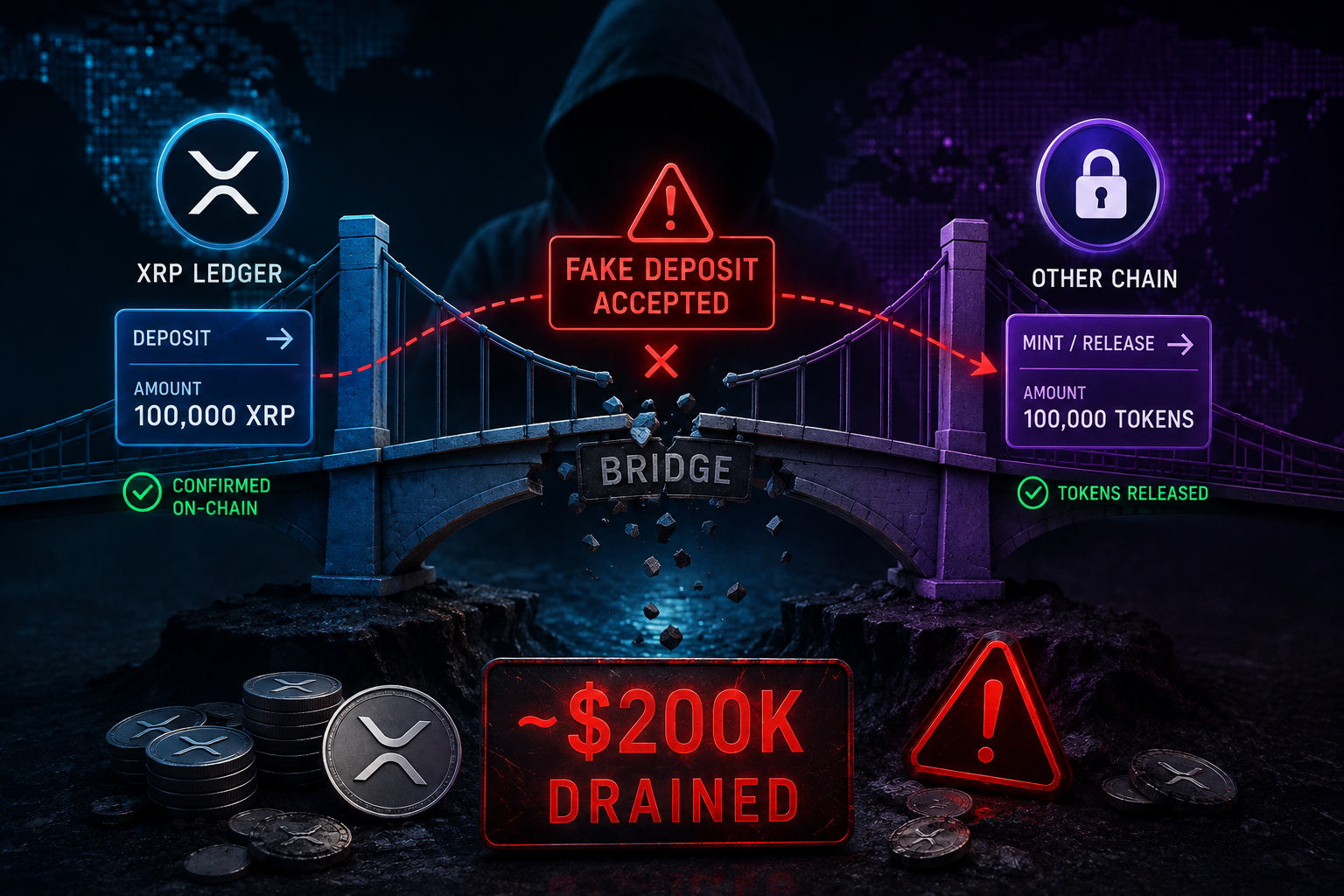
A bridge does not need to lose a private key to lose money. Sometimes it only has to believe a lie.
That is the uncomfortable lesson from CoinDesk’s report that an XRP bridge was drained of roughly $200,000 after its software treated fake deposits as legitimate ones. In plain English: the bridge credited users for funds it had not actually received. The attacker did not need to break the XRP Ledger. They exploited the gap between what happened on-chain and what the bridge’s backend thought had happened.
That distinction matters. Crypto security conversations often focus on smart contract bugs, seed phrases, and phishing. But cross-chain infrastructure has a quieter, more stubborn problem: accounting. Bridges are machines that watch one chain, interpret transactions, and issue assets or unlock funds somewhere else. If that interpretation is wrong, the bridge can mint or release real value against imaginary collateral.
The XRP incident is not an outlier. It is a symptom of one of crypto’s weakest links.
The Fake Deposit Problem Is an Accounting Bug With Real Money
A “fake deposit” does not necessarily mean a forged transaction appears on a blockchain. More often, it means software reads a real transaction incorrectly.
That can happen when a deposit monitor checks the wrong field, ignores transaction metadata, fails to confirm finality, mishandles failed transactions, or assumes that a requested transfer amount equals the amount actually delivered. In XRP Ledger systems, this distinction is especially important because the network supports partial payments. The XRP Ledger’s own documentation warns that applications must use the delivered amount from transaction metadata rather than blindly trusting the transaction’s stated amount.
For an exchange, a fake deposit can mean crediting a customer balance that should not exist. For a bridge, the stakes can be higher. A bridge might see what it thinks is a deposit on Chain A and then mint wrapped tokens, release liquidity, or approve withdrawals on Chain B. Once those funds are moved through decentralized exchanges or mixed with other liquidity, recovery becomes difficult.
The scary part is that this is not a novel cryptographic attack. It is closer to a bank crediting an account because a check says “$10,000” on the front, without checking whether the bank actually received $10,000. In crypto, that kind of mistake can be automated, instant, and irreversible.
Why Bridges Are So Hard to Secure
Cross-chain bridges are deceptively simple in user interfaces and brutally complex underneath. To a user, bridging means clicking a button and watching tokens appear on another network. Under the hood, the system has to answer several questions perfectly:
- Did the deposit transaction really succeed?
- How much value was actually delivered?
- Is the transaction final, or can it be reversed or reorganized?
- Is the sender, destination tag, memo, or contract call valid?
- Has this transaction already been processed?
- Is the destination-chain mint or release authorized by enough independent verification?
A failure in any one of those checks can become a loss.
This is why bridges have repeatedly become prime targets. They sit between ecosystems and often hold large pools of liquidity. They also combine multiple risk surfaces: smart contracts, off-chain relayers, validator sets, RPC providers, transaction parsers, token standards, and administrative controls. A bug in any layer can compromise the whole system.
Chainalysis has documented how cross-chain bridges became a dominant source of stolen crypto, noting that bridge attacks accounted for a large share of crypto theft in 2022. The reason is structural: bridges are honey pots that depend on interpretation. They do not merely verify balances on one ledger; they translate events from one environment into consequences in another.
That translation layer is where fake deposits thrive.
XRP’s Partial Payment Lesson Applies Beyond XRP
The XRP Ledger’s partial payment feature is legitimate. It allows a sender to make a payment that may deliver less than the nominal amount under certain conditions, such as path-based payments through order books. The problem begins when applications do not account for that behavior.
For deposit-processing systems, the rule is straightforward: do not credit based only on the transaction’s requested amount. Credit based on what the ledger says was actually delivered. The XRPL documentation is explicit about this because the risk has been known for years.
But the broader lesson is not “XRP is unsafe.” It is that every chain has quirks, and bridges must understand them precisely.
Ethereum has logs and events that can be emitted by contracts but still require careful validation. Bitcoin-like chains have confirmation-depth assumptions. Cosmos-based networks may involve IBC channel states and relayer behavior. Solana has account model differences that can trip up systems designed around Ethereum-style assumptions. Layer 2 networks introduce their own finality and withdrawal-delay questions.
A bridge cannot be merely “multi-chain” in branding. It has to be chain-native in implementation. That means engineers must deeply understand the transaction semantics of every network they support. A bridge that handles XRP deposits like ordinary account transfers, ERC-20 transfers like generic logs, or L2 withdrawals like instant settlement is asking to be exploited.
What Better Bridge Security Looks Like
The fix is not one magic audit. Bridge security has to be layered.
First, deposit systems should parse canonical transaction metadata, not user-facing fields or assumptions. In the XRP-style fake deposit scenario, that means checking the delivered amount, transaction result, destination, flags, and identifiers before crediting anything.
Second, bridges should use independent verification. If one indexer, RPC provider, or backend parser says a deposit happened, that should not be enough to mint assets on another chain. Multiple watchers, redundant data sources, and consensus among relayers can reduce the odds that one bad interpretation drains funds.
Third, bridges need strict rate limits and circuit breakers. A $200,000 loss is far smaller than the nine-figure bridge hacks crypto has seen, but the same bug class can scale quickly. If a bridge suddenly sees unusual deposit patterns, partial-payment flags, repeated destination-tag activity, or withdrawals that exceed normal liquidity behavior, it should slow down or pause.
Fourth, teams should maintain adversarial test suites for chain-specific edge cases. Audits often focus on smart contracts, but fake deposit bugs frequently live in off-chain code: listeners, parsers, cron jobs, database reconciliation scripts, and withdrawal daemons. Those systems need the same security discipline as contracts holding funds.
Finally, bridges should publish clear post-incident reports. Users need to know whether a loss came from a smart contract flaw, validator compromise, accounting error, or operational failure. Each category requires a different response. Vague “incident” language helps attackers more than users.
Conclusion: The Weakest Link Is Often the Parser
The $200,000 XRP bridge drain is not the biggest crypto exploit. That is exactly why it is worth paying attention to. Smaller incidents often reveal the mundane weaknesses that lead to larger failures later.
Crypto likes to talk about trustlessness, but many bridges still rely on fragile trust in software that reads one chain and acts on another. If that software mistakes a fake deposit for a real one, the blockchain may be working perfectly while the bridge is quietly handing out money it never received.
Cross-chain finance will not become safer just by adding more chains. It will become safer when bridges treat transaction interpretation as a core security problem, not backend plumbing.