Abuja’s Flood Crisis Is a Land-Use Scandal
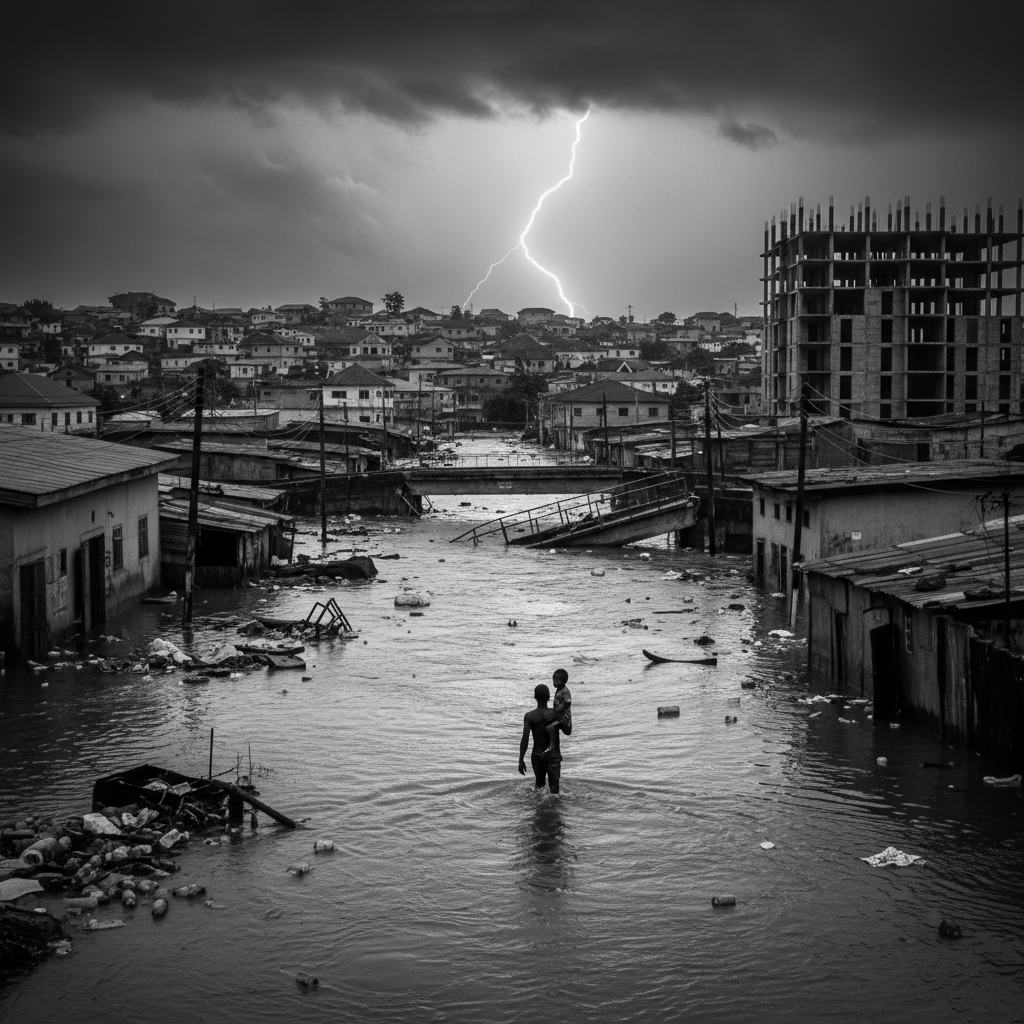
When floodwater rushes through an Abuja estate, the first explanation is usually rain. Too much rain, too quickly, in the wrong place. But the latest scenes from the Federal Capital Territory demand a harder question: who allowed homes, plazas, fences and roads to sit where water was supposed to pass?
That is why Abuja’s flooding is no longer just a weather story. It is becoming a land-use scandal.
Senator Ireti Kingibe, who represents the FCT, and activist-lawyer Deji Adeyanju have both pushed the public conversation in that direction, pointing to construction on green areas, the obstruction of natural flood channels and weak enforcement by authorities. Their comments capture what many residents already know from experience: the rain may trigger the disaster, but bad planning turns it into a crisis.
The Flood Is Following the Map We Ignored
Abuja was not built without a plan. The capital’s design made room for drainage corridors, green buffers, waterways and open spaces meant to absorb runoff and keep development away from flood-prone land. In theory, these spaces are not empty land waiting for investors. They are protective infrastructure.
In practice, many have been treated as opportunities.
Across fast-growing districts, the pattern is familiar: a watercourse is narrowed by perimeter fencing, an undeveloped green strip becomes a building site, a natural depression is filled with laterite, and a road is cut across a drainage line without adequate culverts. The result may look neat in the dry season. In the rainy season, water returns to its original route and punishes everything built in its way.
Residents of areas such as Trademore Estate have seen this cycle repeatedly. The estate has become a symbol of Abuja’s flood problem because the issue is not merely heavy rainfall; it is the collision between real estate expansion and the hydrology of the land. Other communities around Lokogoma, Galadimawa, Gwarinpa, Life Camp and parts of Lugbe have faced similar anxieties whenever intense rainfall overwhelms drains or forces water through occupied corridors.
This is not a mystery. Flood channels are not suggestions. When they are blocked, narrowed or built over, the water does not disappear. It backs up, spreads sideways, enters homes, damages vehicles and can become deadly within minutes.
Kingibe and Adeyanju Are Naming the Governance Failure
The significance of Ireti Kingibe’s intervention is that it comes from the FCT’s elected voice in the Senate. Her criticism places responsibility beyond residents’ bad luck and toward the institutions charged with planning, approvals and enforcement. If green areas are being converted and waterways are being obstructed, then the key question is not only who built there, but who signed off, looked away or failed to act early.
Deji Adeyanju’s comments sharpen the political point. By framing the flooding around blocked channels and development abuses, he moves the debate away from sympathy after disaster and toward accountability before the next storm. Abuja cannot continue to mourn flooded estates while treating illegal or reckless construction as an administrative inconvenience.
Their shared message is uncomfortable because it implicates a system: developers who chase buildable land at any cost, officials who permit or tolerate violations, agencies that act after damage is done, and political leaders who announce demolitions without fixing the incentives that produce the next violation.
The public is often asked to blame residents for living in risky locations. Sometimes that is fair. But in a planned capital, many residents bought or rented homes believing that approvals, layouts and certificates meant something. If a building sits on a flood channel, the chain of responsibility should not end with the tenant or homeowner.
Abuja’s Real Estate Boom Has a Drainage Bill
The FCT’s population has expanded far faster than its infrastructure. That pressure has pushed housing into marginal land, encouraged speculative development and made open spaces politically vulnerable. In a city where land is wealth, every undeveloped plot attracts pressure.
But drainage is not cosmetic infrastructure. It is as essential as roads, power and water supply. When a district is approved without adequate stormwater planning, the bill arrives later through flooded homes and destroyed livelihoods.
Concrete examples are everywhere. A small culvert meant for a low-density neighbourhood becomes useless after the area is packed with estates, schools, churches, shopping plazas and paved compounds. A drain designed to carry stormwater becomes a refuse channel because waste collection is poor. A natural stream is squeezed between buildings until one night of heavy rain forces it to reclaim its width.
The climate dimension makes this more urgent, not less. Agencies such as the Nigeria Hydrological Services Agency and the National Emergency Management Agency regularly warn that many Nigerian communities face seasonal flood risks. But warnings do not clear blocked drains. Forecasts do not demolish illegal structures. Weather alerts do not restore green buffers.
The harder work belongs to land administrators, development control officials, environmental agencies and political leaders. They must decide whether Abuja’s master plan is a living document or a slogan invoked only when convenient.
Demolitions Alone Will Not Fix It
After major floods, authorities often reach for the same tool: mark structures, issue warnings, threaten demolition. In some cases, demolition is necessary. Buildings on waterways are not merely illegal; they are dangerous to their occupants and to neighbouring communities.
But selective enforcement can deepen distrust. Residents ask why a structure was allowed to rise, why roads and utilities reached it, why taxes or levies were collected, and why action comes only after disaster. If enforcement is episodic, it becomes spectacle rather than policy.
A credible response should start with a public flood-channel audit across the FCT. The government should map drainage corridors, green areas and high-risk floodplains, then publish the findings in a format residents can understand. Every obstruction should be classified: illegal private construction, failed public infrastructure, undersized culvert, refuse blockage, or planning error.
Next, approvals must be traceable. If a building sits on a protected corridor, the public should know whether it had approval, who granted it, and whether the approval violated planning rules. Accountability cannot be limited to the bulldozer at the end of the chain.
The FCT also needs routine desilting, waste control, updated drainage capacity for built-up districts, and strict protection of remaining green areas. New estates should not be approved until stormwater impact assessments are taken seriously. Existing vulnerable communities need early-warning systems, evacuation plans and clear communication before heavy rainfall events.
Conclusion: The Water Is Telling the Truth
Abuja’s floodwater is exposing what paperwork often hides. It is showing where green areas have been stolen, where channels have been blocked, where enforcement failed, and where development has outrun infrastructure.
Ireti Kingibe and Deji Adeyanju are right to push the debate beyond rainfall. The next storm will come. The real test is whether Abuja’s leaders will treat flooding as a governance emergency — or wait for water to deliver the next indictment.