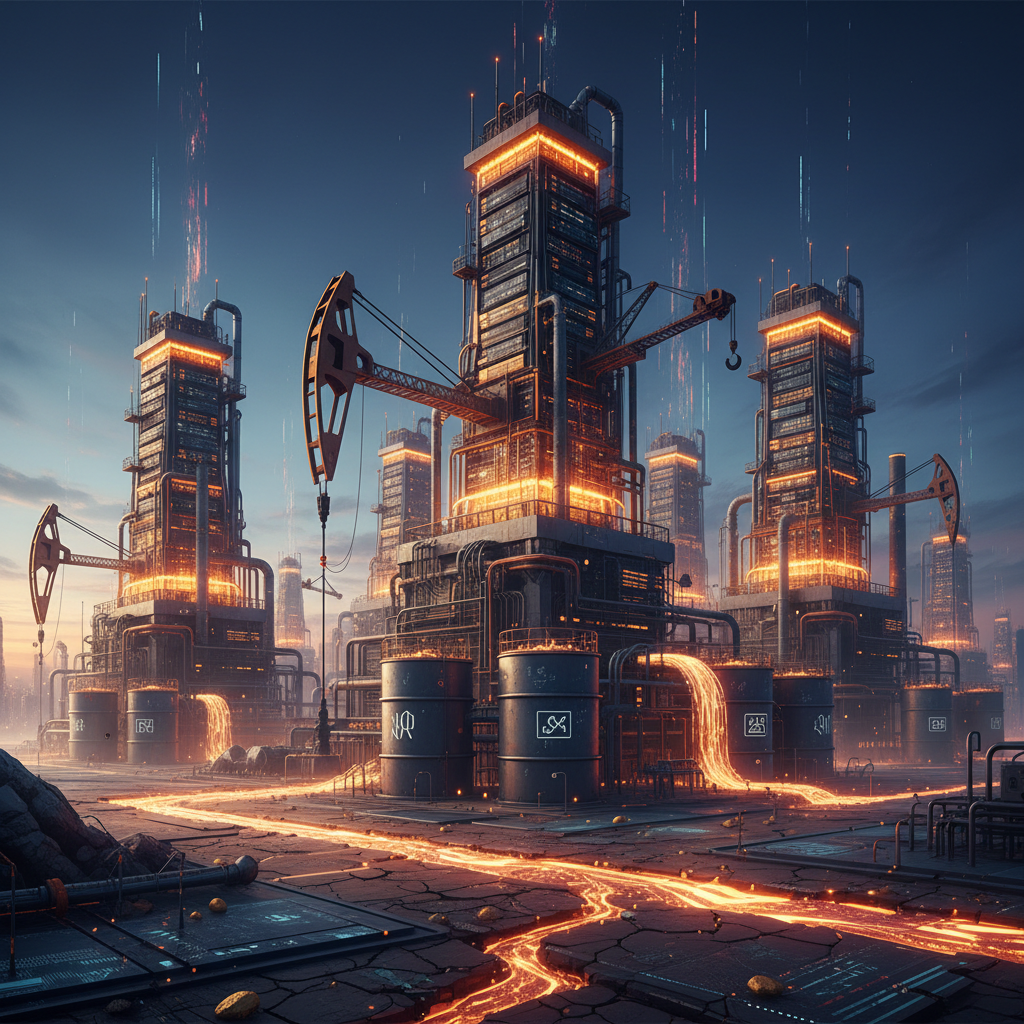
AI’s $500bn Compute Race Turns Data Centers Into Oil
The next phase of artificial intelligence will not be won only by the lab with the cleverest model. It will be won by whoever can get enough chips, electricity, cooling systems, land, fiber connections and debt financing to keep those models running.
That is the real story behind the reported $500bn push by Nvidia and major Wall Street players to finance AI infrastructure. The AI boom is moving from software spectacle to industrial buildout. The scarce resource is no longer just talent or training data. It is compute — the vast, capital-hungry machinery that turns mathematical ambition into usable products.
In other words, compute is starting to look like the new oil: strategically vital, geopolitically sensitive, expensive to extract, and controlled by a relatively small number of companies with the balance sheets to build at planetary scale.
From Model Race to Infrastructure Race
For most of the generative AI boom, attention focused on model quality: which chatbot wrote better code, which image model produced cleaner hands, which startup had the largest context window. That layer still matters, but it increasingly sits on top of a deeper constraint.
Training frontier models requires enormous clusters of Nvidia GPUs, high-speed networking, storage, power supply agreements and data center capacity. Running those models at scale — serving millions of users, enterprise customers and software agents — can be just as demanding. A model that looks magical in a demo becomes a cost center when it is answering queries all day.
That is why Nvidia’s role has expanded far beyond selling chips. Its GPUs are the picks and shovels of the AI gold rush, but the company’s influence now reaches into networking, software libraries, server architecture and full-stack data center design. When Wall Street capital joins that ecosystem, the game changes again: AI infrastructure becomes a financeable asset class.
BlackRock, Global Infrastructure Partners, Microsoft and Nvidia have already framed AI data centers as a major investment opportunity through the AI Infrastructure Partnership, initially announced with a goal of mobilizing large-scale private capital. OpenAI, SoftBank and Oracle’s Stargate initiative has pushed the number even higher in public debate, with plans for up to $500bn in AI infrastructure investment in the United States.
The message is clear: the AI industry is preparing for a buildout closer to telecom networks, railroads or energy grids than a normal software cycle.
Why Wall Street Wants the Data Center Stack
Data centers used to be viewed as back-end real estate: useful, technical and relatively boring. AI has made them strategic.
A modern AI data center is not just a warehouse with servers. It is a dense industrial facility filled with specialized accelerators, high-bandwidth networking gear and cooling systems designed for chips that consume far more power than traditional CPUs. These campuses require long-term electricity contracts, grid upgrades and, increasingly, proximity to clean energy sources or dedicated power generation.
That makes them familiar territory for infrastructure investors. The economics resemble airports, pipelines and power plants: high upfront capital expenditure, long payback periods, contracted customers and the possibility of stable cash flows. If AI demand keeps rising, financing compute capacity could become one of the most attractive infrastructure trades of the decade.
Wall Street also understands scarcity. There are not unlimited sites with enough power, fiber access, water rights and local political support to host gigawatt-scale AI campuses. The firms that secure those sites early may control toll roads for the AI economy.
Concrete examples are already visible. Microsoft has spent aggressively to support OpenAI and its own Copilot products. Amazon is expanding custom AI chip efforts while leasing and building data centers for AWS. Google has its tensor processing units and a global cloud footprint. Oracle, historically seen as an enterprise database giant, has become a serious AI infrastructure player because it can offer massive cloud capacity and partnerships with model builders.
The emerging pattern is not “one model to rule them all.” It is “who owns the factory?”
Power Is Becoming the Bottleneck
The most underappreciated constraint in AI is electricity.
The International Energy Agency has warned that data centers, AI and cryptocurrency could significantly increase power demand in the coming years. In some regions, utilities are already struggling to process interconnection requests from data center developers. Northern Virginia, long the heart of the internet’s physical infrastructure, has become a case study in grid congestion. Similar tensions are emerging in Ireland, Singapore and parts of the American Midwest.
AI worsens the problem because GPU clusters are exceptionally power dense. A traditional enterprise data center might be demanding; an AI training facility can be ravenous. Keeping chips supplied with power is only half the challenge. They also generate heat, forcing operators to adopt advanced cooling, including liquid cooling systems that add complexity and cost.
This is where the “new oil” comparison becomes more than a metaphor. Energy access will shape AI competitiveness. Companies that can lock in cheap, reliable power will have lower inference costs. Nations that can provide permitting speed, transmission capacity and energy abundance will attract AI investment. Regions that cannot may be left with press releases instead of campuses.
Expect more deals that blur the lines between technology and energy: data centers built near nuclear plants, hyperscalers signing renewable power purchase agreements, gas generation used as bridge capacity, and revived interest in small modular reactors. The AI cloud is becoming physical very quickly.
Control of Compute Means Control of the Market
The political economy of AI is also changing. If frontier AI requires hundreds of billions of dollars in infrastructure, the field naturally tilts toward incumbents: Nvidia, Microsoft, Google, Amazon, Meta, Oracle, OpenAI’s partners and the financial institutions willing to fund them.
That raises hard questions for startups. A small AI company can still innovate at the application layer, fine-tune open models or build tools on top of cloud APIs. But competing at the frontier model layer becomes brutally expensive. Even if open-source models improve, training and serving them at global scale requires infrastructure most companies cannot afford.
This could produce a two-tier AI economy. At the top, a handful of compute-rich platforms own the underlying capacity. Below them, thousands of companies rent access, optimize prompts, build workflows and compete on distribution. That structure looks less like the early web and more like the cloud era, where the most important platforms also own the servers.
There are antitrust and national security implications. Governments already restrict advanced chip exports to China. Regulators are watching the relationships between cloud providers, model labs and chipmakers. If compute becomes the critical input for economic productivity, then access to compute becomes a policy issue, not just a business expense.
The Bet Behind the $500bn Number
A $500bn AI infrastructure push is a breathtaking wager. It assumes that demand for AI services will grow fast enough to justify an enormous expansion of physical capacity. That demand could come from coding assistants, autonomous agents, drug discovery, robotics, video generation, customer service automation and AI embedded into every enterprise software product.
But the risk is real. If AI revenue disappoints, the industry could face overbuilt capacity, margin pressure and a data center debt hangover. If power costs rise, economics could tighten. If models become dramatically more efficient, some planned capacity may be less valuable than expected.
Still, the direction of travel is unmistakable. The center of gravity in AI is shifting from demos to deployment, and deployment requires infrastructure. Nvidia and Wall Street are not merely chasing hype; they are trying to own the bottleneck.
Conclusion: The AI Boom Gets Physical
The first act of generative AI was about surprise: machines that could write, draw, summarize and code. The second act is about scale. Who can build enough compute? Who can finance it? Who can power it? Who gets to decide the price of access?
That is why the AI infrastructure race matters. It is not just a story about data centers. It is a story about the industrial foundation of the next technology era — and the companies positioning themselves to collect rent on it.