AI’s Power Problem Hits Amazon’s Data Center Boom
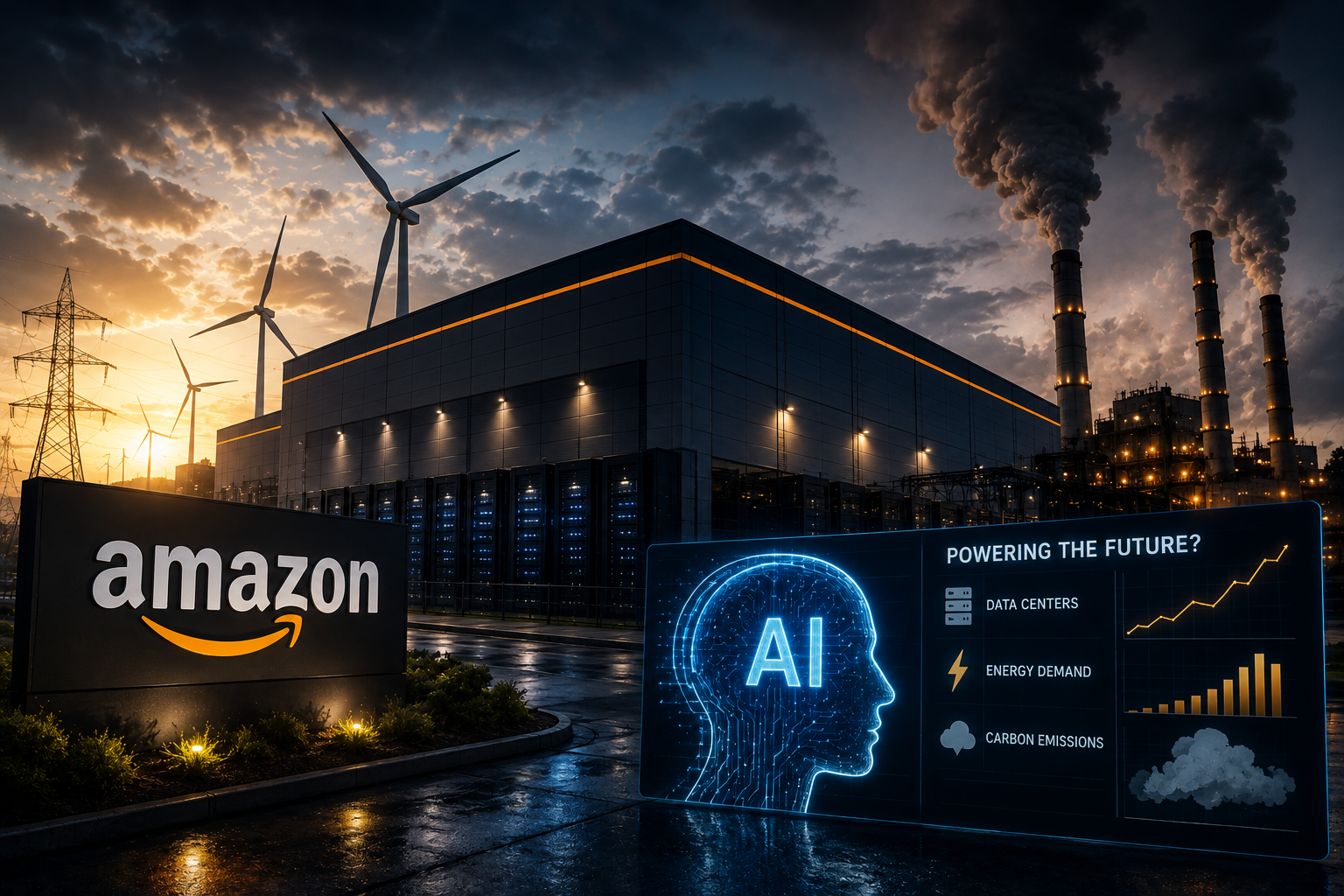
The AI boom has moved from product demos to power plants. A recent report from The Verge about an Amazon data center tied to a highly polluting power source makes the abstract climate math suddenly concrete: every new cluster of GPUs needs electricity, water, land, transmission, and political permission.
The takeaway: hyperscalers can no longer treat clean-energy claims as a branding layer while their infrastructure race reshapes the grid.
The AI boom is becoming a power-market story
For years, the environmental debate around cloud computing was mostly about efficiency: hyperscale data centers were cleaner than millions of scattered server closets, and the biggest operators could buy renewable power at enormous scale. That argument still has merit, but AI changes the size and timing of the load.
Training frontier models is energy-intensive, and inference can be even more consequential because it runs continuously once AI is embedded into search, office software, shopping, coding, customer support, and advertising. A data center built for AI is not just another warehouse with servers; it is a dense industrial facility with huge, round-the-clock power demand.
The International Energy Agency has warned that electricity consumption from data centers, AI, and cryptocurrency could rise sharply this decade, with data centers becoming a significant source of new demand in power systems that are already strained by electrification and extreme weather. A recent U.S. Department of Energy-backed analysis similarly found that American data center electricity use could grow dramatically by 2028, depending on how fast AI infrastructure expands.
That is why The Verge’s Amazon report matters. The central question is no longer whether Big Tech buys enough renewable energy certificates to offset annual consumption. It is whether new AI facilities are causing fossil plants to run longer, new gas plants to be built, or local grids to prioritize data centers over households and other industries.
Clean-energy claims are under stress
Amazon says it matched all of its global electricity consumption with renewable energy in 2023, seven years ahead of its original target. That is a major procurement achievement, and Amazon has been one of the world’s largest corporate buyers of wind and solar power.
But the word matched does a lot of work. In many corporate clean-energy programs, a company can buy renewable power or credits over the course of a year even if a particular data center is drawing electricity from a grid that relies on coal or gas during many hours of the day.
That annual accounting model helped scale renewables, but it is increasingly out of step with the physical reality of AI infrastructure. If an AI data center adds a massive load in a region where fossil generation is the marginal source of power, emissions can rise even when the company’s annual sustainability spreadsheet looks clean.
The problem has several layers:
Time: Annual matching does not guarantee clean electricity during the exact hours a data center consumes power.
Place: Renewable energy bought in one grid region may not reduce emissions near the facility using the electricity.
Additionality: Some purchases support genuinely new clean generation, while others rely on existing projects.
Reliability: Data centers need constant power, which can increase reliance on gas plants, backup systems, or grid upgrades.
Transparency: Public sustainability reports often lack facility-level energy and emissions data.
This gap between accounting and operations is becoming the credibility test for hyperscalers. A company can be a clean-energy leader on paper and still contribute to fossil generation in specific communities if its growth outpaces local clean power.
The Amazon case is a warning for hyperscalers
The Verge’s reporting on an Amazon-linked data center and a heavily polluting power plant lands in the middle of a broader industry scramble. Cloud providers are competing to lock up land, substations, fiber routes, chips, and energy contracts before rivals do.
That competition creates incentives to move fast, especially where power infrastructure already exists. Former industrial sites and power plant campuses can look attractive because they have grid connections, water access, and local officials eager for tax revenue. But those same advantages can also tether the AI economy to the fossil-energy system it claims to be moving beyond.
Amazon is not alone. Microsoft has reported that its emissions rose as data center construction and hardware supply chains expanded. Google has also acknowledged that its emissions have increased, citing data center energy use and supply-chain growth as central challenges to its climate goals.
The industry’s dilemma is straightforward: AI is being sold as a tool for scientific discovery, productivity, climate modeling, and energy optimization, but its near-term buildout can increase emissions before those benefits arrive. That tradeoff may be defensible in some cases, but only if companies are honest about it.
The biggest risk is lock-in. If utilities build new gas capacity to serve AI demand, those assets may expect to operate for decades. Even if hyperscalers later procure more renewable energy, customers could still be left paying for fossil infrastructure approved in the name of near-term reliability.
What credible clean AI would require
The next generation of climate leadership will be more demanding than buying enough renewable energy over a year. It will require companies to show that their growth is aligned with cleaner grids in the places where they operate, hour by hour.
That does not mean every data center must be powered by a solar farm next door. Modern grids are shared systems, and clean-energy procurement can be complex. But hyperscalers have the money, forecasting ability, and political leverage to push for better standards than the minimum required by law.
A credible clean-AI strategy should include:
Hourly matching: Pair electricity use with carbon-free power on a 24/7 basis, not just annually.
Local accountability: Report energy use and emissions by region so communities can see the real grid impact.
Efficiency budgets: Treat model efficiency, chip utilization, and cooling design as climate priorities, not just engineering details.
Flexible demand: Shift non-urgent workloads to times and places where clean electricity is abundant.
Grid investment: Help fund transmission, storage, geothermal, advanced nuclear, and other firm clean resources.
Siting discipline: Avoid deals that extend the life of high-emitting plants or create long-lived fossil dependence.
There are signs of movement. Google has championed 24/7 carbon-free energy goals, Microsoft has pushed carbon-removal markets, and Amazon continues to add large-scale renewable projects. But the AI boom is testing whether those commitments are strong enough when growth and climate discipline collide.
The more honest path is to stop treating energy as a backend procurement detail. AI infrastructure is now industrial policy, climate policy, and local economic policy rolled into one. If hyperscalers want the public to accept more data centers, they need to prove those facilities accelerate the clean-energy transition rather than quietly leaning on the dirtiest parts of the grid.
The bottom line
The Amazon data center controversy is a preview of the next climate fight in tech. AI may deliver real benefits, but its infrastructure cannot be exempt from scrutiny just because the software feels futuristic.
Clean-energy leadership now depends on where power comes from, when it is used, and what new infrastructure gets built to serve demand. The companies racing to define AI should be judged not only by their models, but by the grids they leave behind.