Alphabet’s SpaceX Stake Is Now Too Big to Ignore
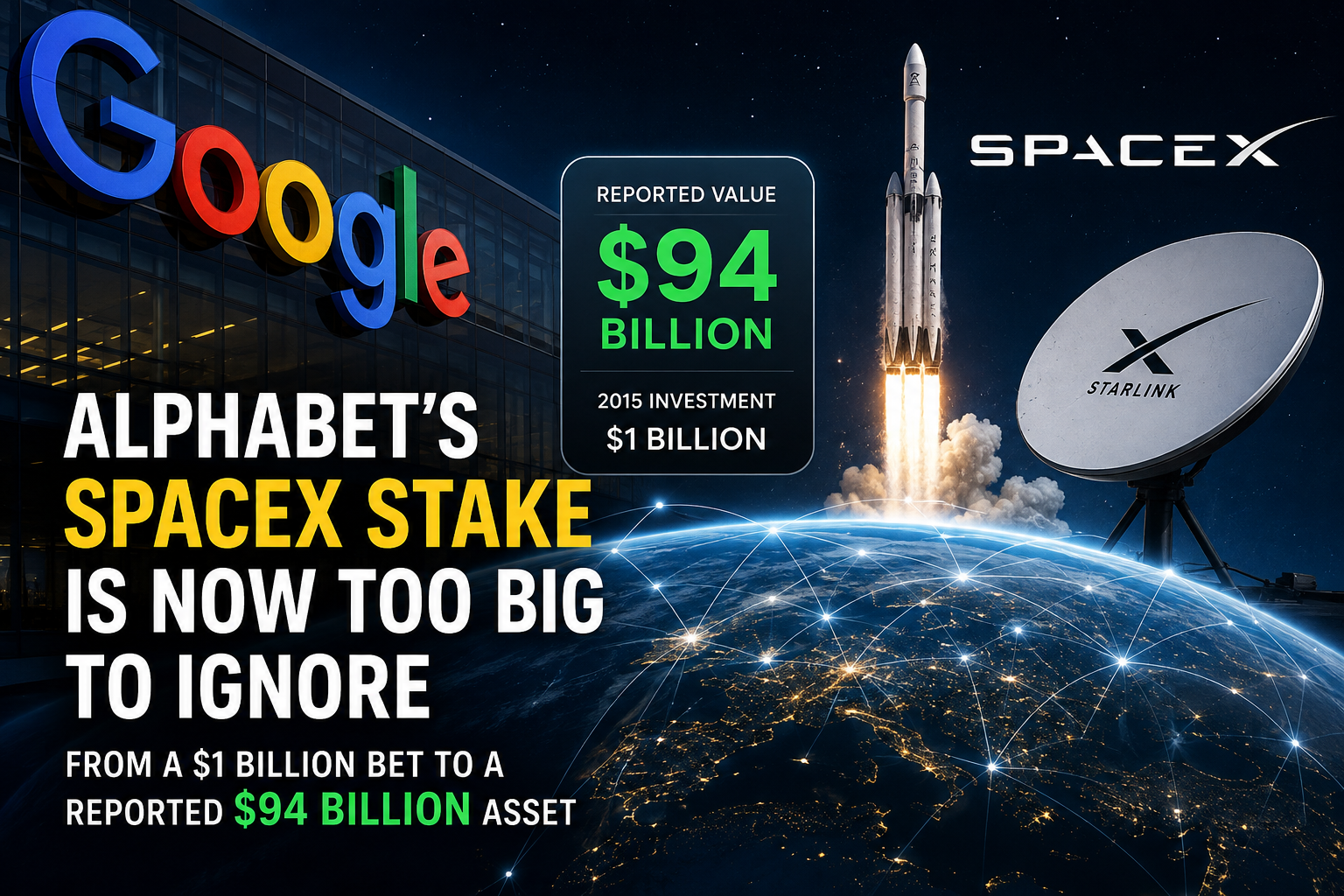
A decade ago, Google’s investment in SpaceX looked like a classic Silicon Valley moonshot: strategic, ambitious and small enough to sit quietly in the corner of a trillion-dollar company’s balance sheet. Now, a live market headline has put a far louder number on that bet: Alphabet’s SpaceX stake has reportedly climbed to about $94 billion, more than 100 times its original cost basis.
Even if the exact valuation and ownership mechanics remain private, the direction is unmistakable. What began as a bet on rockets and internet access has become a proxy for something much larger: the infrastructure layer beneath the next era of computing. SpaceX is no longer just a launch company. Through Starlink, it is building a global communications network. Through reusable rockets, it is lowering the cost of orbit. And for Alphabet, whose future depends on AI, cloud services and global data distribution, that makes the SpaceX stake more than a financial windfall.
It is now a strategic talking point hiding in plain sight.
From Moonshot Check to Mega Asset
In 2015, Google and Fidelity invested $1 billion in SpaceX. At the time, the logic was easy to understand: Google wanted more people online, and SpaceX wanted capital to build a satellite internet network. The companies framed the deal around “space-based internet” and connectivity, not around artificial intelligence or hyperscale infrastructure.
That was before Starlink became a real consumer and enterprise product. It was before reusable Falcon 9 launches became routine. It was before every major cloud provider started racing to secure compute, power, fiber, chips and data pathways for AI workloads.
Alphabet has never treated SpaceX like a core operating segment. It is not Google Search, YouTube, Android or Google Cloud. But early-stage strategic investments can become too valuable to ignore when the private company on the other side compounds at extraordinary speed. SpaceX has reportedly reached valuations in the hundreds of billions of dollars in private share sales, making any early stake dramatically more significant.
For Alphabet shareholders, that matters because the company’s public valuation is usually debated through familiar lenses: search ad growth, AI competition, cloud margins, regulatory risk and capital expenditure. A SpaceX holding of this reported scale complicates the story. It suggests Alphabet may have a massive, underappreciated asset connected to one of the most important infrastructure companies in the world.
Why SpaceX Matters to the AI Stack
The AI boom is often described as a race for chips. That is true, but incomplete. The full stack includes data centers, power generation, networking, cooling, sensors, edge devices and global connectivity. SpaceX touches several of those layers.
Starlink’s satellite network can extend broadband into places where fiber is slow, fragile or uneconomic: rural communities, ships, aircraft, construction sites, disaster zones and remote industrial operations. Those are not just consumer internet markets. They are future data markets.
Consider an autonomous mining operation in Western Australia, a fleet of cargo ships crossing the Pacific, or emergency responders after a hurricane knocks out terrestrial networks. In each case, connectivity determines whether data can move, models can be updated, and intelligent systems can keep operating. Satellite internet is not a replacement for data centers, but it can become a crucial edge layer.
That edge layer is becoming more important as AI moves beyond chatbots into robotics, logistics, agriculture, defense, climate monitoring and transportation. The more physical-world systems depend on machine learning, the more valuable resilient global connectivity becomes.
Alphabet’s own AI strategy makes this especially relevant. Google is building foundation models through Gemini, selling AI infrastructure through Google Cloud, and designing custom AI chips such as TPUs. The bottleneck is no longer just “who has the smartest model?” It is “who can deploy intelligent services everywhere they are needed?” SpaceX is one answer to that question.
A Balance-Sheet Story Investors Can’t Dismiss
Alphabet is famous for businesses that throw off cash. Google Search remains one of the most profitable products ever built. YouTube is a global media platform. Google Cloud has become a serious enterprise business. Against that backdrop, a private-company stake can seem like a side note.
But a reported $94 billion asset is not a side note. It is larger than the market value of many publicly traded technology companies. It could represent optionality: Alphabet can hold, sell into secondary transactions, or simply let the stake continue compounding as SpaceX expands Starlink, launch services and potentially new orbital businesses.
There are caveats. Private valuations are not the same as public-market liquidity. SpaceX shares do not trade like Alphabet stock. The reported value may reflect recent secondary pricing, estimates of ownership, or assumptions that are not fully visible to outside investors. Alphabet also does not provide a simple, line-item public disclosure that says, “Here is our SpaceX stake and here is exactly what it is worth.”
Still, investors care about economic exposure. If Alphabet owns a meaningful piece of an asset that private markets value at enormous scale, it belongs in the conversation about Alphabet’s hidden value.
There is also a narrative benefit. Big Tech is under pressure to prove that AI spending will generate returns. A SpaceX stake gives Alphabet a rare story that combines venture-style upside with infrastructure relevance. It is not just a paper gain; it is exposure to the physical rails of the digital economy.
The Strategic Tension: Partner, Investor, Competitor?
The Alphabet-SpaceX relationship is not simple. Alphabet is an investor, but Google Cloud competes in a world where Amazon, Microsoft and other infrastructure giants are also chasing space, satellite and defense-related workloads. SpaceX has its own ambitions. Starlink increasingly serves enterprise and government customers directly.
That creates an unusual dynamic. Alphabet benefits if SpaceX becomes more valuable, but it does not control SpaceX. Nor can it assume Starlink will become an exclusive pipe for Google services. SpaceX is Elon Musk’s company, and its strategic decisions will be driven by SpaceX’s own priorities.
This is why the stake is best understood as a powerful option, not a guaranteed operating advantage. Alphabet may gain financial upside, strategic proximity and insight into a critical infrastructure platform. But it is not the same as owning the network outright.
Even so, proximity matters in technology. Early relationships can shape cloud partnerships, enterprise integrations, mapping, disaster response, device distribution and AI-at-the-edge experiments. If the next decade is defined by bringing AI into the physical world, Alphabet’s early bet on SpaceX looks less like luck and more like unusually patient strategic positioning.
Conclusion: The Quiet Bet Got Loud
Alphabet’s SpaceX investment used to be an interesting footnote. Now it is a headline asset with strategic consequences.
The reported $94 billion figure should be treated with the caution all private-market estimates deserve. But the broader point is hard to dispute: Alphabet backed SpaceX early, and that bet has matured into exposure to one of the defining infrastructure companies of the AI era.
For years, investors looked at Alphabet and saw search, ads, YouTube and cloud. They may now need to add another line to the mental model: a quiet space bet that has become too large, too relevant and too connected to the future of computing to ignore.