Asake’s Spotify Film Rewrites Afrobeats Live
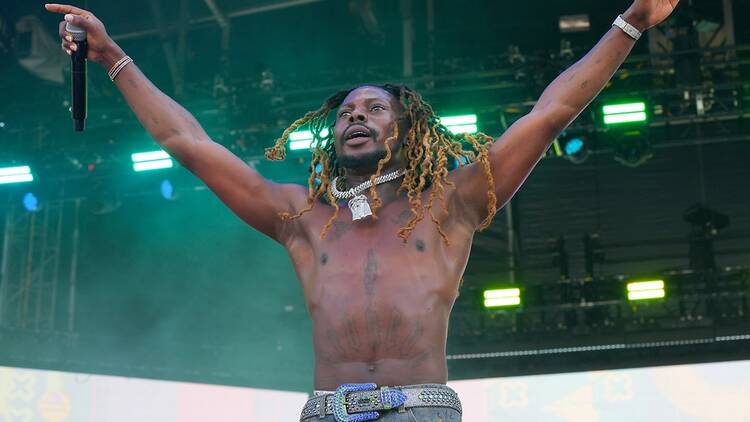
The most important Asake ticket this year may not have a seat number.
With Asake reportedly becoming the first artist to release a full-length live concert film on Spotify, Afrobeats has a new proof point: the concert is no longer just the climax of an album campaign. It is becoming the product. Not a recap clip, not a fan-shot TikTok, not a three-minute highlight reel posted after the hype cools. A full concert film inside the same platform where listeners already discover, save, share, and replay the songs.
That matters because Afrobeats has always sold more than audio. It sells movement, language, fashion, humor, crowd response, diaspora pride, and the high-voltage feeling of hearing a street anthem become a stadium chant. Asake’s Spotify move points to a bigger shift: African pop stars are learning to package the live experience for the streaming era, where a show can be monetized, exported, and mythologized long after the venue lights come up.
The concert is now part of the album rollout
For years, the streaming economy trained artists to think in tracks: singles, remixes, playlist placements, deluxe editions. Afrobeats mastered that game. Burna Boy, Wizkid, Davido, Rema, Tems, Ayra Starr, and Asake all benefited from a world where songs could leap from Lagos clubs to London playlists to New York party sets with almost no friction.
But the biggest Afrobeats careers are now built around moments as much as records. A sold-out arena is not simply evidence of demand; it is content, proof, and brand architecture. When Asake performs, the visual language is as important as the setlist: the choral intros, the Fuji-inflected vocal phrasing, the streetwear, the stage design, the dancers, the sudden shift from swagger to spiritual release. Fans do not just want to hear “Lonely at the Top” or “Joha.” They want to see what those songs do to a room.
That is why a full-length concert film on Spotify feels strategically different from a standard upload elsewhere. Spotify is already where the fan relationship lives daily. A listener can move from studio recording to live film without switching cultural contexts. The concert becomes an extension of the catalog, not a separate marketing asset.
Why Spotify is a particularly interesting stage
Spotify has spent years positioning itself as more than a jukebox. Podcasts made the app feel conversational. Canvas loops added motion to tracks. The company’s music video beta signaled a more direct interest in visual music consumption. A full concert film pushes that logic further: it turns the platform into a venue.
That is especially powerful for Afrobeats, a genre whose global rise has been accelerated by streaming but whose full force is often understood live. Spotify has documented Afrobeats’ explosive growth on the platform, including its transition from regional sound to global category. But numbers alone do not explain why the music travels. A concert film can.
The live format captures what playlists flatten: call-and-response, pidgin punchlines, Yoruba chants, Amapiano log drums rattling through a crowd, British-Nigerian fans singing every word back at an artist who began in Lagos’ street-pop ecosystem. It makes the diaspora visible. It shows executives, promoters, and casual fans that the demand is not theoretical.
For Spotify, the incentive is also obvious. If music streaming services want to deepen engagement beyond passive listening, premium visual formats are one route. Concert films keep superfans in the app longer. They create release events. They give artists a new way to refresh catalog songs without dropping another remix. And they give the platform something social media cannot easily replicate: an official, high-quality, front-to-back performance document.
Afrobeats has outgrown the highlight reel
The old live-content model was fragmented. A fan in the pit posts 30 seconds. A blog aggregates shaky footage. The artist’s team drops a polished montage a week later. Maybe one performance goes viral. Maybe the sound is terrible. Maybe the moment disappears into the feed.
That model helped Afrobeats spread, but it also undersold the scale of what the genre has become. Burna Boy headlining stadiums, Wizkid turning arena shows into communal singalongs, Davido building his catalog around celebration and family, Rema translating “Calm Down” into a global pop phenomenon—these are not small-screen stories anymore. They deserve formats that match the ambition.
Asake is a particularly fitting test case because his rise has been inseparable from performance. His records sound crowded in the best way: choirs, chants, percussion, street slang, and hooks built to be shouted. The live show reveals the architecture of that sound. A song that feels intimate in headphones can become almost ceremonial in an arena.
The same logic applies across the scene. Imagine a Tems concert film built around restraint, atmosphere, and voice. Or a Rema film that traces the jump from Benin City mythology to global youth culture. Or a Davido film that leans into family, guest appearances, and the emotional weight of Nigerian pop’s most communal catalog. These artists are not just releasing songs; they are building worlds. Concert films are how those worlds become exportable.
The business case: sell the feeling, not only the ticket
Live performance has become one of the most important revenue pillars for artists, but tickets are limited by geography, price, visas, venue capacity, and timing. Streaming-era concert films solve part of that problem. They do not replace the room; they extend it.
For Afrobeats stars, that extension is commercially valuable. A fan in Nairobi, Toronto, Accra, Johannesburg, Paris, or Houston may not be able to attend an O2 or stadium date. But if the show becomes a premium streaming artifact, that fan can still participate in the moment. The artist can convert live demand into catalog attention. The platform can serve a high-intent audience. Promoters can use the film as evidence that the next tour should be bigger.
There is also a cultural ownership issue. Afrobeats has often relied on outside institutions to validate its scale: Western award shows, festival slots, chart milestones, magazine covers. A well-produced concert film lets artists document their own history in real time. It says: here is the crowd, here is the sound, here is the proof.
That proof can travel faster than a press release. A great live film gives fans clips to share, journalists scenes to reference, and new listeners a reason to care. It creates a bridge between the algorithm and the archive.
Conclusion: the next frontier is the live catalog
Asake’s Spotify concert film may be remembered less as a one-off novelty than as an early sign of where Afrobeats is heading. The genre has already conquered playlists, short-form video, clubs, and festival stages. The next frontier is the live catalog: official concert films, tour documentaries, performance specials, and platform-native visual releases that turn shows into durable cultural products.
Afrobeats does not need help feeling alive. That has always been its advantage. The opportunity now is to make that aliveness streamable, searchable, and permanent. If Spotify can become not just where fans hear the hits but where they witness the movement, Asake’s experiment could open a new lane for the entire scene.