A Braid-Assist Robot Puts African Haircare on the Robotics Map
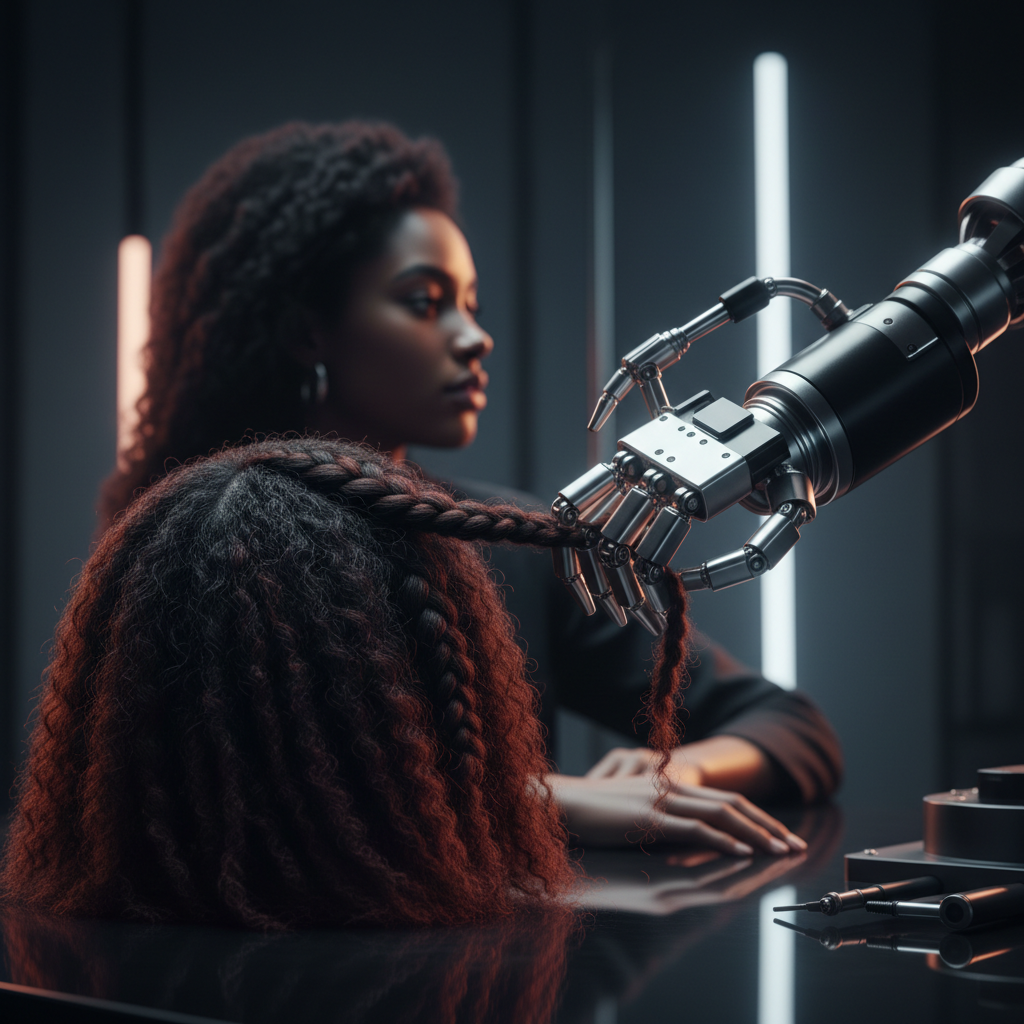
A salon chair can be a manufacturing floor if the industry is brave enough to see it.
That is the real significance of Nigerian-American Yinka Ogunbiyi’s globally recognized braid-assist robot. The headline is easy to frame as a novelty: a machine that helps braid hair. But the bigger story is more consequential. African haircare—one of the world’s most skilled, culturally important and economically active beauty categories—has long been treated as an informal service economy. Ogunbiyi’s robot suggests it can also become a serious robotics, hardware and manufacturing opportunity.
Braiding is not a fringe use case. It is a high-frequency, high-skill, labor-intensive practice across Africa and the diaspora. It is also physically demanding work, often performed by women whose expertise is underpriced and poorly protected. If beauty-tech has spent the last decade optimizing skin analysis apps and virtual lipstick try-ons, braid-assist robotics points to a more ambitious frontier: tools that respect textured hair, reduce strain on stylists and turn African haircare knowledge into defensible technology.
Why braiding is a hard robotics problem
On paper, braiding looks simple: separate strands, cross them in a pattern, maintain tension and repeat. In reality, it is a nightmare for automation.
Hair is soft, variable and unpredictable. It changes behavior depending on curl pattern, moisture, product, density, length and added extensions. A robot that handles hair cannot rely on the kind of rigid, repeatable movements used in automotive assembly. It has to manage a “deformable object,” the robotics term for materials that bend, tangle, stretch and resist standard grasping.
That makes braid assistance technically meaningful. A useful system does not need to replace a braider from start to finish. It can solve one or two painful bottlenecks: feeding extension hair at consistent intervals, holding sections under steady tension, reducing repetitive wrist movements or helping maintain clean strand separation while the stylist controls the design.
That distinction matters. The best near-term beauty robots will likely be collaborative, not autonomous. Think of a sewing machine, not a humanoid stylist. A sewing machine did not eliminate fashion designers or tailors; it amplified their output and made new industries possible. A braid-assist robot could do something similar for salons, mobile braiders and hair schools.
From informal skill to engineered workflow
African haircare is full of invisible engineering. A skilled braider calculates tension, scalp sensitivity, geometry, hair volume and style longevity in real time. The problem is that the market rarely records or rewards that knowledge as technical expertise.
In many cities, braiding operates through home appointments, WhatsApp referrals, weekend side hustles and cash payments. That informality is not a weakness; it is how communities built access when mainstream salons ignored textured hair. But it also limits scale. Informal workers often lack ergonomic tools, business software, financing, insurance and pathways into product development.
Robotics can change the frame. Once braiding is understood as a repeatable technical process, it becomes possible to design around it: tension sensors calibrated for scalp comfort, attachment systems for synthetic and human hair, modular grippers for different curl patterns, training data built with professional braiders and certification programs that teach human-machine workflows.
Imagine a salon in Atlanta using a braid-assist station to cut a six-hour box braid appointment to four hours without increasing scalp tension. Imagine a braiding school in Lagos training students not only in hand technique but also in operating, maintaining and repairing braid-assist tools. Imagine a manufacturer in Accra producing replacement cartridges, combing modules or hair-feed attachments for West African markets.
That is the leap: not “robots doing Black hair,” but African haircare defining a new class of robotics.
The manufacturing opportunity hiding in the salon
Beauty-tech is often treated as software: booking platforms, AI shade matching, influencer commerce, subscription boxes. Hardware is harder, slower and more capital intensive. But it is also where deep competitive advantage can emerge.
A braid-assist ecosystem would require motors, sensors, grippers, washable contact surfaces, hair-feed mechanisms, tension-control software and safety systems. It would also need consumables and accessories: extension-hair spools, sectioning clips, sanitation kits, replacement pads, adjustable arms and portable salon mounts.
That creates room for manufacturing beyond the original robot. A single successful assistive tool can produce a supply chain around it. Local assembly could matter, especially in African markets where repairability and cost control are essential. The goal should not be a luxury robot available only in premium U.S. salons. The bigger opportunity is a platform that can be adapted for different price points, power conditions, salon sizes and hair traditions.
There is precedent. Robotics adoption is no longer limited to car plants. The International Federation of Robotics has tracked rising global industrial robot installations, while service robots are expanding into logistics, healthcare, agriculture and hospitality. Beauty has been slower because human touch is central to the experience. But haircare contains repetitive physical tasks where assistive automation makes practical sense.
The economics are compelling. If a stylist can complete more appointments with less fatigue, earnings can rise without simply working longer days. If salons can standardize parts of a service, training becomes faster. If customers can get protective styles with more consistent tension and shorter wait times, demand expands.
But the technology must serve braiders, not erase them
There is a wrong way to build this industry: extract community knowledge, raise venture capital, file patents and market the product as a replacement for the very workers who made the category valuable.
The right way starts with braiders as co-designers. Their input should shape every design choice: how much tension is safe, which styles are worth automating, how the machine should be cleaned, how it should fit into a crowded salon, what price point makes sense and when human judgment must override automation.
This is especially important because African haircare has already been burdened by unnecessary regulation. In the United States, natural hair braiders have fought licensing rules that forced them into expensive cosmetology programs often designed around chemical treatments and straight hair, not braiding. That history makes trust essential. A robot should not become another gatekeeping tool. It should expand access to safer work, better training and higher productivity.
There are also cultural stakes. Braiding is art, heritage and social connection. A machine cannot replace the creativity of stitch braids, knotless variations, Fulani-inspired patterns or the intimate consultation between stylist and client. The opportunity is to automate strain, not style; repetition, not artistry.
What comes next for beauty robotics
Ogunbiyi’s braid-assist robot arrives at the right moment. The global beauty industry is looking for growth beyond generic skincare and celebrity brands. Consumers with textured hair are demanding products and services built for them from the start. Robotics companies are searching for markets where automation solves a real labor problem rather than chasing spectacle.
For African founders, engineers and manufacturers, this is a signal. The next beauty-tech breakthroughs do not have to come from Paris, Seoul or Silicon Valley alone. They can come from Lagos salons, Nairobi makerspaces, Atlanta braiding studios and diaspora engineers translating lived experience into hardware.
The first generation of braid-assist robots will not be perfect. They will be expensive, limited and probably awkward in early demos. That is normal. The important shift is that African haircare is now visible as an engineering category.
A braid-assist robot is not just a clever machine. It is a challenge to the tech industry’s imagination. For decades, braiders have built businesses with their hands, memory and endurance. Now the question is whether robotics can meet that skill with tools worthy of it—and whether African haircare can move from the margins of beauty-tech to the center of a new manufacturing wave.