Cameroon’s WAFCON Win Resets Africa’s Women’s Game
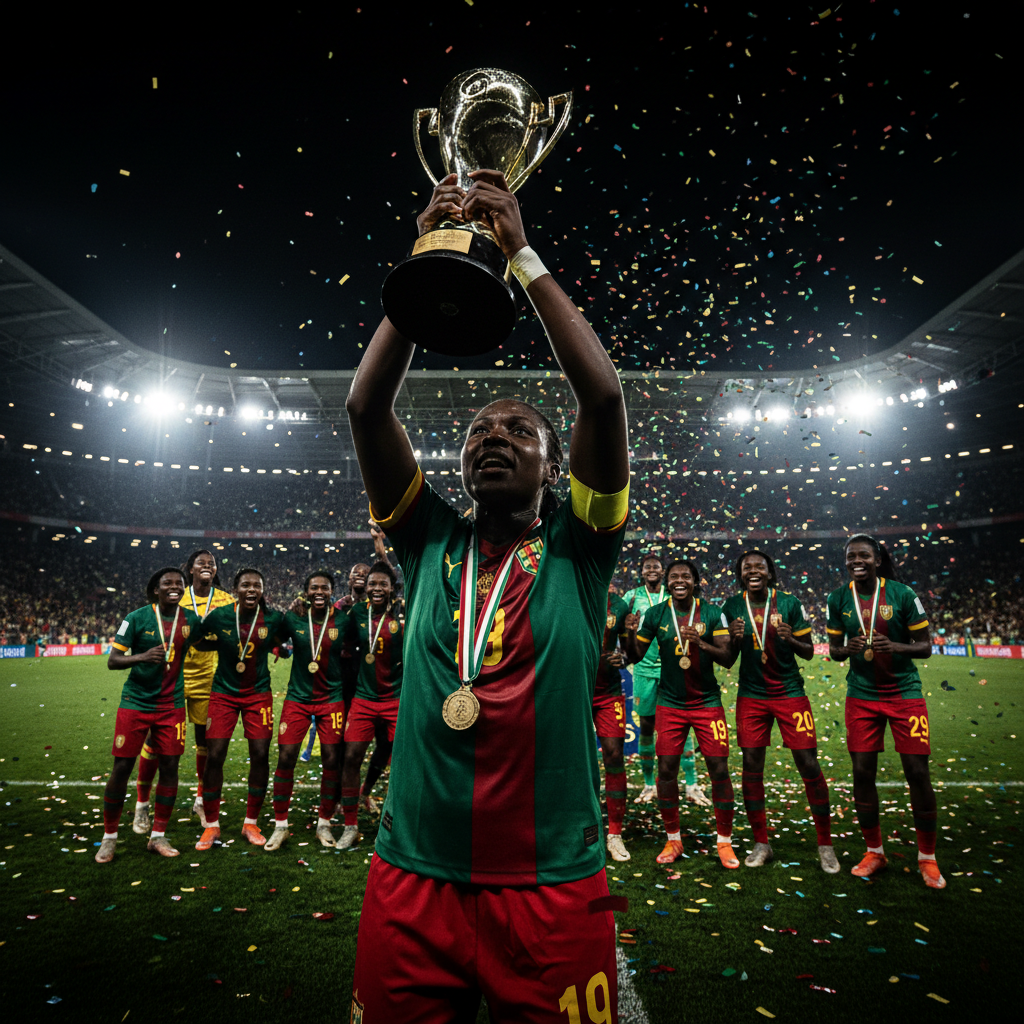
The image that will last from this WAFCON final is not simply Cameroon celebrating or Malawi collapsing into the grass. It is the sight of two very different football stories meeting at the same destination: a traditional force finally finishing the job, and an underdog proving the map of African women’s football has changed.
Cameroon’s victory over Malawi, carried across the night by live headlines from outlets such as Complete Sports and Channels Television, reads at first like a classic final result: one team wins, another’s fairytale ends. But that is too small a frame. This was not just Cameroon beating Malawi. It was a tournament telling the continent that the old hierarchy is no longer enough to explain what is happening.
For Cameroon, the win is historic because it transforms reputation into reward. For Malawi, defeat does not erase the run; it amplifies it. And for African women’s football, the final feels less like a closing chapter than a continental reset.
Cameroon Finally Converts Pedigree Into a Crown
Cameroon have long carried the weight of expectation in women’s football. The Indomitable Lionesses have produced recognisable names, World Cup moments and Olympic-level visibility. Players such as Ajara Nchout and Gabrielle Onguéné helped build a generation that could compete beyond the continent, and Cameroon have often looked like a side capable of breaking through.
What they lacked was the defining continental finish.
That is why this WAFCON triumph matters. It changes how Cameroon’s women’s team will be discussed from now on. No longer are they merely dangerous outsiders, semi-final regulars, or a team admired for physicality and resilience. They are champions, and that label alters everything: funding conversations, federation pressure, player pathways, and the confidence of the next generation.
The importance is not only emotional. Titles create leverage. A trophy gives national federations fewer excuses and players a stronger platform from which to demand better preparation, better camps, better medical care and stronger domestic structures. In African women’s football, where talent has too often outpaced administration, winning can become a political tool.
Cameroon’s challenge now is to make the win structural, not symbolic. A historic title should not be treated as the end of a cycle. It should become the start of a more serious one.
Malawi’s Fairytale Was Never a Fluke
Malawi’s final defeat will sting because fairytales are cruelest when they get close enough to feel real. But the danger in calling Malawi’s run a “fairytale” is that it can make the achievement sound accidental.
It was not.
Malawi’s rise has been visible for anyone paying attention to southern African football. The national team’s success at regional level, including their COSAFA breakthrough, showed a squad growing in belief, tactical maturity and competitive edge. The Chawinga sisters, Tabitha and Temwa, have also given Malawian women’s football international credibility. Their careers abroad have made them symbols of what elite talent from smaller football nations can become when opportunity meets quality.
That matters because Malawi’s run did not fit the old WAFCON script. Traditionally, the tournament’s emotional centre has been built around powerhouses: Nigeria’s dominance, South Africa’s rise, Ghana’s history, Cameroon’s consistency, Morocco’s investment, Zambia’s explosive growth. Malawi forcing their way into the final changed the conversation.
They became proof that smaller federations do not need to wait politely for a generation before competing. With a strong core, smart coaching, regional momentum and a few elite players capable of deciding matches, the gap can narrow quickly.
The final loss does not reduce that message. If anything, it makes it louder: Malawi reached the match that matters most. The next question is whether their football authorities can turn a heroic campaign into a system that keeps producing players after the current stars have moved on.
The Old WAFCON Order Is Under Pressure
This result lands in a wider context. African women’s football is no longer a one-lane road.
Nigeria remain the continent’s most decorated women’s side, and their history still defines the competition. South Africa’s 2022 WAFCON title was a landmark moment because Banyana Banyana finally converted years of near-misses into continental authority. Morocco’s surge, backed by clear investment and hosting infrastructure, showed how quickly a federation can accelerate progress when women’s football becomes a priority rather than an afterthought. Zambia, powered by fearless attacking talents and World Cup exposure, have become one of the continent’s most compelling teams.
Now add Cameroon’s historic title and Malawi’s final run to that picture.
The effect is a crowded elite. That is healthy. It means WAFCON is becoming less predictable, more marketable and more useful as a measure of development. It also means reputations alone will not carry teams through tournaments. Squads need depth. Coaches need adaptable game plans. Federations need year-round programmes, not emergency preparation three weeks before kickoff.
The shift is especially important because women’s football across Africa has often been judged through isolated success stories. One superstar emerges, one team goes on a run, one federation announces a project. What this WAFCON suggests is broader: competitive pressure is spreading across regions.
West Africa no longer owns the narrative. Southern Africa has become a serious production line. North Africa has invested. Central Africa has reasserted itself through Cameroon. The continental game is becoming genuinely continental.
What the Reset Should Mean Off the Pitch
The final’s biggest lesson may be administrative. Talent is not the problem in African women’s football. The problem has been consistency: consistent leagues, consistent pay, consistent youth competitions, consistent broadcast visibility and consistent respect.
Cameroon and Malawi both now become case studies in what must happen next.
For Cameroon, the temptation will be to celebrate the trophy as proof that everything is working. That would be a mistake. Historic wins can hide weaknesses if federations allow emotion to replace planning. The country needs stronger domestic competition, clearer youth identification, and sustained support for players moving between local clubs and overseas contracts.
For Malawi, the temptation will be to treat the final run as a once-in-a-lifetime miracle. That would also be a mistake. The correct response is investment: more girls’ academies, better coaching education, improved facilities, and a calendar that keeps players active. A final appearance should trigger urgency, not nostalgia.
Broadcasters and sponsors have a role too. Matches like Cameroon vs Malawi are exactly why WAFCON needs wider distribution and stronger packaging. The product is there: jeopardy, star power, national pride, tactical variety and stories with emotional force. What has often been missing is the commercial seriousness around it.
When audiences can follow the competition properly, players become visible. When players become visible, sponsorship becomes easier. When sponsorship grows, leagues and federations have fewer excuses. The cycle can work — but only if this moment is treated as a platform rather than a headline.
A Final That Opened the Field
Cameroon are worthy champions, and Malawi are worthy finalists. That combination is what makes this WAFCON final feel bigger than the scoreline.
The result gives Cameroon the historic validation they have chased for years. It gives Malawi something almost as valuable: proof that their ceiling is higher than the continent assumed. Most importantly, it gives African women’s football a new storyline. The era of predictable brackets and inherited status is fading.
This was not the end of Malawi’s fairytale. It was the beginning of a harder, more interesting question: who is ready for the new African order?