Community Shield Test: Arsenal’s Title Mindset
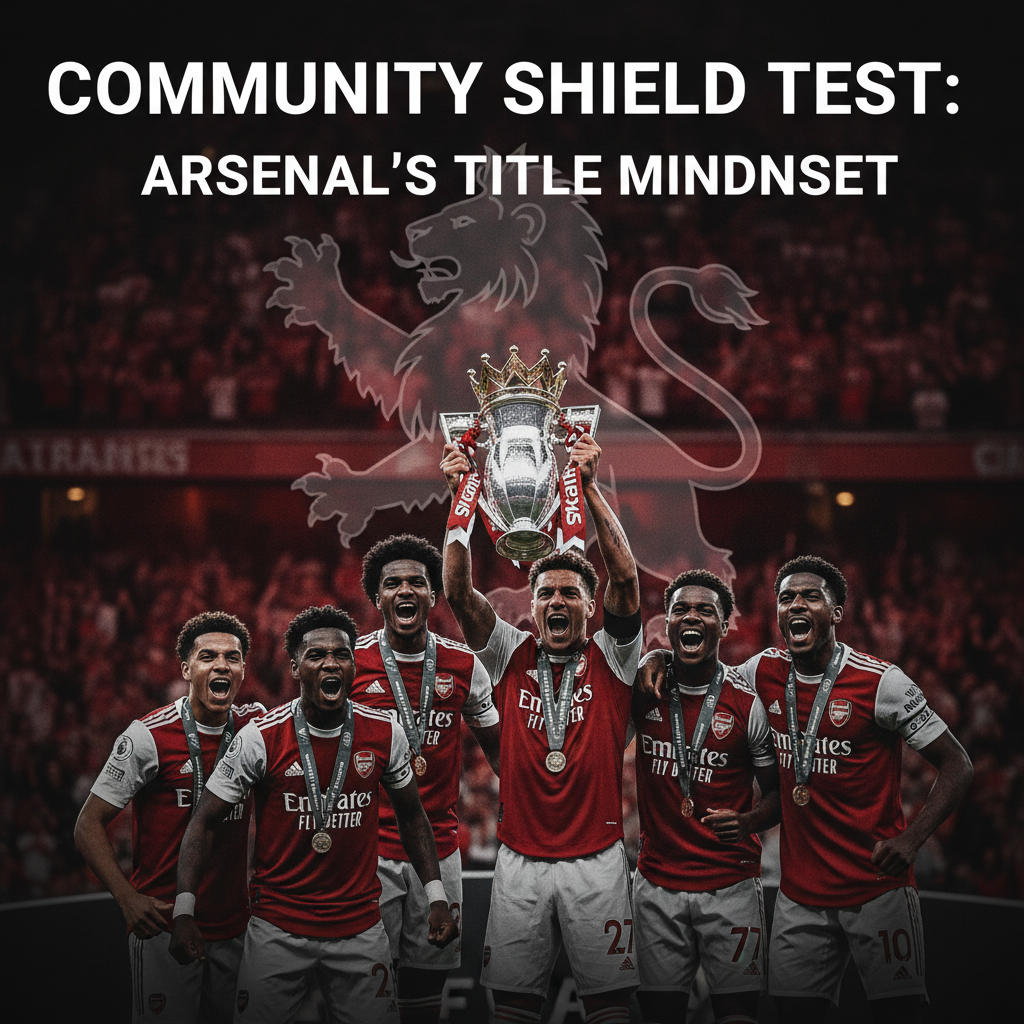
The Community Shield is English football’s annual truth serum and costume party at the same time. Win it, and everyone insists it means nothing. Lose it, and the questions arrive before the medals are back in their boxes.
That tension is why the BBC Sport debate over the Shield’s importance always lands. Is it a glorified friendly? A trophy? A tactical rehearsal? A psychological marker? For Arsenal, the answer matters more than the usual August shrug suggests. Mikel Arteta’s side have spent the past two seasons proving they can live in the title conversation. The next question is harder: can they develop the mindset of a team that expects to win — and eventually defend — the biggest prize?
Arsenal are not defending Premier League champions. That is precisely the point. A title-defence mindset begins before the trophy arrives. It is built in matches that look symbolic, in afternoons when intensity is optional, and in moments when elite teams decide that standards do not get a preseason discount.
The Shield Is Not the League — But It Is Not Nothing
The Community Shield’s awkward status is part of its value. It sits outside the league campaign, yet it is played at Wembley. It is marketed as a curtain-raiser, yet it is contested by teams who spent the previous season collecting major honours. It is not a 38-game examination, but it is not a training-ground bounce match either.
Arsenal know this better than most. Their 2023 Community Shield win over Manchester City, sealed on penalties after Leandro Trossard’s late equaliser, did not make them champions. It did, however, puncture one small but meaningful story: that City’s aura alone could tilt tight games before they had truly begun. Arsenal had gone toe-to-toe with the benchmark side and found a way to leave Wembley with silverware.
That did not guarantee a title. It did provide a useful data point. William Saliba looked comfortable against elite movement. Declan Rice, then newly arrived, immediately gave Arsenal a more robust midfield profile. Kai Havertz, still adjusting, offered a glimpse of why Arteta valued his duels and flexibility even before the goals came. The result was less important than the evidence: Arsenal were trying to add layers, not simply repeat a good season.
That is what the Shield can reveal. Not destiny. Direction.
What a Title-Defence Mindset Actually Looks Like
“Title-defence mindset” can sound like motivational wallpaper, but in football it has concrete traits.
First, there is emotional control. Champions do not treat every setback as a referendum. Arsenal’s challenge has often been managing the temperature of big moments: not becoming frantic when a lead disappears, not overcommitting when chasing a winner, not letting one mistake become three. The Shield, with its strange mix of ceremony and looseness, is a useful stress test because players must create their own competitive edge.
Second, there is tactical authority. A team with title-winning habits can win in different ways. Arsenal under Arteta have evolved from a high-energy pressing side into a more controlled, territorial team. They can suffocate opponents with possession, squeeze the pitch through their centre-backs and full-backs, and generate pressure through set-pieces. But the best teams also know when to be ugly, compact and patient. Against City, Liverpool or any other elite opponent, the Shield can show whether Arsenal are prepared to suffer without losing their structure.
Third, there is squad seriousness. Title challengers have good elevens. Title winners have solutions. Title defenders have solutions when the first solutions break. That means fringe players must look plugged in, substitutes must change games, and new signings must understand the system quickly. A Community Shield lineup can reveal whether the squad is genuinely deeper or merely more expensive.
Arsenal’s Preseason Promise Needs Hard Edges
Preseason optimism is one of football’s least reliable currencies. A sharp tour goal, a confident press conference, a teenager sparkling for 30 minutes — all of it can inflate expectations faster than it improves a team.
For Arsenal, the danger is not hype itself. It is softness disguised as promise. The club have been praised for smart recruitment, improved physicality, clearer tactical identity and a stronger dressing-room culture. Those are real advances. But title races are not won by being admired in July. They are won by converting superiority into routine wins in February, by taking points when fluency disappears, by making opponents feel the match is drifting away before the scoreboard confirms it.
That is why the Shield matters as a pressure check. Not because lifting it predicts the league table, but because the manner of performance can expose habits. Do Arsenal defend transitions with the same aggression when legs are heavy? Do they maintain distances between midfield and defence when the game opens up? Do Bukayo Saka and Martin Ødegaard still set the press with the intensity of players chasing history rather than protecting status? Does the back line communicate like a unit that expects clean sheets, not simply hopes for them?
The most revealing passages may be the dull ones: five minutes after conceding, ten minutes before half-time, the spell after multiple substitutions when rhythm often collapses. Serious teams keep their shape then. Pretenders call it rust.
The Manchester City Standard Still Defines the Question
Arsenal’s modern title pursuit cannot be assessed without City in the frame. Pep Guardiola’s side have turned relentlessness into a domestic language: long winning runs, technical control, tactical adaptation, and a refusal to treat any competition as beneath them until circumstances demand it.
That is the standard Arsenal are measuring themselves against. Not merely beating City once, but becoming the kind of club that can absorb City’s pressure across a season. The Community Shield compresses that challenge into one afternoon. It asks Arsenal whether they can look across the pitch at the era’s dominant English team and play with clarity rather than reverence.
There is a danger, of course, in over-reading Wembley. City have lost Community Shields and still won major trophies. Arsenal have won them without becoming league champions. The match does not hand out prophecy. But elite sport is full of small psychological deposits. A tackle won early, a midfield duel controlled, a goalkeeper calm under the press, a new signing immediately trusted in possession — these things accumulate.
A title defence, when Arsenal finally earn the right to mount one, will require exactly that accumulation. Not one grand emotional surge, but repeated proof that standards survive the change of context.
Conclusion: Treat the Shield Like a Clue, Not a Verdict
The Community Shield will not tell us whether Arsenal are champions in waiting. It can tell us whether they are behaving like a side that understands what champions must become.
For Arteta, the challenge is to make August intensity feel non-negotiable without pretending the Shield is bigger than it is. For Arsenal’s players, it is a chance to show that preseason promise has acquired hard edges: control, resilience, depth and nerve.
So no, the curtain-raiser is not the Premier League. It is not a title defence. But if Arsenal want to move from challengers to champions — and then from champions to defenders of a crown — these are the afternoons when the mindset starts to show.