DeepSeek V4 Pro Raises the Stakes in AI
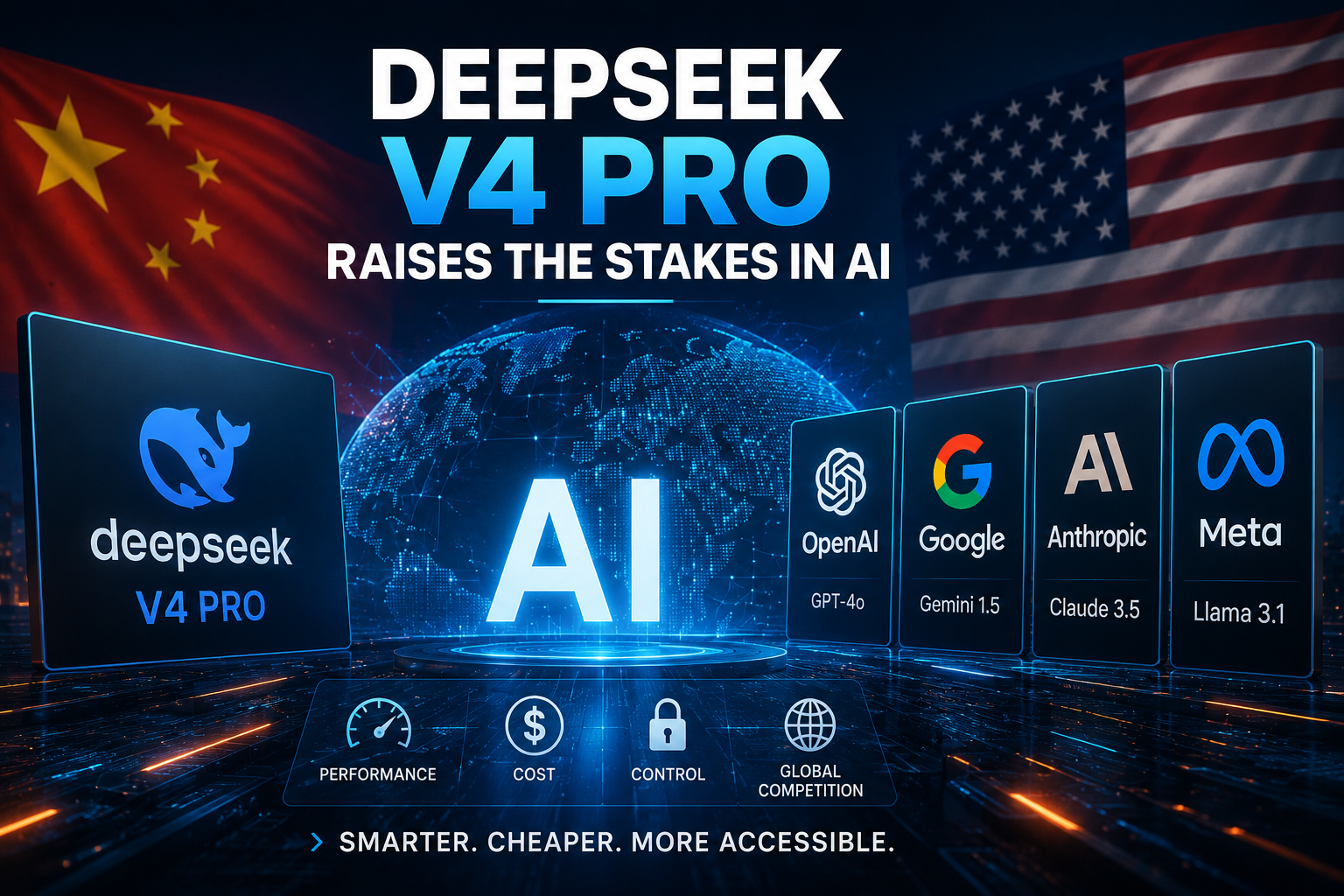
The global AI model race no longer looks like a simple contest between Silicon Valley giants. DeepSeek’s reported launch of V4 Pro is the latest reminder that Chinese AI labs are not merely catching up; they are forcing the market to argue over different metrics: not just who has the smartest model, but who can make intelligence cheaper, more accessible, and harder to lock down.
That shift matters. For the past two years, OpenAI, Google, Anthropic, and Meta have defined the tempo of frontier AI. Each pushed the field forward in a different way: OpenAI with product polish and developer reach, Google with massive infrastructure and multimodal research, Anthropic with safety-oriented enterprise models, and Meta with open-weight releases that gave developers alternatives to closed APIs. DeepSeek’s rise adds a sharper competitive edge: aggressive efficiency, low pricing, and a willingness to release models and technical details that pressure both proprietary and open-source incumbents.
If V4 Pro delivers on the performance implied by early reports, the question is not whether China has a serious AI contender. That question has already been answered. The question is how quickly the economics of model access will change for everyone else.
The new battleground: price-performance
The most disruptive part of DeepSeek’s strategy has not been branding. It has been math.
AI developers care about benchmark scores, but businesses care about the cost of turning tokens into useful work. A customer-support startup, a code-review tool, or a search company does not simply ask, “Which model is best?” It asks, “Which model is good enough at a price that lets our margin survive?”
DeepSeek has leaned into that equation. Its published API pricing has historically undercut many Western frontier-model providers, and its technical work has emphasized efficiency in training and inference. That matters because the AI market is splitting into tiers. At the very top, premium models compete for state-of-the-art reasoning, coding, video, and agentic workflows. Just below that, a huge commercial layer wants reliable summarization, extraction, coding assistance, translation, retrieval-augmented generation, and customer operations at scale.
This is where price-performance becomes a weapon. If a Chinese model can deliver near-frontier capability at a fraction of the cost, developers will test it. Some will route simpler tasks to cheaper models and reserve OpenAI, Anthropic, or Google for the hardest prompts. Others will build multi-model systems that automatically choose the cheapest model capable of producing an acceptable answer. In that world, the winner is not always the model with the flashiest demo. It is the model that can be used a billion times without breaking the budget.
Open-model pressure is becoming a strategic force
DeepSeek also arrives in a market reshaped by Meta’s Llama strategy. Meta’s Llama 3.1 release showed how open-weight models can become infrastructure: downloadable, customizable, and deployable in private environments. For enterprises wary of sending sensitive data to a black-box API, open models offer control. For startups, they offer independence. For governments, they offer sovereignty.
Chinese labs have learned the lesson. Even when a model is not fully open in the strictest sense, releasing weights, model cards, research papers, or permissive developer access can create momentum that closed providers struggle to match. Openness turns a model into an ecosystem. Fine-tuners adapt it. Cloud providers host it. Tool builders optimize it. Researchers probe it. Developers benchmark it against paid APIs and share the results.
That dynamic puts pressure on all four major Western players. OpenAI and Anthropic must defend premium pricing with clearly superior capability, reliability, safety, and workflow integration. Google must turn research depth into developer adoption and cloud stickiness. Meta must keep proving that open-weight releases can remain competitive enough to matter.
DeepSeek’s reported V4 Pro launch fits into this broader pattern: the more capable open or semi-open Chinese models become, the harder it is for any single company to define the frontier on its own terms.
The incumbents still have real advantages
None of this means DeepSeek has already overtaken the West’s leading labs. Frontier AI is not one leaderboard.
OpenAI remains deeply embedded in consumer and enterprise workflows, from ChatGPT to developer APIs. Google has unmatched AI infrastructure, distribution through Android and Workspace, and deep multimodal research through Gemini. Anthropic has built a strong reputation with enterprises that care about reliability, long-context work, and safety guardrails. Meta has the advantage of massive distribution and a developer-friendly open-model posture.
There are also trust, compliance, and geopolitical constraints. Many companies in the United States and Europe will hesitate before routing sensitive workloads to Chinese-hosted services. Regulated industries may require strict data residency, auditability, and vendor assurances. Governments will scrutinize model supply chains the same way they scrutinize chips, cloud infrastructure, and telecom equipment.
But those constraints do not erase competition. They shape it. A company may avoid a Chinese-hosted API while still using a DeepSeek-derived model hosted on its own infrastructure. A developer may not move all workloads to a new provider, but may use lower-cost models for preprocessing, search ranking, synthetic data generation, or internal tooling. AI adoption is rarely all-or-nothing. It is modular, and modular markets reward cheaper competent components.
The global race is now about systems, not just models
The V4 Pro discussion also points to a larger truth: the AI race is becoming a systems race.
A frontier model is only one layer. The winning stack includes efficient training, inference optimization, chips, cloud partnerships, data pipelines, developer tools, safety testing, app distribution, and enterprise procurement. That is why the rivalry is so intense. Each lab is trying to control more of the stack while preventing rivals from commoditizing its most profitable layer.
DeepSeek’s challenge is to turn technical credibility into durable adoption. That means stable APIs, strong documentation, predictable latency, enterprise controls, and a developer community that trusts the roadmap. Western labs face the inverse challenge: they must justify higher prices by delivering not just better raw intelligence, but better products, support, governance, and integration.
Concrete examples are already visible across the industry. A coding assistant may use a premium model for complex architecture questions, a cheaper model for autocomplete, and an open model for on-device privacy. A legal-tech company may use Anthropic or OpenAI for high-stakes drafting, Llama-family models for internal retrieval, and lower-cost alternatives for document classification. A customer-service platform may route millions of routine tickets to cheaper models while escalating sensitive disputes to stronger systems.
That is the market DeepSeek is pushing toward: not one model to rule them all, but a competitive mesh of models where cost, control, latency, and specialization matter as much as benchmark rank.
Why V4 Pro matters even before the dust settles
The reported DeepSeek V4 Pro launch matters because it changes expectations. Every new capable model from a Chinese lab narrows the perceived gap between U.S. and Chinese AI ecosystems. Every aggressive price point forces developers to question default vendor choices. Every open or accessible release adds pressure on closed labs to explain why their intelligence should cost more.
This is good for developers and complicated for incumbents. Lower prices expand experimentation. More model diversity reduces dependency on a handful of providers. But the same trend raises hard questions about security, provenance, regulation, and the geopolitical fragmentation of AI infrastructure.
The next phase of the AI race will not be decided by a single launch post or benchmark chart. It will be decided by who can deliver useful intelligence at scale, at the right price, with enough trust for customers to build on it.
DeepSeek’s V4 Pro, if it performs as reported, is another signal that the frontier is no longer owned by one region or one business model. The race is faster, cheaper, more open, and more global than it was a year ago. That should make every AI company uncomfortable — and every AI builder pay attention.