Edge’s Ad-Blocker Lockout Raises the Browser Stakes
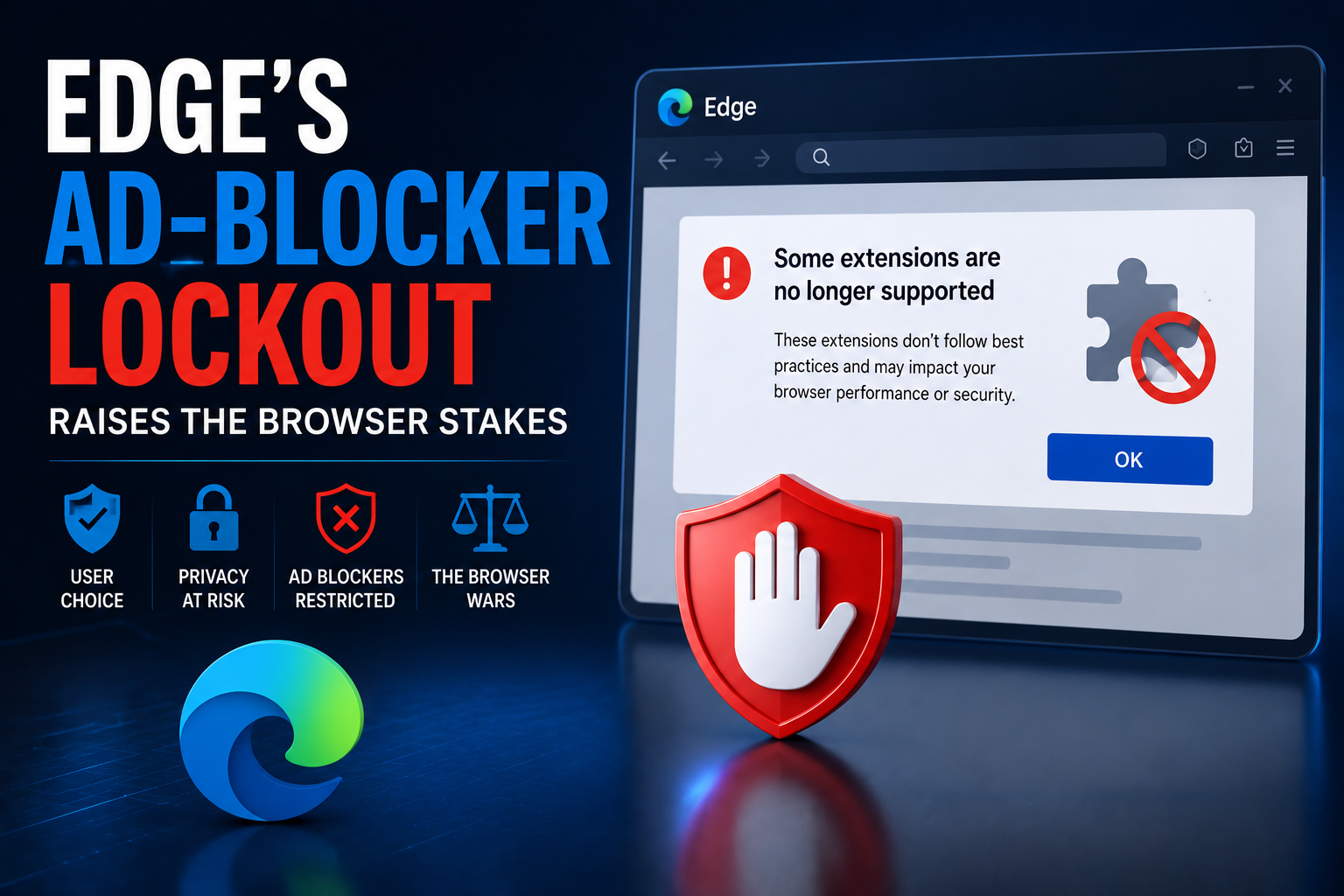
Microsoft Edge has entered the ad-blocker fight in the most visible way possible: by warning users that some extensions are no longer supported and, in some cases, switching them off. The Verge’s report on Edge following Chrome’s Manifest V3 transition turns a technical extension-policy change into something much bigger: a browser loyalty test.
The takeaway: ad blocking is no longer a niche settings preference; it is becoming a defining line in the browser wars.
Why Edge’s lockout feels different
For years, browser users treated extensions as portable. If an ad blocker worked in Chrome, it would probably work in Edge, Brave, Vivaldi, or another Chromium-based browser with minimal friction. Manifest V3 is breaking that assumption, because the extension model itself is changing underneath the browser.
Google’s official Manifest V2 deprecation timeline explains the shift as a migration toward Manifest V3, a newer extension framework with tighter limits on what extensions can do. Microsoft’s own Edge extension documentation points developers in the same direction, which is not surprising: Edge is built on Chromium and shares much of the same extension plumbing.
The controversy is not that browsers are modernizing their extension systems. The controversy is that the most affected category is one users care about intensely: ad blockers, tracker blockers, and privacy tools that rely on deep access to web requests.
That is why Edge’s move lands differently from a normal compatibility warning. When a browser says an extension “doesn’t follow best practices” or is no longer supported, many users do not hear a neutral platform update. They hear the browser taking a side against the tool they installed to control the web experience.
Manifest V3 turns policy into product
Manifest V3 changes the way many blocking extensions operate by pushing them toward a more constrained rules-based system. Google argues the newer model improves security, privacy, and performance by reducing the amount of broad request-level power extensions can exercise. Critics argue that this also limits the flexibility that made powerful ad blockers effective in the first place.
That distinction matters because ad blocking is not just about hiding banners. Modern content blockers block trackers, malware domains, cookie prompts, autoplay annoyances, anti-adblock scripts, and other infrastructure that users often experience as the worst parts of the modern web.
The Electronic Frontier Foundation has long argued that Manifest V3 can hurt privacy and innovation by weakening the tools users depend on to defend themselves. Extension developers have made a related point: even if Manifest V3 ad blockers still exist, they may not be able to adapt as quickly or block as comprehensively as their Manifest V2 predecessors.
That is how a developer API becomes a product-positioning issue. If Chrome and Edge enforce the new model aggressively, while other browsers preserve stronger blocking capabilities or build ad blocking into the browser itself, users suddenly have a reason to choose browsers based on values rather than speed charts.
Users, publishers, and developers all have skin in the game
The fight is easy to oversimplify as “users versus ads,” but the incentives are more tangled. Publishers rely on advertising to fund reporting, video, newsletters, reviews, and niche communities. Users block ads because too many sites abused attention, battery life, bandwidth, and privacy for too long.
Extension developers sit in the middle. They must rebuild tools around new APIs, handle store-review rules, communicate confusing changes to users, and absorb blame when a blocker becomes less capable because the browser platform narrowed what is possible.
The result is a three-way squeeze:
Users: They want faster, calmer, more private browsing without having to study extension architecture.
Publishers: They need revenue models that do not punish readers with invasive ad stacks and tracking scripts.
Developers: They need stable APIs that let them protect users without being treated as a platform risk.
Browser makers: They want safer extension ecosystems, but also control over the default economics of the web.
Advertisers: They want reach and measurement, even as users increasingly reject surveillance-heavy formats.
The real failure is that trust collapsed. If ads were lightweight, clearly labeled, non-invasive, and minimally tracked, fewer people would install aggressive blockers. If browsers had not spent years bundling search deals, shopping features, crypto experiments, AI prompts, and default-service nudges, users might be more willing to accept their explanations for restricting extensions.
The browser-war map is changing
Chrome remains the dominant browser, and Edge has spent years trying to become the default alternative on Windows. But when both browsers converge on the same extension limits, they risk looking less like competitors and more like two doors into the same walled policy environment.
That creates an opening for browsers that can credibly say, “We work for the user first.” Mozilla has said Firefox will support Manifest V3 while keeping support for blocking capabilities through its version of the webRequest API, a position it outlined in its Manifest V3 planning. Brave, meanwhile, leans on built-in blocking rather than relying entirely on extension APIs.
This is where the browser wars get less about benchmark scores and more about governance. Users are asking who gets to decide what runs in the browser: the person using it, the company distributing it, the extension store, or the advertising economy around it.
That does not mean every Manifest V3 decision is anti-user. Extensions really can be dangerous, and a browser that grants too much unchecked power can create security and privacy risks of its own. The issue is whether the cure reduces user agency more than it reduces harm.
What happens next
The most likely outcome is fragmentation. Some users will accept Manifest V3-compatible blockers such as lighter, rules-based versions of familiar tools. Others will switch to browsers with stronger built-in blocking or looser extension support. Many will not understand why their blocker changed at all; they will simply blame the browser when the web gets worse.
For publishers, this should be a warning. A crackdown on ad blockers might recover some impressions in the short term, but it does not repair the underlying relationship with readers. If the ad experience remains hostile, users will keep searching for technical escape routes, whether through alternative browsers, DNS filters, private browsing tools, or paid reader modes.
For Microsoft, the risk is sharper because Edge is still fighting for trust. A browser that already struggles against the perception of nagging, defaults games, and Microsoft-account pressure cannot afford to look like it is also taking away a user’s preferred privacy tool.
The bottom line
Edge’s ad-blocker lockout shows that Manifest V3 is no longer an abstract developer migration. It is a public test of whether browsers are agents of the user or gatekeepers for the web’s business model.
The next browser war will not be won only with speed, AI features, or battery claims. It will be won by the browser that convinces users it is still on their side.