Gemini Hits 1 Billion Users. Now Comes the Hard Part
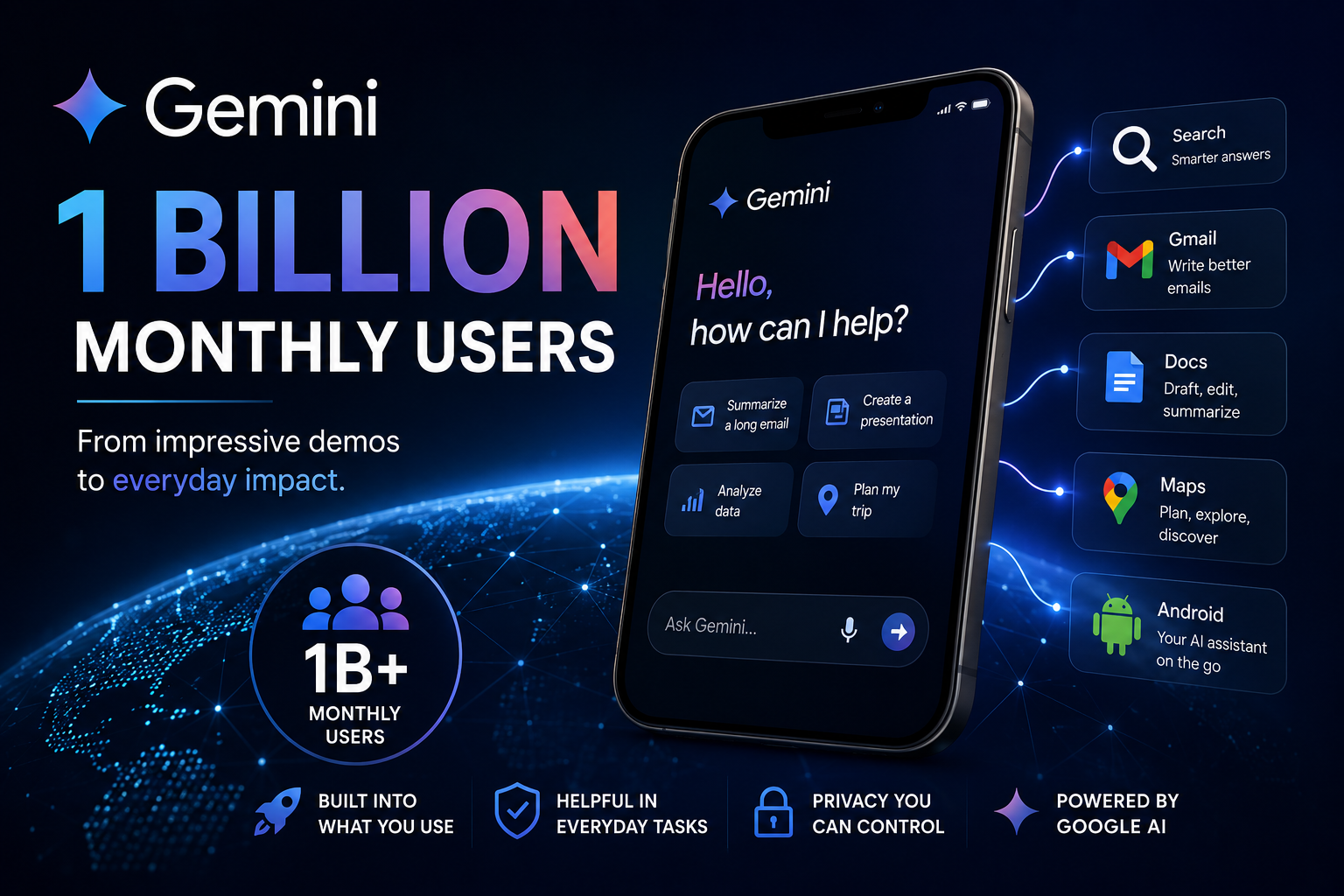
A billion monthly users changes the story.
For the past two years, the AI assistant race has been judged by spectacle: the slickest voice demo, the longest context window, the most human-sounding answer, the wildest video generator. But Google’s latest Gemini milestone — crossing 1 billion monthly users — signals a different phase. The contest is no longer just about who can produce the most dazzling model onstage. It is about who can make AI unavoidable, useful, and trusted in the daily flow of billions of people.
That is a fight Google is structurally built to win — and still very capable of losing.
Gemini’s scale does not automatically mean loyalty. Monthly users can include people who try an AI feature once in Search, tap Gemini on Android, ask for help in Workspace, or experiment inside the standalone app. But scale is the raw material from which habits are formed. And in consumer technology, habits are where markets harden.
The assistant war has moved from wow to workflow
The early AI boom rewarded novelty. ChatGPT made the first mainstream impression because it felt like a new interface to knowledge. Google, despite decades of AI research, looked reactive. It had to prove that Gemini could reason, write, code, see, listen, and act across text, images, documents, phones, and the web.
That proof phase is not over, but it is no longer the whole game. Gemini’s next challenge is much more ordinary and much more important: becoming the assistant people use without thinking.
That means helping a student summarize lecture notes in Google Docs, not just answering trivia. It means drafting a complicated Gmail reply with the right tone. It means finding the photo of a hotel receipt from last month. It means turning a messy set of calendar conflicts into a workable schedule. It means understanding the context of what is on a phone screen and offering the next useful action.
These are not viral demo moments. They are micro-interactions. The company that wins them repeatedly wins the assistant layer.
Google’s advantage is that Gemini can be inserted into places users already spend time: Search, Android, Chrome, Gmail, Docs, Drive, YouTube, Maps, and Pixel devices. OpenAI may have defined the category, and Apple may own the premium phone relationship, but Google has one of the broadest daily distribution networks in consumer software.
Distribution is Google’s unfair advantage
AI assistants do not spread like normal apps. Most people will not download five different AI tools, compare benchmarks, and choose a default. They will use the assistant that appears where their work, communication, search, and device habits already live.
That makes Google’s 1 billion-user milestone strategically important. Gemini is not only an app; it is becoming a service layer across Google’s ecosystem. In Search, AI features can answer complex queries and push users toward follow-up conversations. In Workspace, Gemini can summarize long threads, generate slides, analyze spreadsheets, and rewrite documents. On Android, it can become the default helper that replaces the old Google Assistant model with something more conversational and context-aware.
Consider the difference between opening a chatbot and asking Gemini to help inside a document you are already editing. The first requires intent. The second is embedded assistance. That distinction matters because the future of AI is likely to be less about visiting a chatbot destination and more about having intelligence appear inside the task at hand.
Google also has a monetization path that does not depend entirely on charging every consumer directly. Gemini can support paid Workspace tiers, cloud services, developer tools, Android hardware differentiation, and advertising-adjacent search experiences. That flexibility gives Google room to subsidize adoption while it figures out which AI behaviors are durable enough to become revenue.
Scale creates trust problems, not just momentum
A billion users is a bragging right. It is also a liability.
When an AI assistant is used by a niche audience, mistakes are embarrassing. When it is used at Google scale, mistakes become public infrastructure problems. A wrong answer in a chatbot is one thing. A wrong answer surfaced in a search-like interface, an email workflow, or a productivity suite carries a different level of expectation.
This is where Google faces a harder standard than many AI rivals. Users have long treated Google Search as a high-confidence gateway to information. Gemini blurs that relationship. It does not merely retrieve links; it can synthesize, recommend, draft, and decide what to emphasize. That creates obvious risks around hallucinations, sourcing, bias, privacy, and overreliance.
Trust will be built through boring details: clear citations, visible uncertainty, better controls over data usage, reliable enterprise privacy settings, and fewer moments where the assistant confidently invents something. The more Gemini becomes a default layer across products, the less tolerance users will have for “AI is experimental” disclaimers.
There is also the personalization dilemma. The most useful assistant knows your emails, files, location, meetings, preferences, and history. The creepiest assistant knows the same things. Google must convince users that Gemini’s contextual awareness is a benefit rather than a surveillance upgrade. That will require product restraint, transparent permissions, and settings normal people can understand.
The real rival is inertia
It is tempting to frame this as Google versus OpenAI, Microsoft, Meta, Anthropic, or Apple. Those rivalries matter. OpenAI still has cultural leadership in AI. Microsoft has a deep enterprise channel through Copilot. Meta can push AI across Instagram, WhatsApp, Facebook, and Ray-Ban smart glasses. Apple has the device trust and operating system control to make AI feel native.
But Gemini’s biggest competitor may be user inertia.
Most people do not wake up wanting an AI assistant. They want fewer chores, faster answers, cleaner writing, better photos, cheaper travel, easier shopping, and less time lost to digital admin. If Gemini feels like another interface to manage, it will be sampled and forgotten. If it removes steps from tasks people already do, it can become sticky.
That is why habit formation matters more than raw model performance at this stage. Benchmarks are useful, but they do not decide whether someone uses Gemini 20 times a week. Defaults, speed, accuracy, placement, memory, and trust do.
A concrete example: a user planning a trip does not want to bounce between Search, Maps, Gmail confirmations, YouTube reviews, Docs notes, and airline sites. A useful Gemini experience could assemble flight details from Gmail, suggest neighborhoods based on Maps, summarize restaurant options from the web, generate an itinerary in Docs, and adjust it when plans change. That is the promise. The challenge is doing it reliably enough that the user lets Gemini handle more next time.
Conclusion: Gemini’s next test is everyday usefulness
Crossing 1 billion monthly users puts Gemini in rare company, but it does not settle the AI assistant war. It changes the battlefield.
The next phase will be won less by cinematic demos and more by repetition: the assistant that answers correctly, appears at the right moment, respects privacy, and saves real time. Google has the distribution to make Gemini ubiquitous. Now it has to make Gemini dependable.
Scale got Google into the race. Habit and trust will determine whether it leads.