Google Just Made Gemini Free for Students — But There’s a Bigger Strategy Behind It
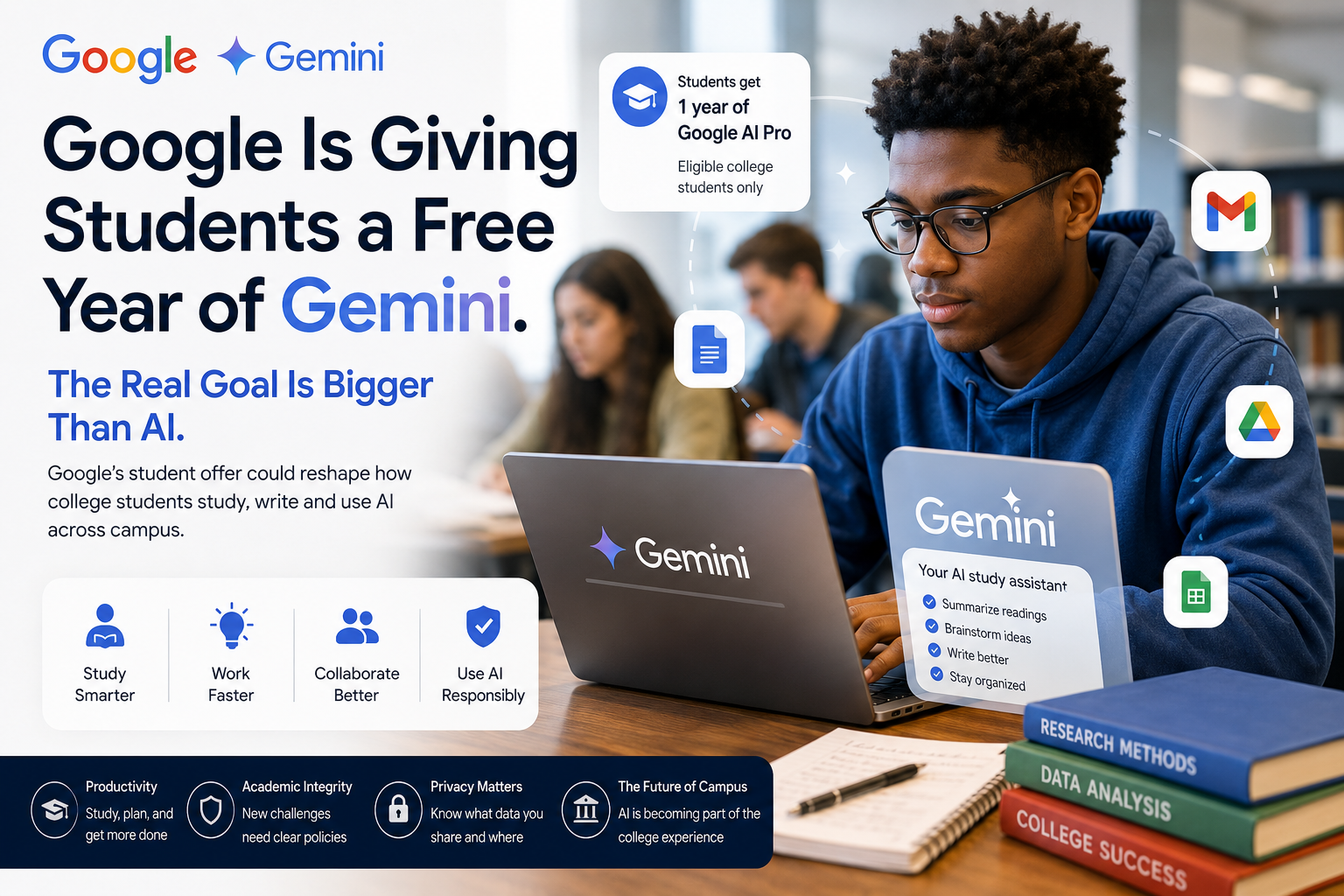
Google is not just handing students a free AI tool. It is trying to become part of the semester.
The company’s “start the school year” pitch for eligible college students—offering a free year of Google AI Pro through its Gemini student program—lands at exactly the moment universities are still arguing over what counts as acceptable AI use.
That timing matters. A free year is long enough for a freshman to build habits, for a senior to reshape a thesis workflow, and for faculty to discover that “don’t use AI” is no longer a policy so much as a wish.
The move positions Gemini less like a chatbot and more like default academic software: alongside Docs, Gmail, Sheets, Slides, and Search. If Google succeeds, students may not think of AI as a separate destination. They will think of it as the layer sitting inside the apps where schoolwork already happens.
The Offer Is Really About Habits
Google’s student offer is straightforward: eligible students can sign up for a year of Google AI Pro, which includes access to more capable Gemini features and integrations across Google’s ecosystem.
The company’s student page frames Gemini as a study assistant for summarizing material, brainstorming ideas, writing support, and project planning.
That sounds useful, but the strategic value is bigger than a subscription giveaway.
Student software habits are sticky. The apps used to take notes in September often become the apps used to manage internships, side projects, and first jobs.
Microsoft won campuses through Office familiarity. Google did the same with Docs, Gmail, Drive, and Chromebooks. Now the competition is for the AI layer students will trust by default.
A one-year offer is long enough to normalize specific behaviors: pasting a reading into Gemini before class, asking for an outline before drafting, turning lecture notes into flashcards, or using an AI assistant to clean up a group presentation.
Once those actions become routine, paying for the service—or expecting an employer or university to pay—feels less like an upgrade and more like continuity.
The giveaway also arrives as AI tools become more bundled. Google AI Pro is not merely a web chatbot; Google’s AI plan page highlights broader access across Gemini and Google apps.
That matters because a student’s workflow rarely lives in one place. A research question becomes a Doc, then a Slide deck, then an email to a professor, then a Sheet tracking sources or lab results.
Google wants Gemini present at each step.
Campus Work Will Get Faster—and Messier
The productivity upside is obvious.
A biology major can ask Gemini to turn a dense chapter on cellular respiration into a plain-English study guide, then generate practice questions before an exam.
A political science student can compare competing arguments in assigned readings and ask for a debate prep outline.
A commuter student juggling work can use Gemini to summarize club emails and turn deadlines into a weekly plan.
The best use cases are not “write my paper.” They are smaller, repeated moments of acceleration.
For example:
A student records scattered notes from a lecture, then asks Gemini to organize them into key concepts, definitions, and unanswered questions.
A team working on a marketing class project uses Gemini in Slides to draft a rough presentation structure, then edits the claims and visuals themselves.
A finance student uses Sheets with AI assistance to explain a formula error or model different budget assumptions.
A first-generation student drafts an email asking for office hours, then uses Gemini to make the tone clearer and more professional.
These are real workflow improvements.
They can make students more prepared, reduce blank-page anxiety, and help those who never received informal training in academic language or professional communication.
But speed creates its own problems.
If every assignment can be accelerated, instructors have to decide what the assignment is actually measuring.
Is a weekly response paper testing reading comprehension, original argument, writing fluency, or compliance with deadlines?
AI exposes the ambiguity.
When a tool can summarize, outline, revise, translate, and simulate feedback, old assessment formats start to wobble.
The Plagiarism Question Is Not Going Away
Universities spent the first wave of generative AI panic asking whether students were cheating.
That question is still relevant, but it is too narrow.
The harder issue is authorship.
If a student asks Gemini to generate three thesis options, chooses one, drafts the body, then uses Gemini to tighten the conclusion, who wrote the essay?
Most professors would say the student remains responsible for the final work. But responsibility is not the same as transparency.
Should the student disclose the AI brainstorming? The editing? The summary of a source?
Policies vary widely, and students often face different rules in different classes.
Detection tools have not solved this.
Companies such as Turnitin market AI-writing detection, but even detection systems require cautious interpretation. False positives, paraphrasing, multilingual writing, and legitimate AI-assisted editing all complicate enforcement.
As AI becomes embedded in mainstream software, the evidence trail gets even blurrier.
Students may not even perceive a grammar rewrite in Docs as “using AI” in the same category as asking a chatbot for a full essay.
That is why the smartest campus policies will focus less on prohibition and more on disclosure and assignment design.
A professor might allow Gemini for brainstorming but require students to submit a short process note explaining how they used it.
A lab instructor might permit AI-assisted coding help but require students to annotate what each function does.
A writing class might ban AI-generated prose for early drafts but allow AI feedback after peer review.
The key is specificity.
“Use AI ethically” is not enough.
Students need examples: acceptable, unacceptable, and must-disclose.
Google’s Advantage Is Distribution
Plenty of AI companies want students.
Google has a special advantage: it already owns a large part of the academic workflow.
Many students live in Google Workspace before they ever open a dedicated AI app. They collaborate in Docs, manage club files in Drive, coordinate projects in Gmail, and present in Slides.
If Gemini appears inside those surfaces, it reduces the friction that slows adoption.
Students do not need to learn a new system; they can ask for help where the work already sits.
That integration also raises privacy and data-literacy concerns.
Google’s Gemini privacy documentation explains that user interactions may be handled differently depending on product, account type, and settings.
Students often do not read those distinctions.
Universities will need to teach AI privacy the way they teach citation: what not to upload, when not to include sensitive data, and how institutional accounts differ from personal ones.
A nursing student should not paste identifiable patient information into an AI prompt.
A student journalist should be careful with unpublished interview transcripts.
A researcher working with confidential lab data should know whether a tool is approved by the institution.
These are not edge cases; they are normal academic scenarios.
The Software Stack of College Is Being Rewritten
The bigger story is not whether Gemini helps someone finish a sociology essay faster.
It is that AI is becoming part of the default student software stack.
That shift will pressure universities in three directions.
First, IT departments will need clearer approved-tool lists and account guidance.
Second, faculty will need practical training, not abstract AI ethics seminars.
Third, students will need AI literacy that goes beyond prompt tricks: verification, source evaluation, bias awareness, privacy, and disclosure.
The U.S. Department of Education has urged schools to treat AI as a tool that requires human judgment, transparency, and guardrails.
That is the right frame.
Gemini can be a tutor, editor, organizer, and productivity engine. It can also hallucinate, flatten complexity, and make weak thinking look polished.
Google’s free year will not settle the campus AI debate.
It will accelerate it.
By making advanced AI feel like ordinary school software, Google is forcing colleges to move from emergency response to durable policy.
Conclusion
Gemini’s back-to-school push is a smart subscription play, but it is also a cultural bet.
Google is betting that students who learn with AI will keep working with AI—and that the assistant inside their documents, inboxes, and study routines will become hard to replace.
For students, the opportunity is real: faster studying, clearer drafts, better organization.
For campuses, the challenge is just as real: define acceptable use before default use defines it for them.
🎓 Want to Get the Google Gemini Student Offer?
If you're an eligible college student, Google is currently offering a student promotion that may include a free year of Google AI Pro, giving students access to more advanced Gemini features and AI tools across Google's ecosystem.
👉 Check Your Eligibility
Check the Google Gemini Student Offer
Before signing up, review the eligibility requirements, offer terms, and expiration date on Google's official student page. Availability may depend on your country, school status, and other requirements.
Important: The offer is subject to Google’s eligibility requirements and terms. Availability and promotional details may change.