Copilot’s Usage Pricing Rewrites AI Coding Budgets
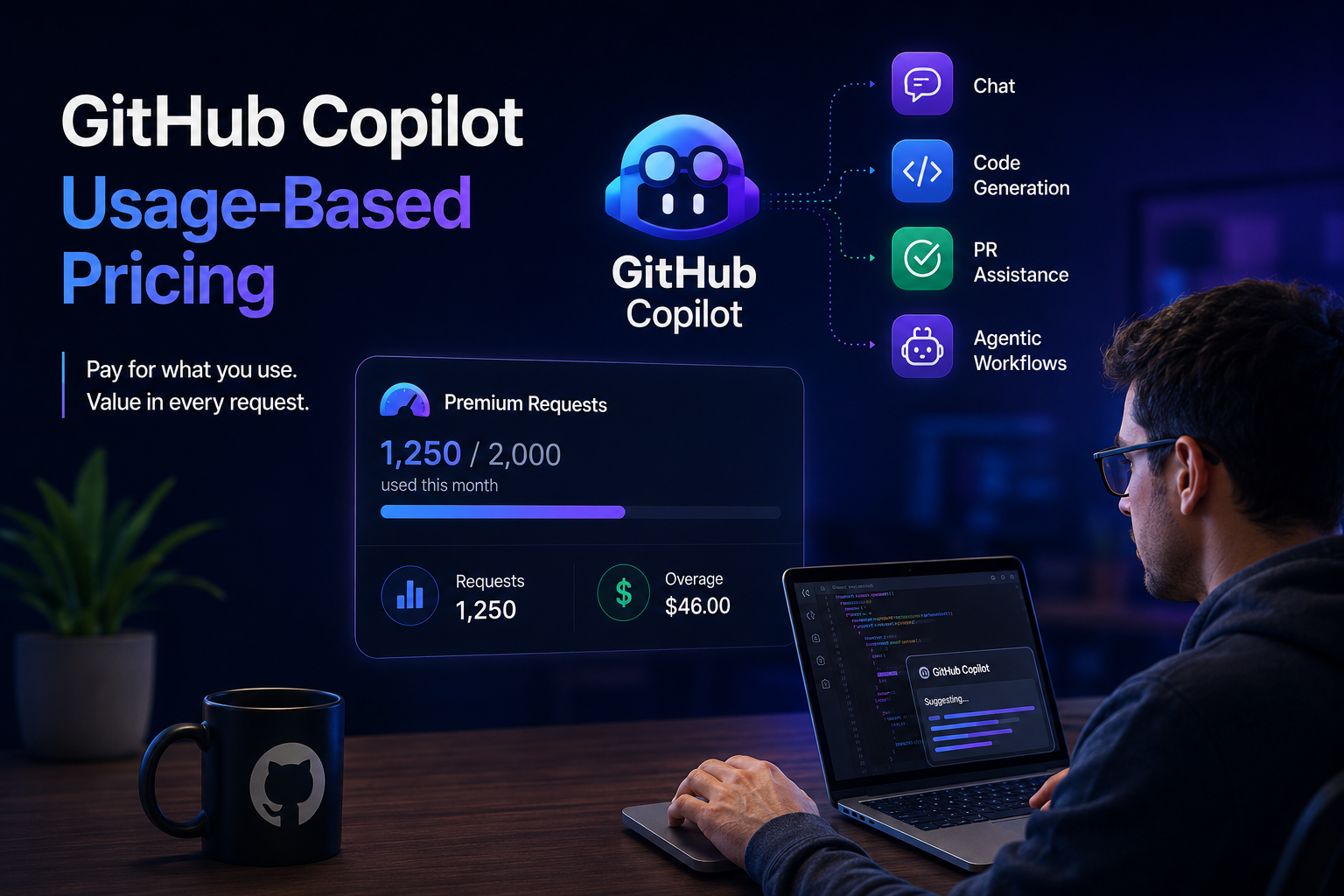
GitHub Copilot is moving further away from the simple “seat equals cost” model that made AI coding tools easy to buy and harder to manage. With GitHub’s latest pricing updates, the real unit of value is becoming the request: how often developers ask Copilot to reason, generate, explain, refactor, test, or orchestrate work across increasingly powerful models.
The takeaway: AI coding budgets are about to look less like SaaS subscriptions and more like cloud spend.
What GitHub is changing
GitHub’s Copilot plans still start with familiar per-user subscriptions, but the company is now putting more weight behind metered consumption through “premium requests.” According to GitHub’s documentation, premium requests are used when developers access higher-end Copilot capabilities and models, with plan-specific monthly allowances and overage billing available for organizations that opt in.
That matters because Copilot is no longer just autocomplete in the editor. GitHub has been expanding Copilot into chat, pull request assistance, code review, workspace-style task execution, and agentic workflows, all of which can involve more expensive inference than a quick inline suggestion.
The pricing shift also reflects a broader reality in the AI market: not every prompt costs the same to serve. A short completion from a fast model is economically different from a multi-step request sent to a more capable model that reads broader context, reasons over a repository, and produces a larger answer.
GitHub’s public Copilot plans now frame usage around included premium requests, while the company’s billing documentation explains how organizations can manage paid usage. The message to buyers is clear: seats still matter, but usage is becoming the lever that determines the real bill.
Why usage-based pricing changes the budget conversation
For engineering leaders, Copilot’s original appeal was partly operational simplicity. A company could buy licenses for a team, compare the price to developer compensation, and justify the spend if the tool saved even a small amount of time.
Usage-based pricing complicates that equation, but it also makes it more honest. If one team uses Copilot only for occasional completions and another leans on advanced models for migrations, test generation, architecture exploration, and pull request reviews, those teams are consuming very different amounts of compute.
The budget conversation will likely shift in four ways:
Forecasting: Finance teams will need estimates based on request volume, not just headcount.
Controls: Platform teams will need policies for who can use premium models and when overages are allowed.
Reporting: Engineering managers will want visibility into usage by team, feature, and workflow.
ROI: Leaders will need to tie spend to outcomes such as cycle time, defect reduction, onboarding speed, or migration throughput.
This resembles the evolution of cloud infrastructure. Early cloud adoption was often justified as flexible and scalable, but mature organizations eventually built FinOps practices to prevent flexibility from becoming budget sprawl.
AI coding tools may now be entering the same phase. The early question was “Should every developer have an AI assistant?” The next question is “Which AI workflows deserve premium compute, and how do we measure their value?”
Adoption will become more deliberate
Usage-based billing does not necessarily make Copilot less attractive. In fact, it could accelerate adoption among organizations that want wider access but tighter controls over expensive features.
A flat per-seat model can create a binary decision: either give everyone the tool or restrict it to a smaller group. A hybrid model allows companies to give broad access to baseline capabilities while reserving premium usage for teams with the clearest need.
That could benefit platform engineering, security, data, and infrastructure teams working on complex codebases where deeper context and stronger reasoning are especially valuable. It may also encourage temporary bursts of usage around specific initiatives, such as framework upgrades, monolith decomposition, incident remediation, or test coverage campaigns.
The risk is that developers begin to self-censor if usage feels too visible or too tightly rationed. AI pair programming works best when it is available at the moment of friction: the confusing stack trace, the unfamiliar library, the repetitive refactor, the blank test file.
If organizations manage premium requests like a scarce luxury, they may blunt the productivity gains they hoped to buy. The better approach is to set guardrails without turning every prompt into a purchasing decision.
Expectations for AI pair programmers are rising
The pricing change also signals a deeper product shift. Copilot is being positioned less as a suggestion engine and more as a tiered AI development platform, where different tasks may call for different model classes.
GitHub’s premium requests documentation describes how certain requests draw from included quotas depending on the model and feature used. That gives GitHub room to expose more advanced models while keeping lower-cost interactions available at scale.
For users, this may normalize a new expectation: the AI assistant should match the tool to the job. Fast completions should feel instant and cheap, while deeper reasoning should be available when the task justifies the cost.
This mirrors how developers already think about infrastructure and observability. Not every log needs long-term retention, not every workload needs the largest instance, and not every AI coding interaction needs the strongest model.
Still, product design will be critical. If developers must constantly understand request classes, model multipliers, and billing consequences, the experience could become distracting. The winning AI coding platforms will hide complexity where possible, surface costs where necessary, and help teams understand which workflows produce measurable value.
GitHub has an advantage because Copilot is already embedded in places developers work: editors, GitHub.com, pull requests, and enterprise controls. Its changelog announcement on premium requests shows how the company is turning pricing into an operating model for more advanced AI features, not just a billing tweak.
What teams should do now
Engineering organizations do not need to panic, but they should stop treating AI coding spend as a fixed software line item. The practical move is to build a lightweight operating model before overages become surprising.
Start by segmenting use cases. Inline assistance, chat-based explanations, automated reviews, agentic coding, documentation generation, and migration work may all have different value profiles.
Then decide where premium usage is most justified. A senior engineer using Copilot to automate a risky cross-repository change may be producing far more leverage than a casual prompt that saves a few minutes.
Teams should also define success metrics before debating caps. Good measures might include pull request throughput, review latency, test coverage changes, developer satisfaction, onboarding time, or escaped defects.
The most mature buyers will likely combine enablement with governance. They will teach developers how to use AI tools effectively, monitor usage trends, and adjust policies based on value rather than instinct.
The bottom line
GitHub Copilot’s move toward usage-based pricing is a sign that AI coding tools are becoming serious infrastructure, not just developer perks. The companies that benefit most will be the ones that manage AI assistance like a strategic capability: broadly accessible, carefully measured, and aligned with real engineering outcomes.