Google’s Gemini Push Makes Browsers the AI Battleground
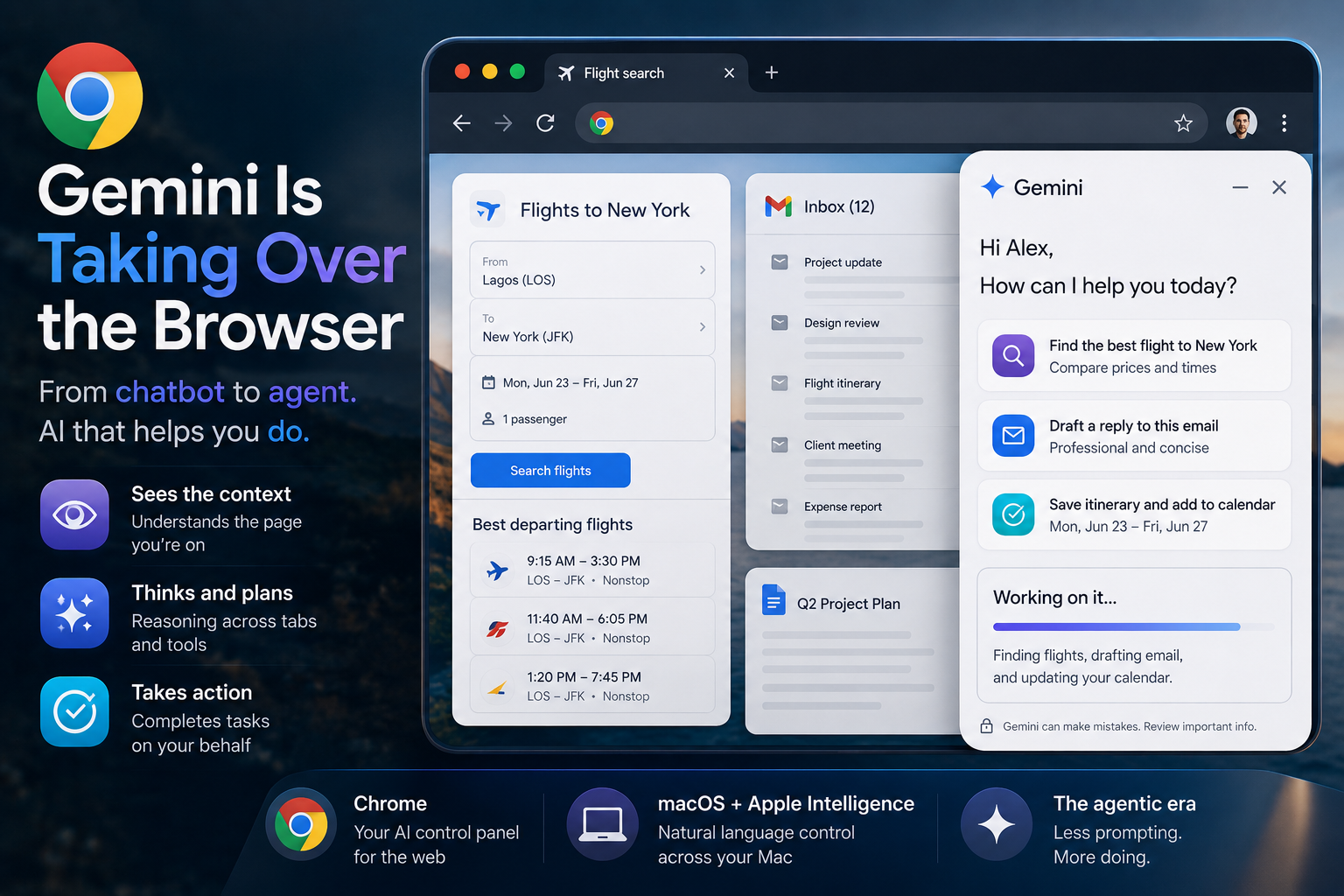
Google is no longer pitching Gemini as a chatbot you visit when you have a question. The company’s latest AI messaging points to an “agentic” future in which Gemini lives inside the browser, watches the context you are already working in, and helps operate software on your behalf.
The browser is becoming the control panel for everyday AI, and Google is moving fast to make Chrome the place where that control happens.
Why the browser is the new AI front door
For the past two years, the consumer AI race has mostly been framed around standalone assistants: ChatGPT, Gemini, Claude, Copilot, and Perplexity. That framing is already outdated. The more important contest is shifting toward the surfaces people use all day, especially browsers, operating systems, and productivity apps.
Google’s own language makes the direction clear. In its announcement of Gemini 2.0, the company described the model as built for “the agentic era,” emphasizing systems that can reason, plan, and take action across tools. That is a different promise from answering a prompt in a blank text box.
Chrome is the obvious beachhead. It is where users research purchases, manage work apps, read email, fill out forms, compare travel options, and bounce between dozens of tabs. An assistant embedded there does not need users to explain everything from scratch; it can infer intent from the page, the tab set, and the task in progress.
That is why experiments such as Project Mariner, which Google has described as a browser-based agent prototype, matter even if they are not yet mainstream products. They show that Google sees the browser not as a place to display AI answers, but as a place where AI can start completing workflows.
From chatbot window to software layer
The phrase “Gemini Spark” captures the larger product direction: smaller, context-aware Gemini experiences that ignite directly inside the tools people already use. Whether surfaced as a Chrome-side assistant, an address-bar interaction, or a page-aware helper, the strategic move is the same. Gemini becomes less of a destination and more of a layer.
Google has already laid technical groundwork for this inside Chrome. The company’s built-in AI documentation for Chrome points to on-device and browser-integrated AI capabilities, including work connected to Gemini Nano. That matters because browser-level AI can be faster, more private in some cases, and more tightly connected to web interactions than a remote chatbot tab.
The difference is practical. A traditional assistant can summarize a web page if you paste a link or text into it. A browser-native assistant can see the page you are on, understand the form you are filling out, compare it with information in another tab, and potentially help you complete the task without forcing you to choreograph every step.
That is the shift from “ask me anything” to “help me do this.” It is also why agentic AI sounds abstract until it appears inside familiar software. The moment a user can say “find the refund policy, draft a reply, and save the receipt,” the concept becomes concrete.
The macOS signal is just as important
Google is not operating in a vacuum. Apple is pushing AI deeper into the Mac through Apple Intelligence, with a renewed Siri that the company says will understand richer language, personal context, and actions across apps. Apple’s Apple Intelligence announcement framed the Mac as another place where natural-language control becomes part of the operating system.
That creates a platform-level collision. If users can tell macOS what they want in ordinary language, and tell Chrome or Gemini what they want inside the browser, the assistant becomes a new user interface above the traditional app grid. The question is no longer which app has the best menu; it is which assistant can safely and reliably operate the most useful software.
This is why natural-language controls on macOS are more than an accessibility or convenience feature. They signal that operating systems are being redesigned around intent. Instead of opening apps, finding commands, and managing file paths, users increasingly describe outcomes.
For Google, that raises the stakes for Chrome. If Apple owns the operating-system layer and Microsoft owns Windows with Copilot, Chrome is one of Google’s strongest remaining consumer surfaces outside Android. Turning Chrome into an AI agent platform is a defensive move as much as an offensive one.
The platform fight hidden inside convenience
The consumer pitch will be simple: fewer clicks, faster answers, less drudgery. But underneath that convenience is a high-stakes platform battle over distribution, data, defaults, and trust. Whoever controls the assistant layer gets a privileged position between the user and the web.
That position could reshape search. If Gemini can answer questions, compare options, summarize pages, and take action from within Chrome, fewer tasks need to begin with a traditional search results page. Google can preserve its relevance by moving search intelligence into the workflow before competitors do.
It could also reshape web publishing and commerce. An agent that browses for users may skip visual layouts, ignore ads, and extract just the information needed to complete a task. That is useful for users, but it puts pressure on websites built around human attention and page views.
The trust problem is just as large. A browser agent may interact with bank pages, medical portals, work dashboards, and shopping carts. Small mistakes can become consequential when an assistant is not merely suggesting text but clicking buttons, filling forms, or making commitments.
That makes guardrails a product feature, not a compliance footnote. Users will need clear consent moments, visible action logs, permissions by site or task, and easy ways to stop or undo an agent’s work. The winning assistant will not be the one that acts the most aggressively; it will be the one people can supervise without anxiety.
What users and developers should watch
The next phase will not arrive as one dramatic switch. It will show up through small features that make software feel more conversational and less manual. Those features will gradually train users to delegate bigger tasks.
Context: Watch how much of the current page, tab group, or app state Gemini can understand without copy and paste.
Actions: The key milestone is moving from summaries and drafts to form-filling, navigation, booking, and workflow completion.
Permissions: Strong products will make it obvious what the assistant can see and what it is allowed to do.
On-device AI: Browser and OS-level models can reduce latency and improve privacy for routine tasks.
Developer hooks: If Chrome exposes reliable AI APIs, websites may start designing pages for both humans and agents.
Developers should treat this as an interface shift similar to mobile or voice, but with broader reach. If users arrive through agents, sites and apps will need clearer structure, machine-readable flows, and transaction paths that can be safely delegated. The web may become less about pages and more about capabilities.
For users, the short-term advice is simpler: pay attention to where the assistant lives. A chatbot in a separate tab is easy to compartmentalize. An assistant embedded in Chrome or macOS is closer to your daily work, which makes it more useful and more sensitive.
The bottom line
Google’s agentic Gemini push is a clear sign that the AI race is moving from chat windows into the software surfaces people already use. Chrome gives Google a powerful place to turn Gemini into a task assistant rather than a question-answering box.
The battleground is not just model quality anymore. It is distribution, permissions, trust, and the ability to turn natural language into reliable action inside the browser and operating system.