How Nigeria’s Roadworks Are Cutting the Internet
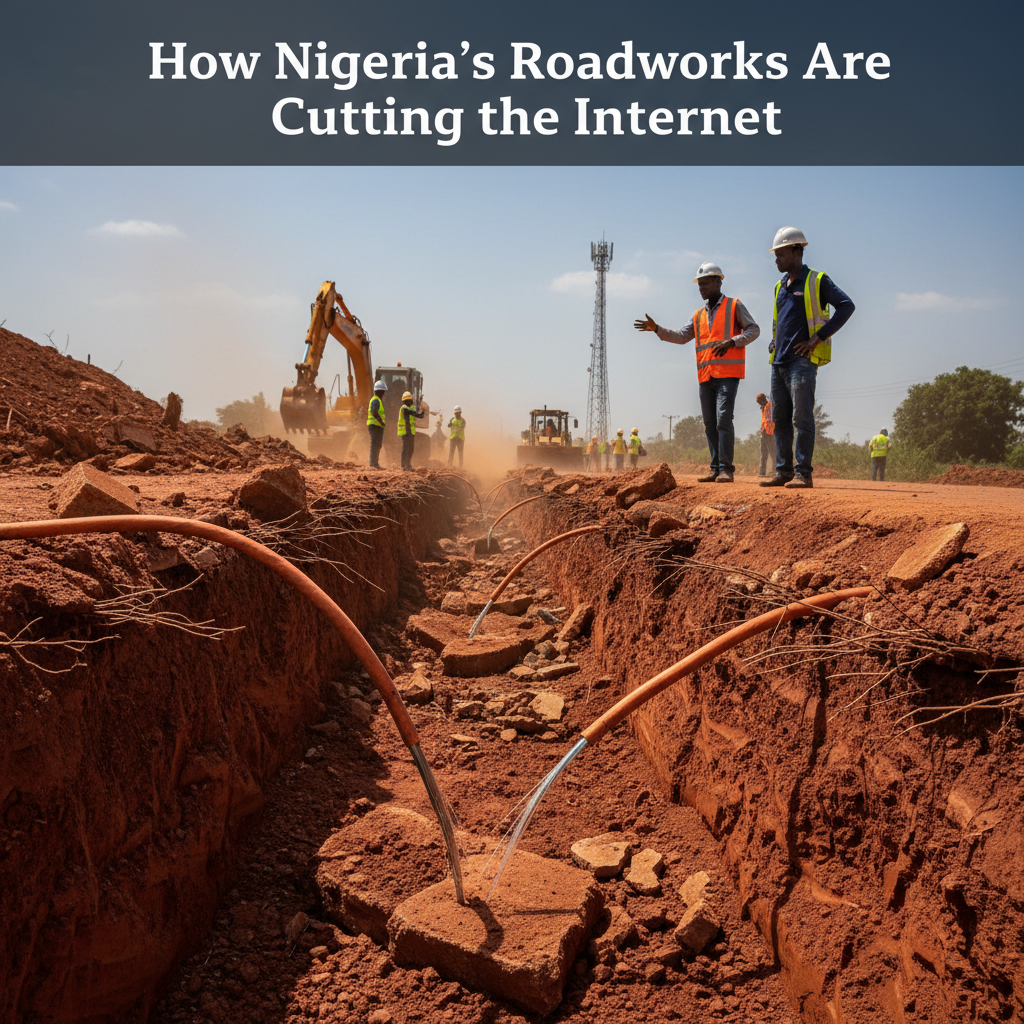
A bulldozer does not need to touch a data centre to take a bank offline. In Nigeria, it may only need to dig too deeply beside a highway.
That is the uncomfortable reality behind a warning from the Nigerian Communications Commission: road construction and rehabilitation projects have been damaging thousands of fibre-optic links, with operators reportedly recording about 5,000 fibre cuts in just six months. For a country trying to build a modern digital economy, this is more than a telecoms maintenance problem. It is a national productivity leak running under the asphalt.
Fibre cables are the nervous system of the internet. They connect mobile base stations, bank branches, payment processors, cloud services, government portals, schools, hospitals and homes. When they are severed, the disruption can look like many different failures at once: failed card payments, patchy mobile data, delayed bank transfers, dropped video calls, slow hospital systems, and businesses unable to process orders.
Nigeria is expanding roads because it needs better transport infrastructure. But when roadworks repeatedly break digital infrastructure, the country is effectively upgrading one network by damaging another.
The internet is buried beside the road
Most Nigerians experience the internet wirelessly: through phones, MiFi devices and mobile routers. But the wireless experience depends heavily on fixed infrastructure. Behind every 4G or 5G mast is a backhaul connection carrying traffic from the tower to the operator’s core network. Increasingly, that backhaul is fibre.
Fibre is preferred because it moves large volumes of data with low latency and higher reliability than microwave links. It is also essential for high-capacity services: streaming, cloud computing, digital banking, enterprise connectivity, telemedicine and real-time collaboration.
The problem is that fibre routes often follow roads. Road corridors are logical paths for cable deployment because they provide continuous access across cities and between states. But that convenience becomes a vulnerability when road agencies, contractors, utility companies and telecom operators do not coordinate properly.
A road project may involve excavation, drainage works, grading, bridge repairs, culverts, lane expansion or relocation of other utilities. If contractors do not have accurate maps of underground fibre routes, or if they ignore them, a single trench can cut multiple ducts. In dense areas, one incident can affect several operators and thousands of users.
The damage is rarely as simple as “the internet is down.” Operators may reroute traffic, but rerouting can create congestion. Affected customers may see slower speeds rather than complete outages. Enterprise users may lose dedicated links. Mobile towers may remain powered but become isolated from the network. The result is a frustrating grey zone: the signal is present, but the service is unreliable.
Why a fibre cut can break banking, retail and work
Nigeria’s economy has become far more dependent on digital connectivity than many infrastructure planners appear to recognise.
Consider a typical weekday in Lagos, Abuja, Port Harcourt or Kano. A commuter pays for a ride through a mobile app. A supermarket accepts card and transfer payments. A small business owner confirms an order on WhatsApp. A remote worker joins a video meeting. A bank processes interbank transfers. A logistics company tracks deliveries. A hospital accesses patient information. A student streams a lecture or submits an assignment online.
All of these activities depend on resilient connectivity.
When fibre is cut, the consequences spread quickly. A bank branch may be unable to connect reliably to central systems. Point-of-sale terminals may fail or time out, causing queues and abandoned transactions. USSD sessions may become unstable. ATMs can go offline. Merchants who depend on instant transfers may delay releasing goods because payment confirmation is slow.
For telecom operators, fibre cuts mean emergency repairs, service credits, customer complaints and degraded network performance. For businesses, they mean lost sales and wasted hours. For workers, they mean missed deadlines. For consumers, they mean one more reason to carry cash, keep multiple SIM cards and distrust digital services.
The damage also hits confidence. Nigeria has pushed aggressively toward cashless payments, digital identity, broadband expansion and startup-led innovation. But those ambitions require dependable underlying infrastructure. A fintech company cannot build trust if users routinely blame its app for failures caused by a severed cable 20 kilometres away.
The coordination gap is the real fault line
Fibre cuts are sometimes treated as accidents, but repeated damage at this scale points to a systems problem.
At the heart of it is poor infrastructure coordination. Road agencies plan projects. State governments issue permits. Contractors mobilise equipment. Telecom operators maintain fibre maps. Utility companies manage power, water and pipelines. In a well-coordinated environment, these parties share information before work begins. Contractors know where fibre lies. Operators are notified in advance. Cables are relocated or protected. Emergency contacts are available on-site.
In practice, that chain often breaks.
Nigeria has long struggled with right-of-way charges, inconsistent state-level rules, vandalism, multiple taxation and weak enforcement of infrastructure protection. Even when operators have approval to lay fibre, records may be incomplete or poorly shared. Some ducts are not marked properly. Some contractors work without detailed underground utility scans. In fast-moving road projects, the pressure to deliver visible construction can override the quieter duty to protect buried assets.
This is why the NCC’s warning matters. It reframes fibre not as a private telecoms asset but as critical national infrastructure. That distinction is important. A severed fibre route does not only affect one operator’s balance sheet. It affects payments, public services, security communications and economic activity.
The federal government has already moved in that direction by designating telecoms infrastructure as critical national information infrastructure. But classification alone is not enough. Protection has to be operational: embedded into procurement, road design, contractor obligations, permits, inspections and penalties.
What smarter infrastructure planning would look like
Nigeria does not need to choose between roads and broadband. It needs to build them together.
A better model starts with mandatory “dig once” coordination. Whenever a road is built, expanded or rehabilitated, planners should account for ducts that can host fibre and other utilities. Instead of repeatedly cutting roads open after completion, agencies can create shared utility corridors that reduce future disruption and lower deployment costs.
Second, road contracts should include utility protection clauses. Contractors should be required to obtain verified maps, conduct underground scans where necessary, notify operators before excavation, and keep telecom emergency contacts on-site. Damage caused by negligence should carry meaningful financial penalties, not just apologies.
Third, Nigeria needs better geospatial mapping of critical infrastructure. Fibre routes, power lines, water pipes and other buried assets should be documented in secure, standardised systems accessible to authorised planners and contractors. This does not mean publishing sensitive network details to the public. It means ensuring that the people authorised to dig have the information needed not to destroy what already exists.
Fourth, telecom operators should continue investing in redundancy. No network can be immune to physical damage, but resilient design can reduce the blast radius. Diverse routes, ring architectures, backup microwave links and faster fault response can keep more users online when a cut occurs.
Finally, regulators must measure and publish the cost of these disruptions. Counting fibre cuts is useful; estimating their economic impact is more powerful. If policymakers can see how many hours of connectivity, transactions and business activity are lost to avoidable cuts, coordination will stop looking like bureaucracy and start looking like economic protection.
The digital economy cannot run on fragile foundations
Nigeria’s internet future will not be decided only by apps, smartphones, data prices or startup funding. It will also be decided by what happens before an excavator bucket hits the ground.
The country is right to fix its roads. It is also right to expand broadband, digitise government, deepen financial inclusion and attract technology investment. But these goals are connected. Roads move goods and people; fibre moves money, data and work. Damaging one to build the other is a false economy.
If Nigeria wants a digital economy that works at national scale, it must treat fibre routes with the same seriousness as bridges, airports and power lines. The internet beneath the road is no longer invisible infrastructure. It is the economy’s bloodstream — and it cannot keep being cut by mistake.