Jonathan 2027 Filing Exposes PDP’s Real Crisis
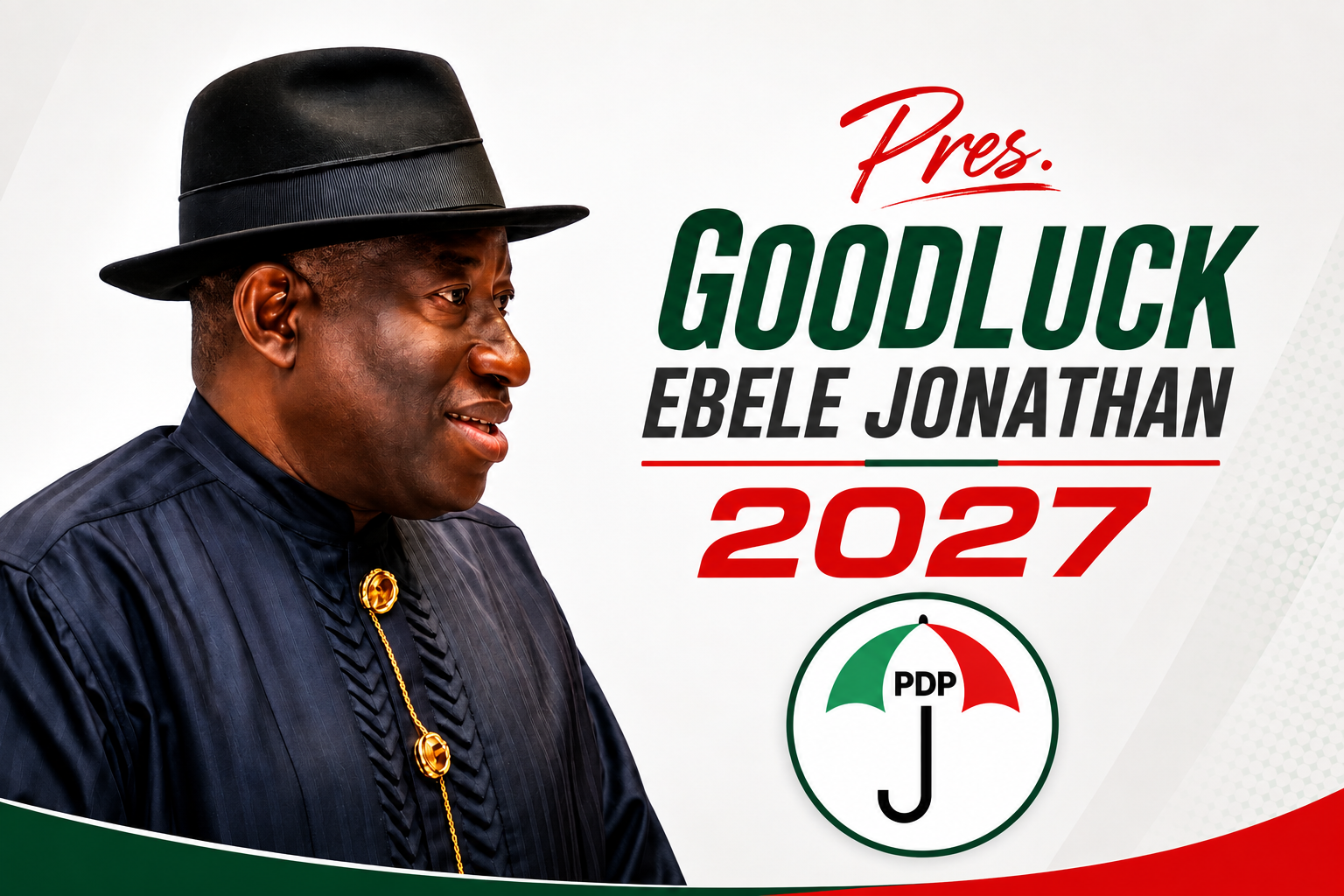
The Goodluck Jonathan 2027 rumour has crossed the line from beer-parlour speculation into paperwork. Live political reports that a faction of the Peoples Democratic Party submitted Jonathan’s name to the Independent National Electoral Commission have given the story a harder edge: not necessarily legitimacy, but momentum.
That distinction matters. In Nigerian politics, a document sent to INEC can be a legal step, a media stunt, a bargaining chip, or all three. This one should be read less as a completed presidential project and more as a signal of what is breaking inside the opposition: nostalgia for a less polarising figure, distrust of the PDP’s current power brokers, and a widening scramble for leverage ahead of 2027.
What the INEC move can—and cannot—do
The first point is basic but crucial: a faction cannot simply “submit” a presidential candidate to INEC and make it so.
Presidential nominations are governed by party constitutions, INEC guidelines and the Electoral Act. Candidates emerge through recognised party processes, usually primaries, and their names are submitted within INEC’s timetable by the party’s authorised officials. A factional letter, even if stamped and received, does not equal nomination.
That is why the paperwork is politically significant without being legally decisive. INEC may receive correspondence from rival camps, but it does not normally resolve a party’s internal war by accepting the loudest faction’s preferred candidate. Courts, party organs and INEC’s own recognition of official signatories become central when factions collide.
So if the reported submission was made by a bloc outside the PDP’s recognised national leadership, it is best understood as a pressure document. It puts Jonathan’s name into the official bloodstream. It forces journalists, party officials and rival aspirants to respond. It creates the impression that something is moving. But it does not, by itself, create a Jonathan candidacy.
A real Jonathan 2027 bid would require far more: his personal consent, a functioning political structure, a negotiated path through the PDP, and a clear answer to the legal and political questions around his eligibility and appetite for another bruising national race.
Why Jonathan remains a tempting shortcut
The attraction is obvious. Jonathan is one of the few Nigerian politicians whose name still travels across party lines with emotional weight. To his admirers, he represents restraint: the incumbent president who conceded defeat in 2015 and helped avert a national crisis. In an era of hardening rhetoric and exhausted institutions, that memory is powerful political currency.
For PDP actors looking at 2027, Jonathan also offers a shortcut around a problem the party has not solved since 2015: who can unify the base, reassure swing voters and compete nationally without reopening every old wound?
Atiku Abubakar remains formidable but divisive. Peter Obi’s 2023 Labour Party run proved that a large urban and youth vote can detach from the PDP and become a separate force. Nyesom Wike and the G-5 rebellion showed that elite sabotage inside the PDP can be just as damaging as attacks from outside. The result was an opposition field split badly enough for the All Progressives Congress to survive a difficult election cycle.
Jonathan’s name offers something different: recognition without the immediate factional baggage of the 2023 ticket. He is from the South-South, has governed before, and can be marketed as a one-term stabiliser. For politicians who fear another endless PDP primary war, he looks like a consensus brand—even if that consensus may be more imagined than real.
There is also a nostalgia factor. Many Nigerians who criticised Jonathan in office now compare his administration with the economic stress, insecurity and political bitterness that followed. That does not automatically make him electable, but it explains why his name keeps returning whenever the opposition appears short of a unifying centre.
Pressure tactic or serious gambit?
The timing and method suggest both ambition and theatre.
If a faction truly wanted to draft Jonathan, the more serious route would be quiet negotiation: secure his buy-in, win over governors, lock down party organs, and avoid a public procedural fight that can be dismissed as illegitimate. A noisy INEC submission before broad elite alignment looks more like a power play.
It may be aimed at the PDP leadership: a warning that certain blocs will not accept another imposed candidate. It may be aimed at northern aspirants: proof that the zoning debate is alive and that a southern alternative can be activated. It may even be aimed at Jonathan himself: a public invitation designed to make neutrality harder.
There is precedent for this kind of political kite-flying. Ahead of 2023, Jonathan’s name surfaced repeatedly in connection with an APC presidential bid, even though the project never became a formal campaign. Nomination forms, endorsements and rumours can be used to test the water, unsettle opponents and raise bargaining value.
That may be what is happening again. The faction gets attention. Jonathan’s loyalists measure reaction. PDP heavyweights see whether the public laughs, panics or leans in. Rival aspirants are forced to factor him into calculations, even if he never enters the race.
But seriousness cannot be ruled out entirely. Nigerian presidential projects often begin as deniable rumours before becoming formal alignments. If Jonathan is open to a return, paperwork from a faction could be an early marker placed on the table before a broader coalition is assembled.
The bigger signal: opposition fragmentation
The more important story may not be Jonathan at all. It is what his sudden paperwork comeback says about the PDP and the wider opposition.
A healthy party does not need factions to send symbolic names to INEC to prove a point. It has internal channels strong enough to manage ambition, zoning, alliances and succession. The PDP’s problem is that those channels have been weakened by years of unresolved disputes: North versus South, old guard versus new blocs, Atiku loyalists versus anti-Atiku forces, governors versus national officers, PDP stayers versus defectors.
The opposition space is even messier. The Labour Party still has the Obi factor but faces its own organisational stress. The NNPP remains regionally relevant but nationally limited. Smaller parties can negotiate but rarely dominate. Meanwhile, the APC benefits from incumbency, patronage and the simple fact that divided opponents often defeat themselves before voting begins.
In that environment, Jonathan becomes a mirror. Some see him as a rescue candidate. Others see a recycled elite answer to a country asking for renewal. Some PDP members may embrace him as a bridge. Others will resist him as an outsider to current party battles who cannot simply be parachuted in.
That is why the reported INEC move matters even if it goes nowhere legally. It exposes a party still searching for authority and an opposition still unable to agree on whether 2027 should be fought through consolidation, generational change, regional balancing, or the return of a familiar face.
Conclusion
The reported submission of Goodluck Jonathan’s name to INEC is not yet a Jonathan candidacy. It is not even proof that the PDP can unite behind him. But it is not meaningless either.
It is paperwork as politics: a factional flare, a pressure tactic, and possibly the first public marker of a 2027 negotiation. Whether Jonathan runs or not, the episode confirms the central question facing Nigeria’s opposition: can it build a disciplined alternative to the APC, or will it spend another cycle turning its own uncertainty into the ruling party’s advantage?