Nigeria’s Arms Crackdown Needs a Security Strategy
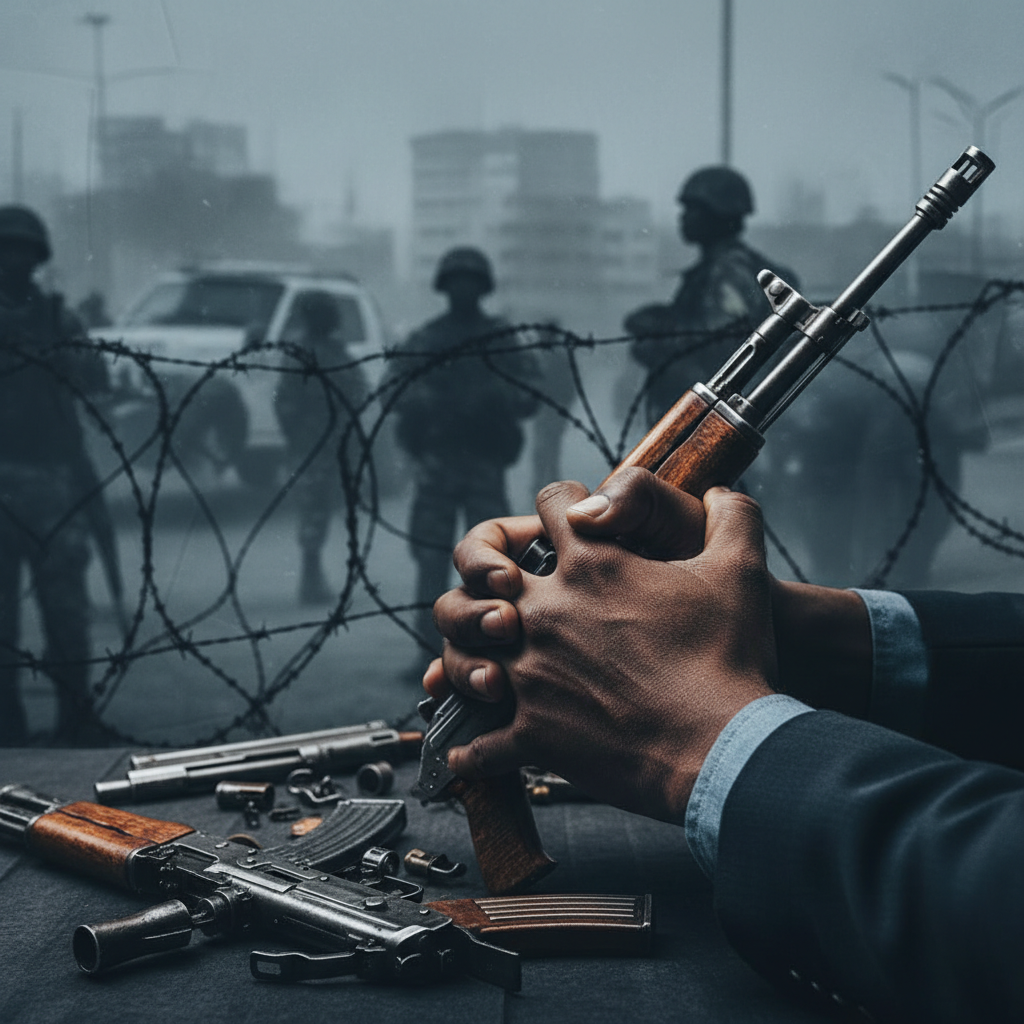
A rifle in the wrong hands is not just a weapon; in Nigeria, it is often a business plan, a political instrument and a symptom of state failure. That is why the latest order from the Inspector-General of Police for forceful action against illegal arms bearers, reported by Channels Television, lands with urgency. It also lands with a question the country can no longer avoid: can tougher policing defeat illegal weapons networks if Nigeria still has a weak security strategy?
Former Nigerian Electricity Regulatory Commission chairman and public affairs analyst Sam Amadi has warned repeatedly that Nigeria’s security problem is not merely a shortage of force. It is a shortage of strategy: intelligence, coordination, accountability and prevention. The IGP’s directive may be necessary. But on its own, it is not enough.
The Order Is Understandable — and Long Overdue
No serious state can tolerate the casual circulation of assault rifles, locally fabricated guns and ammunition among criminals, militias, cult groups, kidnappers and political enforcers. Illegal arms are the operating system of Nigeria’s insecurity.
In the North West, armed bandits have transformed rural communities into hostage economies. In the North Central, farmer-herder violence and communal reprisals have become deadlier because disputes that once involved sticks and machetes now involve AK-style rifles. In the South East, separatist-linked violence and criminal gangs have fed on access to weapons. In the South South, illegal refining, piracy and cult violence often move with firearms. In cities, cult clashes and robbery rings turn neighborhoods into miniature war zones.
So a police order to go after illegal arms bearers is not controversial in principle. The state must disarm unauthorized actors. It must make unlawful possession costly. It must restore the basic idea that the monopoly of legitimate force belongs to public authority, not whoever can buy a rifle.
But Nigeria has heard tough orders before. The problem is what happens after the press statement.
Crackdowns Fail When Guns Are Treated as the Root Problem
Illegal guns are not the root of Nigeria’s insecurity. They are the accelerant.
A crackdown can seize weapons from street-level carriers while leaving the supply chain intact. It can arrest young men at checkpoints while missing the financiers, smugglers, armoury leakers, corrupt officials and cross-border networks that keep the market alive. It can produce photographs of recovered rifles without changing the security environment in which those rifles circulate.
That is the danger in a purely kinetic response. If the police operation is reduced to raids, roadblocks and mass arrests, it may create temporary pressure but not lasting disruption. Worse, it can deepen mistrust in communities that already see security agencies as predatory, politicized or absent until violence erupts.
Consider kidnapping corridors. The armed men who abduct travelers are only one layer of the system. There are informants who track movement, negotiators who contact families, suppliers who move food and ammunition, money handlers who process ransom, and local collaborators who provide concealment. Disarming the gunman matters, but dismantling the network matters more.
The same is true of communal violence. Weapons often flow before an attack, not after it. If intelligence systems cannot detect stockpiling, mobilization, threats on local radio or social media, and unusual movements across vulnerable boundaries, policing becomes reactive. The state arrives after bodies are counted.
The Missing Piece Is Intelligence Reform
Nigeria does not lack security institutions. It has the police, the Department of State Services, the military, customs, immigration, civil defence, state-level security outfits and multiple intelligence channels. The problem is that these institutions too often operate in silos, compete for relevance, hoard information or respond only after violence has escalated.
A serious illegal-arms strategy would begin with intelligence fusion. At zonal and state levels, Nigeria needs standing cells that bring together police investigators, DSS analysts, customs officers, immigration officials, military liaison officers, prosecutors and vetted local intelligence sources. Their job should not be to hold meetings after attacks. Their job should be to map arms routes, identify brokers, monitor armoury leakage, track ammunition patterns and connect local incidents to wider networks.
Arms tracing is especially important. Every recovered weapon should trigger a chain of questions: where was it made, how did it enter circulation, has it appeared in previous crimes, who supplied the ammunition, and which routes were used? Without a national ballistics and firearms tracing system, seizures become trophies rather than evidence.
Nigeria also needs stronger protection for informants and witnesses. Communities often know who is carrying weapons, who is recruiting, and who suddenly has money. But people do not volunteer intelligence when the state cannot protect them or when security agents leak tips to criminals. Intelligence reform is therefore not just technology; it is trust.
Policing Must Be Precise, Not Performative
The IGP’s order will be judged by its precision. A professional crackdown should target unlawful arms possession, trafficking and organized violence. It should not become an excuse for extortion at checkpoints or indiscriminate profiling of young people, motorcycle riders, cattle herders, transport workers or residents of already stigmatized communities.
The police can make the operation credible by publishing clear enforcement priorities: illegal possession of military-grade weapons, trafficking routes, armoury diversion, political thuggery, kidnapping supply chains and cult firearms. It should also release periodic data: number of weapons recovered, locations, arrests, prosecutions filed, convictions secured and links to known networks.
That last point matters. Nigeria often celebrates arrests and seizures but says little about convictions. If suspects are paraded on television and then quietly released because case files are weak, evidence was mishandled or prosecutors were not involved early, the deterrent effect collapses.
A real strategy would embed prosecutors in major arms cases from the beginning. It would preserve chain of custody, document forensic findings, protect witnesses and pursue financiers as aggressively as gun carriers. The message should be simple: possession is a crime, trafficking is a bigger crime, and sponsoring armed violence is a national threat.
The Strategy Nigeria Needs
Nigeria’s illegal-arms problem requires a layered response.
First, border and port controls must improve. Weapons enter through porous land borders, maritime routes and sometimes through concealed commercial channels. Customs, immigration and police intelligence must share watchlists and seizure data in real time.
Second, official armouries need rigorous audits. Some weapons in criminal hands originate not only from smuggling but from theft, battlefield loss, corrupt sale or poor inventory control within state institutions. A country cannot credibly disarm criminals while failing to secure its own stockpiles.
Third, the government should pair enforcement with targeted amnesty or surrender windows in specific conflict zones, followed by strict prosecution. Disarmament works best when communities see an exit ramp before the hammer falls.
Fourth, state governments must stop treating security as press optics. Security votes, local vigilantes and emergency meetings are not a strategy. Governors need measurable plans: early warning systems, community mediation, prosecution support, victim protection and funding for data-driven policing.
Finally, political actors must be held accountable. Nigeria cannot condemn illegal arms during insecurity debates and tolerate armed thugs during elections. The line between political violence and criminal violence is often thinner than officials admit.
Conclusion: Force Without Strategy Will Not Be Enough
The IGP is right to move against illegal arms bearers. No country survives when private violence becomes normal. But Nigeria’s security crisis will not be solved by force alone.
The bigger question is whether this crackdown becomes another loud operation or the beginning of a smarter doctrine: intelligence-led, evidence-based, rights-respecting and aimed at networks rather than headlines. Sam Amadi’s warning is the point. Nigeria does not only need more action. It needs action governed by strategy.
If the state wants to take guns off the streets, it must first understand how they got there, who profits from them, and why communities no longer trust the institutions meant to protect them. Anything less is not a crackdown. It is theatre with uniforms.