Ogazi’s 400m Gold and Nigeria’s New Sprint Era
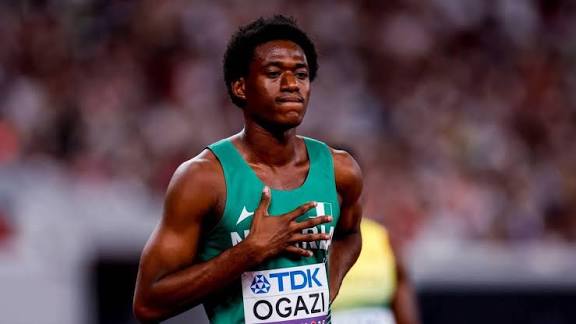
Nigeria did not need another reminder that it produces speed. It needed proof that the speed could travel through a full lap, survive championship pressure, and end with a flag around a runner’s shoulders.
Samuel Ogazi’s reported men’s 400m gold at Glasgow 2026 is, on the surface, a brilliant individual result. But its deeper value is bigger than one podium. If handled properly, it could become the sort of moment that forces Nigerian athletics to look beyond the familiar comfort zones: football headlines, relay nostalgia, and occasional one-off track miracles.
The 400m is not a glamour shortcut. It is sprinting with consequences — speed, endurance, race intelligence, and pain management compressed into less than 45 seconds. For a Nigerian man to win a major 400m title in that event is not just historic. It is a signal that the country may finally have the raw material for a new sprint era.
Why this gold feels different
Nigeria has always had athletes with acceleration, stride power, and competitive nerve. The country’s track history is not empty; it is under-organised.
The men’s 4x400m relay team remains part of Olympic folklore after Nigeria was awarded gold from the Sydney 2000 Games. Sunday Bada, Clement Chukwu, Jude Monye, and Enefiok Udo-Obong became symbols of what Nigerian quarter-milers could achieve when talent aligned with timing. Before that, Innocent Egbunike was a global 400m force in the 1980s. On the women’s side, Falilat Ogunkoya’s 400m bronze at Atlanta 1996 remains one of Nigeria’s great individual Olympic sprint medals.
But for years, those examples have felt like monuments rather than foundations. Nigeria has celebrated flashes without building a conveyor belt. A sprinter emerges, shines, and too often has to fight the system as much as the field.
That is why Ogazi matters. A 400m gold in 2026 would not arrive in isolation. It follows his rise into global relevance as a young quarter-miler, including his appearance on the Paris 2024 stage, where he showed he could live in the company of elite one-lap runners. Glasgow would turn promise into authority.
That distinction is crucial. Prospects create excitement. Champions change expectations.
The 400m is the perfect test of Nigeria’s ambition
The 100m can be disrupted by one generational athlete. The 400m usually exposes the strength of a programme.
To produce a world-class quarter-miler, an athlete needs more than explosive talent. He needs technical coaching, strength and conditioning, recovery planning, tactical education, nutrition, competition exposure, and a calendar that does not leave him peaking at the wrong time. The race is too demanding for guesswork.
That is why Ogazi’s breakthrough should be read as a challenge to Nigerian athletics administrators: can the country support a system that turns one elite runner into a generation?
The raw ingredients are not in doubt. Nigerian schools and universities are full of athletes who look like future sprinters before they ever see a professional track programme. The diaspora and American collegiate route have also become important development channels. Ogazi’s own rise fits into a broader pattern of Nigerian athletes sharpening their talent in more structured environments abroad, where competition is regular and performance data is taken seriously.
That is not a criticism of home-based athletes. It is a criticism of the gaps they are often forced to overcome. If Nigeria wants more Ogazis, it cannot rely only on scholarships, luck, or personal sacrifice. It needs domestic sprint hubs that can identify 200m and 400m talent early, protect athletes from over-racing, and keep coaches in the same development conversation as the world’s best.
Beyond football and relay nostalgia
Nigeria’s sporting imagination is still dominated by football. When the Super Eagles win, lose, qualify, collapse, rebuild, or appoint a coach, the national conversation follows. Athletics usually gets oxygen only when a medal is won or a controversy breaks.
That imbalance has consequences. It affects sponsorship, visibility, grassroots funding, athlete welfare, and media attention. A 400m gold can help rebalance the conversation, but only if it is treated as more than a celebratory weekend.
Recent Nigerian track success has already shown the appetite is there. Tobi Amusan’s world-record run in the 100m hurdles turned her into a household name. Ese Brume has carried Nigerian jumps with consistency. Relay teams continue to generate emotional interest because Nigerians understand the drama of baton exchanges and collective speed.
Ogazi offers something slightly different: a male individual sprint champion in an event that has historically produced some of Nigeria’s most respected but under-celebrated athletes.
The opportunity is commercial as well as competitive. A young 400m champion is marketable. He represents discipline, toughness, and modern Nigerian excellence. Brands that usually queue behind football should see the opening. Athletics can sell national pride without needing a 90-minute fixture.
What must happen next
The worst outcome would be to turn Ogazi’s gold into a slogan and do nothing else.
Nigeria should be ruthless about converting this moment into structure. That means creating a clearer pathway for 400m runners from junior competitions into elite camps. It means investing in coaches who understand long-sprint periodisation, not simply asking fast 200m runners to “hold on” for another bend. It means sports science, physiotherapy, and transparent selection policies.
It also means strengthening the relay programme around him. A world-class individual quarter-miler raises the ceiling of a 4x400m team immediately. If Nigeria can identify three or four more athletes capable of consistent sub-45-second or low-45-second performances, the country becomes dangerous again at global championships.
There are concrete lessons from the past. Nigeria’s Sydney 2000 relay success was not built on one runner. It came from depth. Ogunkoya’s era mattered because it showed that Nigerian women could compete in the most punishing sprint event on the Olympic programme. Amusan’s rise showed how one athlete can force an entire country to learn the language of a technical event.
Ogazi’s gold should now force Nigeria to speak 400m fluently.
A breakthrough, not a finish line
A medal can be an ending for an athlete. For a country, it should be a beginning.
Ogazi has given Nigeria a rare kind of sporting evidence: that its sprint future does not have to be limited to short dashes, relay memories, or football’s overwhelming shadow. The 400m is hard, honest, and unforgiving. Winning it says something about talent. Sustaining success in it says something about a system.
Nigeria has the first part. The next question is whether it can build the second.