OpenAI’s Smart Speaker Could Be Its Alexa Moment
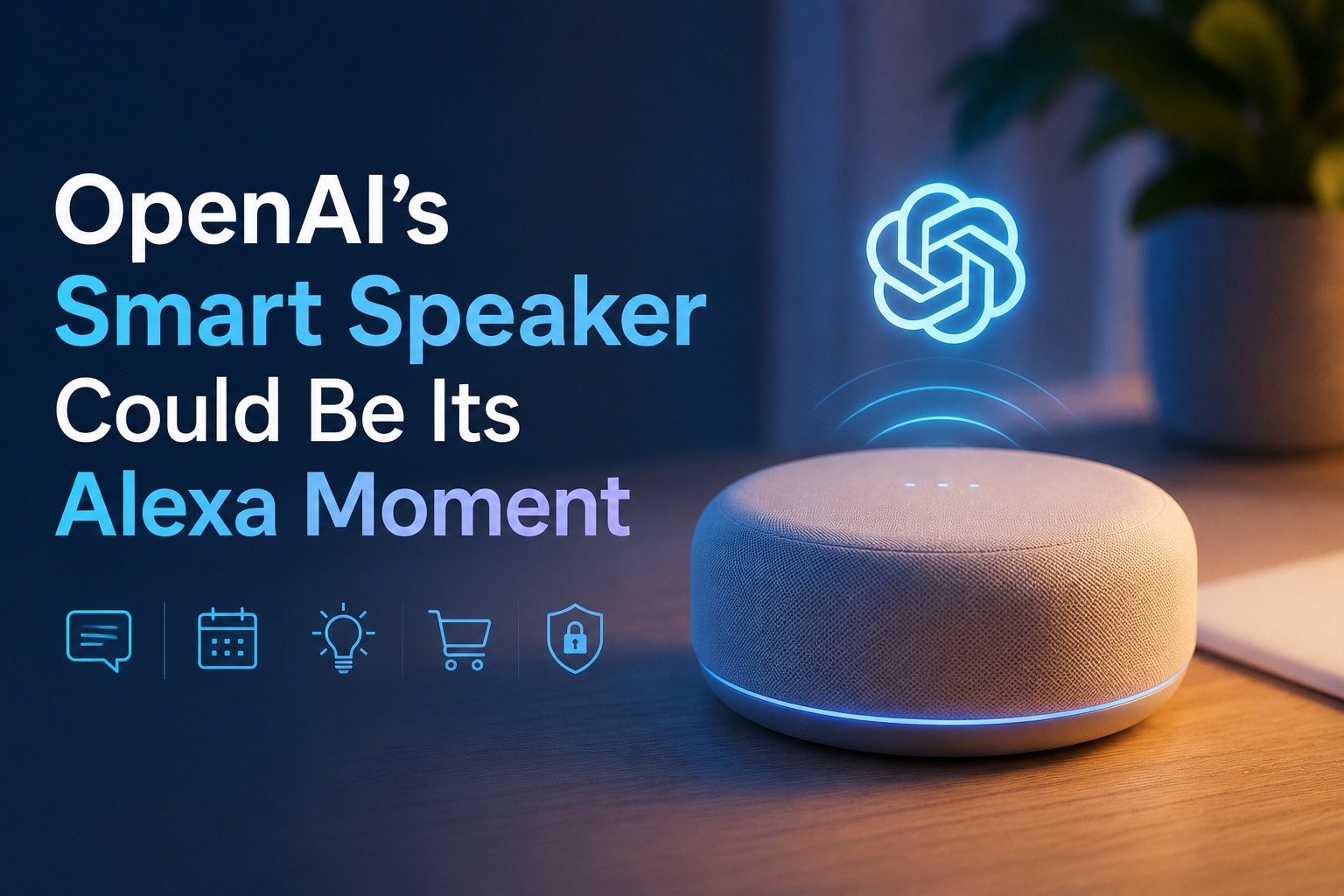
The most interesting thing about OpenAI’s rumored first device is not that it might be a speaker. It is that a $300–$400, hockey-puck-sized object could be the company’s clearest attempt yet to make ChatGPT feel less like software and more like a room-level presence.
If the rumors are right, OpenAI is not building an Alexa clone. It is trying to build the interface Alexa was supposed to become.
Why a puck makes sense
Reports and coverage from TechCrunch and The Verge have pushed attention toward a surprisingly modest form factor for Jony Ive’s first OpenAI hardware effort: small, screenless, stationary, and closer to a smart speaker than a phone replacement. That sounds underwhelming if you expected a sci-fi wearable or a new category of personal computer.
But the rumored shape is exactly what makes the idea credible. A hockey-puck-sized device does not need to win the entire day; it needs to win the kitchen counter, the nightstand, the desk, and the shared spaces where voice still makes more sense than tapping through apps.
The original smart speaker pitch was simple: ask for something and get it done. The problem was that most assistants never grew far beyond timers, weather, music, and basic smart-home commands. OpenAI’s bet would be that a large language model, paired with memory, better speech, and tool use, can finally make that ambient-computing promise feel real.
OpenAI has already moved ChatGPT toward a broader everyday interface, from voice conversations to multimodal inputs to task-oriented assistants. A dedicated device would take that same experience out of the app tray and put it in the room, where the friction of unlocking a phone and choosing an app disappears.
ChatGPT wants to leave the app
ChatGPT is already a destination for search-like questions, drafting, tutoring, coding help, brainstorming, and planning. Yet as long as it lives mostly inside phones, browsers, and desktop apps, it is still competing for attention with everything else on the screen.
A speaker changes the interaction model. Instead of opening ChatGPT, you address it. Instead of treating it as a tool you remember to use, it becomes part of the environment.
That matters because the home is full of low-intent, context-heavy moments. People ask half-formed questions while cooking, negotiating schedules, helping kids with homework, assembling furniture, or trying to remember whether a bill was paid. A stronger assistant can answer, ask clarifying questions, and potentially act across connected services.
The strongest version of this product would not be a better Echo Dot. It would be a shared household intelligence layer: conversational, personalized, and aware enough to help without turning every request into a miniature customer-support ticket.
The Alexa problem OpenAI must solve
Amazon deserves credit for making voice assistants mainstream. The Alexa platform put microphones in millions of homes and trained people to talk to computers casually. But it also exposed the ceiling of command-based assistants.
Alexa is useful, but it often feels like a voice remote. It can execute known commands, but it struggles when a request is ambiguous, multi-step, or dependent on personal context. That gap is exactly where OpenAI would try to differentiate.
A credible ChatGPT speaker would need to excel in areas where older assistants disappointed:
Conversation: It must handle natural back-and-forth without forcing users into rigid phrasing.
Memory: It needs to remember household preferences while making privacy controls obvious.
Agency: It should complete tasks across calendars, messages, shopping lists, and smart-home systems.
Speed: It has to respond quickly enough that talking still beats pulling out a phone.
Trust: It must be clear about what it knows, what it is doing, and when it is guessing.
That last point is the hardest. A smart speaker sits in intimate space, often always plugged in and ready. If OpenAI wants ChatGPT to become the household interface, it has to make privacy feel designed in, not buried in settings.
The price says this is not just a gadget
A $300–$400 price would put OpenAI’s rumored device far above mass-market smart speakers. That is a risky position in a category where consumers have been trained to expect discounts, bundles, and near-commodity hardware.
It also signals ambition. OpenAI may not be trying to beat Amazon on price; it may be trying to create a premium appliance for AI access. In that framing, the device is less like an Echo and more like the first Nest thermostat: expensive, designed, and meant to make a complicated technology feel inevitable.
Jony Ive’s involvement raises the stakes. OpenAI’s io announcement framed the partnership as a new hardware and design effort, not a side project. If Ive’s team is building the object, the physical experience will need to communicate calm, usefulness, and restraint.
That restraint matters. The failure mode for AI hardware is not merely that it is bad; it is that it is annoying. A home assistant that interrupts, mishears, hallucinates, or overreaches will be rejected faster than a buggy app because it occupies shared physical space.
The business model is also unresolved. Does the speaker require a ChatGPT subscription? Does it include a limited AI plan? Does it become a gateway to paid agents, commerce, or household automation? The device price may be only the first part of the economic story.
The real fight is for the default interface
The strategic reason to build hardware is control. Apple controls the iPhone, Amazon controls Echo, Google controls Android and Nest, and Microsoft controls the workplace layer. OpenAI, despite ChatGPT’s reach, still depends heavily on other people’s devices and operating systems.
A dedicated speaker would give OpenAI its own foothold in the home. It would not need to replace the smartphone to matter. It only needs to become the default place people ask questions, delegate chores, coordinate routines, and interact with connected services.
That is why the rumored smart speaker angle is more important than it looks. A screenless device forces OpenAI to prove that conversation alone can be a primary interface. If it succeeds, the company gains a new kind of distribution: not another app icon, but a presence in the room.
The competition will not stand still. Amazon is already racing to make Alexa more generative, Google has Gemini, and Apple is expected to keep pushing Siri deeper into its ecosystem. OpenAI’s advantage is that ChatGPT already has the cultural position these assistants wanted: people know it as the thing you ask when you need a real answer.
The bottom line
OpenAI’s rumored Jony Ive smart speaker is compelling because it aims at the home, not the pocket. If ChatGPT can become fast, useful, private, and trustworthy in a shared space, it could finally deliver the assistant experience Alexa popularized but never fully completed.
The device does not need to be flashy to matter. It needs to make talking to ChatGPT feel as natural as turning on a light.