Osun Ballot Reprint Exposes Election System Risk
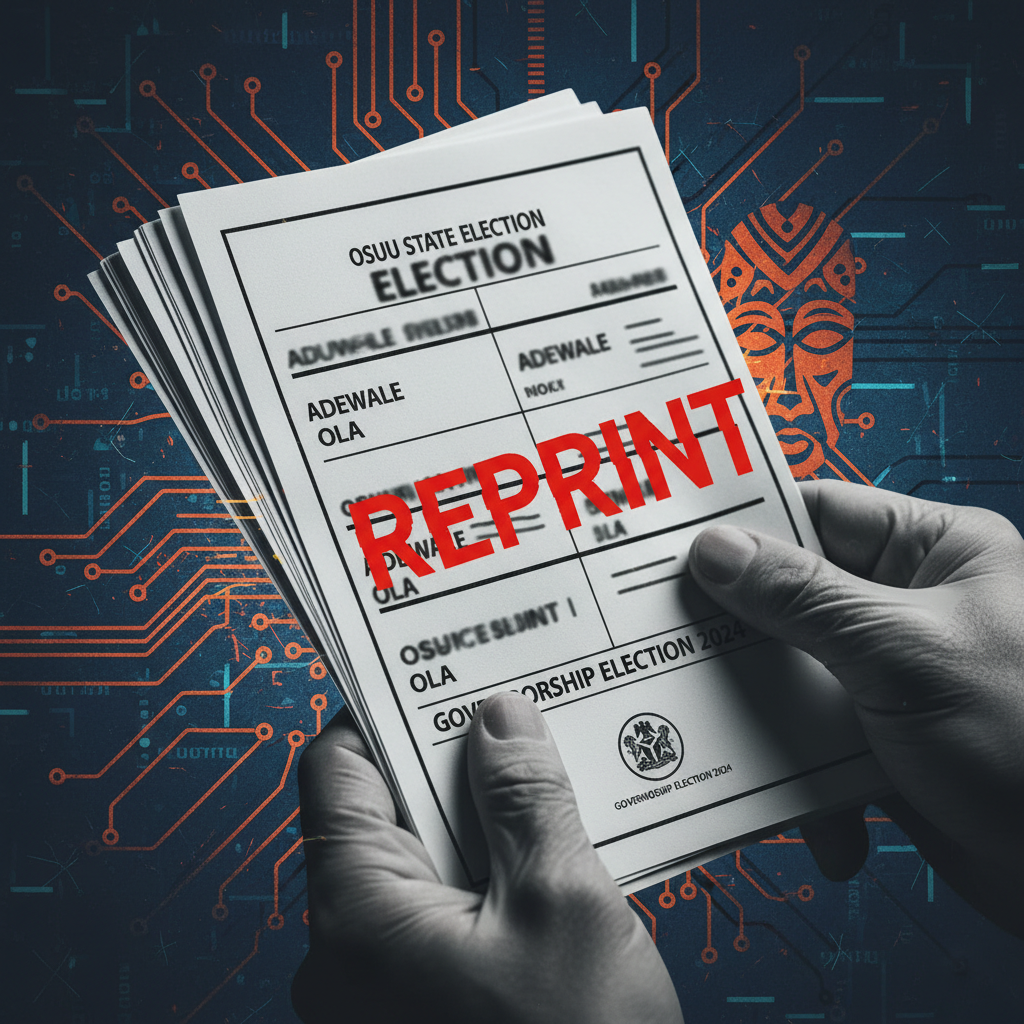
A ballot paper looks simple on election day: party logos, candidate names, a thumbprint box. Behind it sits a fragile industrial operation involving court deadlines, security printers, transport contractors, police escorts, local government sorting centres and thousands of polling units. That is why a court order requiring the Independent National Electoral Commission (INEC) to reprint Osun ballot papers after a party-inclusion ruling is more than a local election dispute. It is a warning shot for 2027.
The Osun episode shows how one late legal decision can force Nigeria’s election managers to reopen a process they thought was closed. A party excluded from the ballot goes to court. The court agrees. INEC must comply. The democratic principle is straightforward: eligible parties and candidates should not be shut out. The operational consequence is anything but simple: redesign, reprint, redistribute and reassure the public — all under pressure.
As Nigeria moves toward another high-stakes general election cycle, the question is not whether courts should enforce electoral rights. They must. The harder question is whether the country’s election machinery is built to absorb late judicial shocks without raising costs, delaying preparations or feeding distrust.
What the Osun order changed
In the Osun case, reported by The Punch as an order directing INEC to reprint ballot papers to accommodate a party-inclusion ruling, the court effectively reopened a sensitive-materials process that normally sits near the end of election preparation. Ballot printing is not like updating a website banner. It is a security operation.
Once ballot design is approved, INEC must produce papers with the correct party logos, names and layout. Printers must follow strict controls to prevent leakage, duplication or tampering. Materials are then packaged by state, local government, registration area and polling unit. They are moved under security, stored, inspected and finally deployed.
A late inclusion order disrupts every stage. The old ballot becomes unusable. New templates must be checked to ensure the party is properly represented. Printing schedules shift. Distribution plans change. If the election is close, officials may have to work nights, reassign vehicles and renegotiate delivery windows. Even where INEC complies quickly, the system pays in stress.
This is the hidden machinery voters rarely see. When it works, elections feel routine. When it is reopened by litigation, every small error becomes politically explosive.
The cost is bigger than paper
The most visible cost of a reprint is paper and ink. But the real bill is wider.
There is the direct cost of fresh secure printing. There is the cost of recalling, destroying or quarantining defective ballot batches. There are logistics costs: transport, storage, armed escorts, insurance, handling and overtime. There is also the cost of management attention. Senior election officials who should be finalising training, accreditation arrangements and contingency plans are pulled back into ballot compliance.
In a country where elections already consume enormous public resources, late reversals are not budget footnotes. They can become major unplanned expenses. A single state reprint is disruptive; a similar pattern across several states before a general election would be far more damaging.
The Electoral Act 2022 improved Nigeria’s framework in important ways, including timelines around party nominations, candidate publication and dispute processes. But legal timetables and operational timetables do not always align neatly. A matter may be filed within time and still produce an enforceable judgment after INEC has crossed a practical point of no return.
That gap is where costs multiply.
Trust takes the hardest hit
The bigger risk is not financial. It is trust.
When ballot papers are changed late, voters and party agents want answers. Was a party deliberately excluded? Was the correction made fully? Are old ballot papers still in circulation? Did all polling units receive the new version? In a low-trust environment, logistics becomes politics.
Nigeria has lived through enough election disputes for citizens to understand that courtrooms can determine outcomes. The Supreme Court’s 2020 decision that removed Bayelsa governor-elect David Lyon before inauguration remains one of the clearest reminders that legal compliance can override electoral victory. In Zamfara in 2019, internal party nomination failures led to sweeping consequences for candidates who had already campaigned and won votes. These examples differ from Osun’s ballot reprint order, but they all point to the same reality: legal defects do not remain on paper. They reshape power.
That is why INEC’s communication burden is as important as its logistics burden. When a court compels a ballot change, the commission must not only obey; it must explain. It should tell voters what changed, why it changed, how the old materials are being handled and how parties can verify the corrected ballot. Silence creates room for conspiracy. Transparency does not eliminate suspicion, but it narrows the space in which it grows.
What 2027 planners should learn
The lesson for 2027 is not that courts are the problem. Courts are part of the election system. They protect ballot access, enforce party rules and correct unlawful exclusions. The problem is the collision between slow political compliance and fast election logistics.
First, political parties must treat internal democracy as election infrastructure. Many late court cases begin with flawed primaries, disputed substitutions or unclear candidate submissions. When parties mismanage their own processes, INEC and the courts inherit the mess.
Second, INEC needs stronger litigation-risk planning. Ballot production should include contingency windows for unresolved pre-election matters. Procurement contracts should anticipate emergency reprints, not treat them as surprises. State offices should maintain updated lists of cases that could affect ballots, with clear triggers for design holds or conditional approvals.
Third, courts handling pre-election matters should recognise the operational consequences of timing. Speed is not merely administrative convenience; it protects voters from confusion and reduces public cost. Where possible, ballot-access cases should be prioritised before sensitive materials enter final production.
Finally, public verification should be routine. Before printing, INEC can publish final ballot layouts or party lists subject to pending cases, making disputes visible early. After court-ordered changes, it can publish corrected samples and invite parties to inspect. That is cheaper than fighting rumours on election week.
Conclusion
The Osun ballot reprint order is a local story with national implications. It proves that Nigeria’s election machinery is only as stable as the legal and party processes feeding it. If disputes are resolved late, even a correct judgment can become a logistical shock.
Ahead of 2027, Nigeria does not need fewer court protections. It needs cleaner party processes, faster dispute resolution and election planning that assumes litigation will happen. Ballots may be printed on paper, but confidence in them is built much earlier — in party primaries, court calendars, procurement plans and public communication.