Spotify’s AI Persona Badge Tests Music Trust
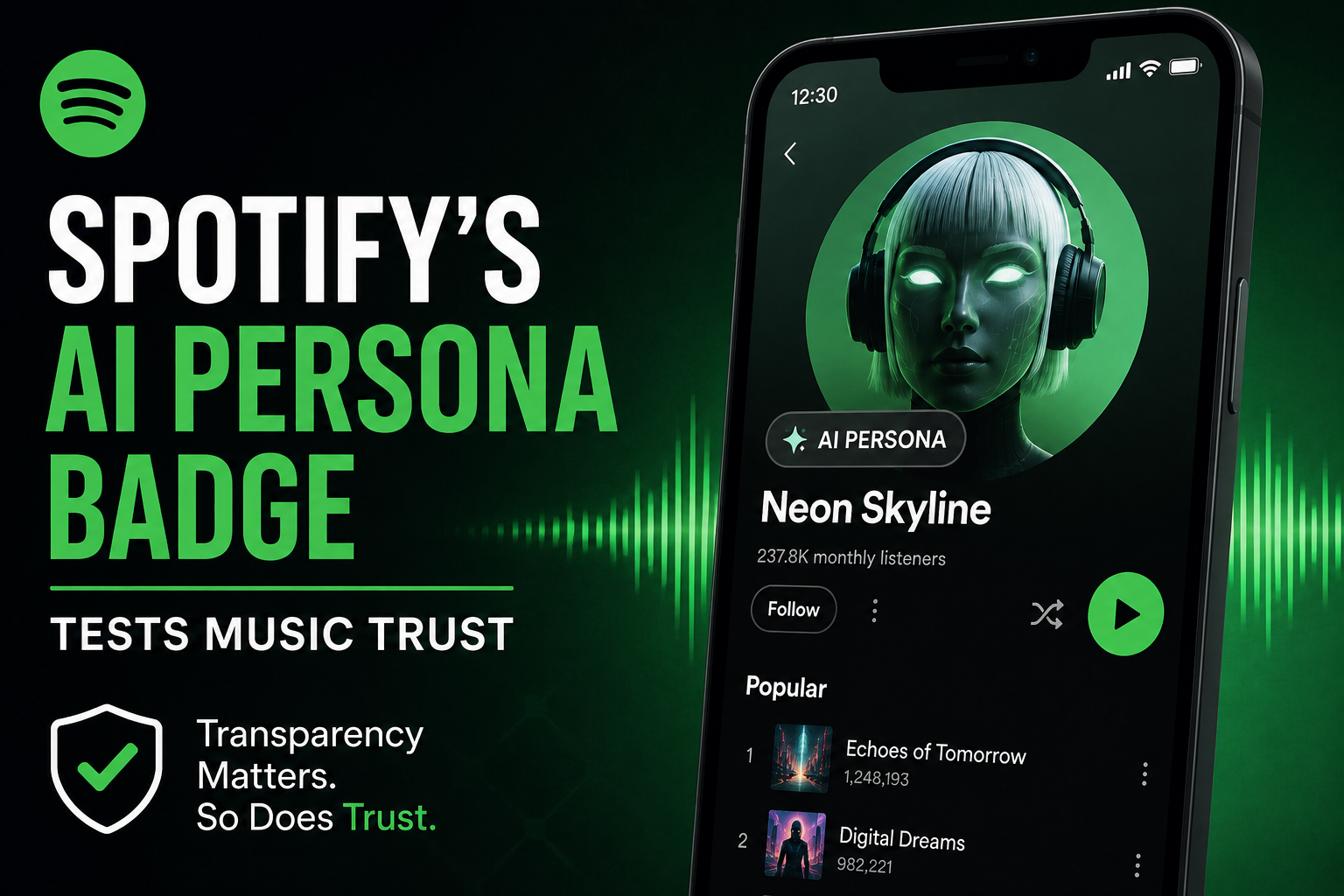
Spotify’s reported plan to mark certain AI-driven acts with an “AI Persona” badge lands at a moment when listeners are already asking a harder question: who, exactly, are we hearing? A label on a profile page sounds simple, but it could become one of the most important trust signals in streaming music.
The key issue is not whether Spotify discloses AI. It is whether disclosure becomes a substitute for responsibility.
Why a badge matters
Billboard’s report that Spotify will identify AI artists with an “AI Persona” badge points to a shift from backstage moderation to visible labeling. For years, platforms have handled synthetic music, fake artist pages, and suspicious upload behavior mostly behind the scenes. A badge would make at least part of that judgment visible to fans.
That visibility matters because streaming has trained listeners to trust interfaces. A verified-looking artist page, algorithmic playlist placement, and familiar cover-art conventions can make a fictional or synthetic act feel as legitimate as a touring musician. If a platform introduces a badge, it is acknowledging that presentation itself can shape belief.
The move would also separate different AI questions that are often mashed together. An artist might use AI tools in production, vocals, artwork, marketing, or identity design. An “AI Persona” label appears aimed less at whether software touched a track and more at whether the public-facing act is itself a constructed character.
That is a narrower target, and it could be useful. Fans may feel differently about a human artist using AI stem separation than about a profile built around a nonhuman singer, borrowed aesthetics, or a fictional biography. The badge could give listeners a faster way to understand the premise before they emotionally invest.
Disclosure is not accountability
The risk is that a badge becomes a neat interface solution for a messy rights problem. Labels can tell fans that something is synthetic or persona-based, but they do not answer who owns the work, who gets paid, what data trained the sound, or whether a human artist’s likeness has been imitated. Transparency is valuable, but it is not the same as consent.
Spotify already has policies aimed at harmful or deceptive activity, including rules around impersonation and platform manipulation in its platform rules. It also warns artists and teams about artificial streaming, a separate but related trust issue in which plays can be inflated or manipulated. AI personas could sit at the intersection of both concerns: they may be legitimate creative projects, deceptive branding exercises, or vehicles for gaming discovery.
The real test will be how Spotify defines the label. If it applies only to accounts that voluntarily disclose they are AI personas, bad actors may simply avoid the term. If Spotify applies it through detection, metadata, distributor reporting, or manual review, the company will need a process that is consistent, appealable, and clear enough for artists to understand.
There is also a difference between labeling an account and policing its impact. A synthetic artist could be properly labeled and still crowd playlists, mimic a niche community, or siphon attention from working musicians. Accountability begins when platforms explain not just what a badge means, but what limits, if any, come with it.
The new trust layer in streaming
Streaming services are becoming identity systems as much as music libraries. Artist pages now carry bios, merch links, tour dates, credits, canvases, editorial placement, and algorithmic recommendations. When AI-generated personas enter that environment, the platform is not merely hosting audio; it is helping stage a character.
That is why other companies are moving toward disclosure frameworks too. YouTube has published music-focused AI principles emphasizing responsible experimentation with the industry, including protections around artists’ voices and rights in its AI music principles. Deezer has gone in a more detection-heavy direction, saying it built tools to identify and tag AI-generated content in its catalog through an AI detection initiative.
Spotify’s badge, if implemented broadly, would add another layer: identity disclosure. That is distinct from audio disclosure, where a track might be tagged because it contains AI-generated vocals or production. An AI Persona badge would tell the audience that the act itself is part of the artificial construction.
This distinction could eventually shape search, recommendations, credits, and playlisting. A fan may want to discover AI persona projects as a new genre-adjacent form of entertainment. Another may want to filter them out, especially in mood playlists where they expect human performers.
Once a badge exists, users will reasonably ask for controls. Disclosure without choice can feel cosmetic. If fans can see the label but cannot decide how much AI persona music appears in their recommendations, trust may still erode.
What fans and artists will look for
For listeners, the first question is whether the badge is prominent enough to matter. A tiny label hidden on a profile page will not help much if most discovery happens through playlists, autoplay, radio, short clips, or search results. Trust signals need to appear where decisions are actually made.
For artists, the question is whether the policy protects creative experimentation without flattening all AI use into suspicion. Many musicians are already using AI-adjacent tools for demos, mixing assistance, translation, visuals, or workflow. A fair system should distinguish between a human artist using technology and a synthetic brand presented as an artist.
Several details will determine whether the badge becomes useful or performative:
Definition: Spotify needs to explain what qualifies as an AI persona rather than ordinary AI-assisted music.
Placement: The label should appear in search, playlists, profile pages, and playback contexts where fans encounter the act.
Credits: Listeners should be able to see the humans, companies, producers, and rights holders behind the project.
Controls: Users may want recommendation settings that include, reduce, or exclude AI persona acts.
Enforcement: The badge should not depend only on self-reporting if undisclosed synthetic identities can still spread.
Appeals: Artists wrongly labeled need a clear way to challenge the designation.
The broader industry should care because the badge could set a norm. If Spotify treats AI identity as a category requiring disclosure, distributors, labels, and rival platforms may follow. If the label is vague, inconsistent, or buried, it could normalize a weaker standard instead.
There is a commercial layer too. AI persona projects can be cheaper to scale, easier to localize, and less dependent on touring or artist availability. That makes them attractive to companies, but it also raises uncomfortable questions about whether platforms will quietly prefer endlessly productive synthetic acts over human careers.
The bottom line
An AI Persona badge could be a meaningful step toward honesty in streaming, especially if it helps fans understand when an artist identity is synthetic or heavily constructed. But the badge is only the front door to a bigger system of rights, credits, recommendations, and enforcement.
Spotify’s challenge is to make disclosure visible without letting it become a shield. Fans do not just want to know that something is AI; they want to know whether the platform is protecting trust in the music ecosystem they rely on every day.