Top Tech Careers & In-Demand Skills for 2026
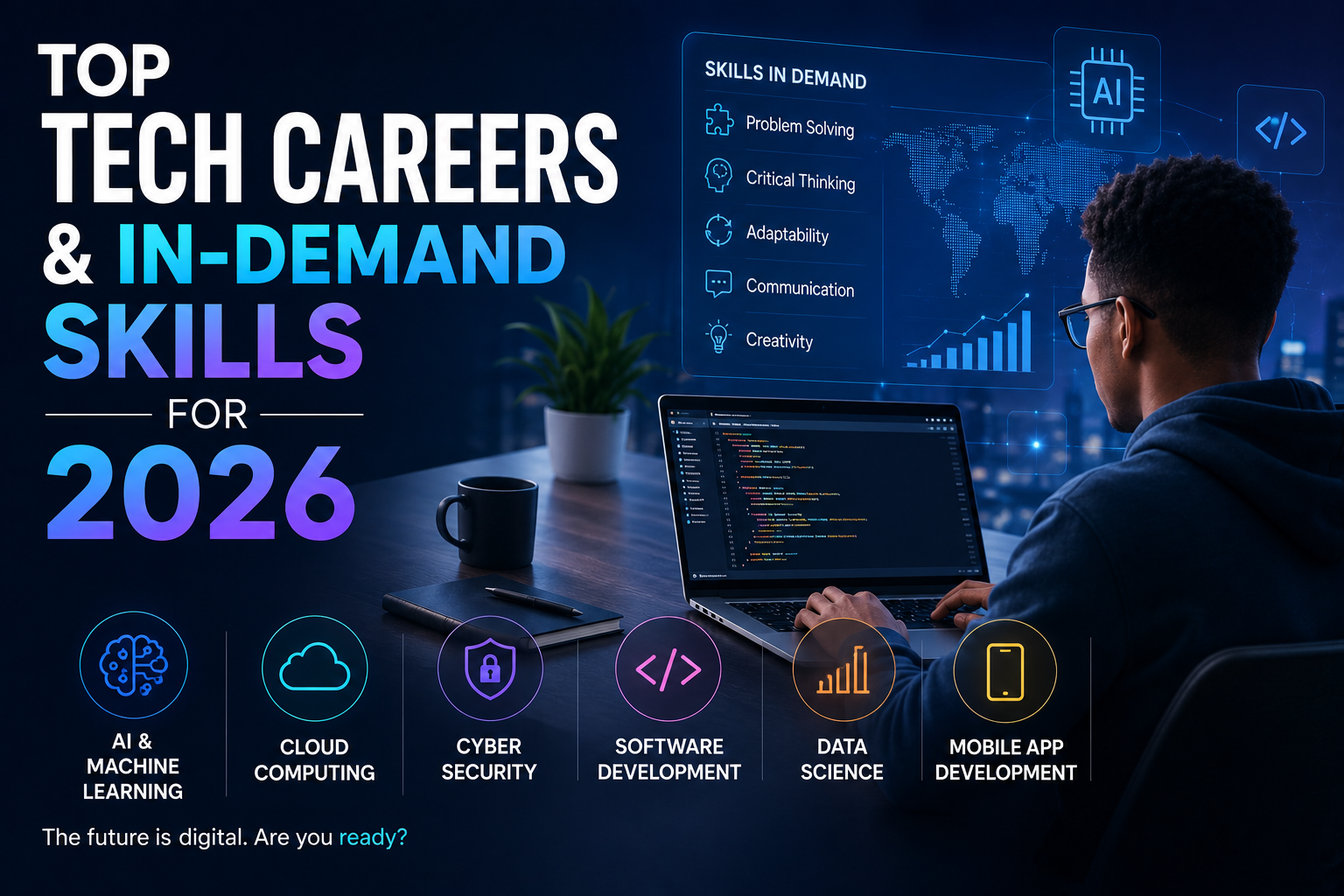
Top 5 High-Demand Tech Jobs in 2026 and the Skills You Need
The technology industry is evolving faster than ever. Artificial intelligence, cloud computing, cybersecurity, and data engineering are transforming how businesses operate, creating exciting opportunities for professionals with the right skills.
Gone are the days when simply knowing how to write code was enough. Today's employers are looking for people who can solve real business problems, automate workflows, build scalable systems, and work alongside AI-powered tools.
Whether you're a student exploring career options, a graduate preparing to enter the workforce, or an experienced professional looking to future-proof your career, understanding where the industry is heading can help you make smarter decisions.
In this guide, we'll explore the five most in-demand tech jobs in 2026, the skills employers are looking for, expected salary potential, and practical steps to help you prepare for these exciting careers.
How We Chose These Careers
This list is based on current technology trends and hiring demand across global industries. We considered several factors, including:
Rapid adoption of Artificial Intelligence
Cloud computing growth
Enterprise digital transformation
Rising cybersecurity threats
Data-driven decision making
Industry hiring trends
Long-term career opportunities
While technology changes quickly, these careers continue to appear among the fastest-growing and most valuable roles in today's job market.
1. AI Engineer
Artificial Intelligence is no longer just a research topic—it has become one of the most sought-after skills in the technology industry. Businesses are integrating AI into customer support, software development, healthcare, finance, education, and countless other industries.
AI Engineers design, develop, and deploy intelligent systems that solve real business problems. Rather than simply using AI tools, they build applications powered by machine learning models, large language models (LLMs), and intelligent automation.
What You'll Do
Build AI-powered applications
Develop intelligent chatbots
Integrate AI into business systems
Improve AI model performance
Monitor AI accuracy and reliability
Skills to Learn
Python
Machine Learning
Prompt Engineering
LangChain
LlamaIndex
Vector Databases
APIs
Git
Retrieval-Augmented Generation (RAG)
Best For
People who enjoy problem-solving, mathematics, automation, and building intelligent software.
2. Cloud Engineer
Cloud computing powers almost every modern website, mobile application, and online service. Organizations rely on cloud engineers to build secure, scalable, and reliable infrastructure.
Cloud Engineers help businesses migrate to the cloud, reduce infrastructure costs, improve system performance, and ensure applications remain available around the clock.
What You'll Do
Deploy cloud infrastructure
Configure servers
Manage networking
Monitor performance
Improve scalability
Automate deployments
Skills to Learn
Amazon Web Services (AWS)
Microsoft Azure
Google Cloud Platform
Docker
Kubernetes
Linux
Terraform
CI/CD
Best For
People interested in infrastructure, automation, networking, and system reliability.
3. Data Engineer
Data has become one of the world's most valuable resources. Every AI model, business dashboard, and analytics platform depends on clean, reliable, and well-structured data.
Data Engineers create systems that collect, process, organize, and deliver massive amounts of information for businesses.
Without high-quality data, even the most advanced AI systems cannot perform effectively.
What You'll Do
Build data pipelines
Process large datasets
Design data warehouses
Improve data quality
Support business analytics
Enable AI applications
Skills to Learn
SQL
Python
Apache Spark
Apache Kafka
ETL Processes
Snowflake
BigQuery
dbt
Best For
People who enjoy analytics, databases, automation, and working with large amounts of information.
4. Cybersecurity Engineer
As cyber threats continue to increase, organizations need skilled professionals to protect sensitive data, networks, and cloud infrastructure.
Cybersecurity Engineers identify security vulnerabilities, respond to cyber threats, and build systems that protect businesses from attacks.
This career continues to offer excellent job stability because every organization needs cybersecurity expertise.
What You'll Do
Secure computer networks
Monitor cyber threats
Perform penetration testing
Protect cloud environments
Respond to security incidents
Develop security policies
Skills to Learn
Network Security
Ethical Hacking
Cloud Security
Identity & Access Management (IAM)
SIEM Tools
Incident Response
OWASP Top 10
Best For
People who enjoy investigation, critical thinking, and solving security challenges.
5. DevOps Engineer
Modern businesses release software updates more frequently than ever. DevOps Engineers make this possible by automating software development and deployment processes.
They help developers release reliable software faster while improving collaboration between development and operations teams.
What You'll Do
Automate software deployments
Build CI/CD pipelines
Manage cloud infrastructure
Improve system reliability
Monitor production environments
Reduce deployment failures
Skills to Learn
Docker
Kubernetes
Git
GitHub Actions
Jenkins
Terraform
Linux
Monitoring Tools
Best For
People who enjoy automation, scripting, infrastructure, and improving software delivery.
Salary Expectation
🤖 AI Engineer
📈 Demand: ⭐⭐⭐⭐⭐
💰 Salary: Very High
🛠 Skills: Python, Machine Learning, LangChain
☁️ Cloud Engineer
📈 Demand: ⭐⭐⭐⭐⭐
💰 Salary: Very High
🛠 Skills: AWS, Docker, Kubernetes
📊 Data Engineer
📈 Demand: ⭐⭐⭐⭐☆
💰 Salary: High
🛠 Skills: SQL, Python, Spark
Note: Salaries vary depending on location, experience, industry, and employer.
How to Prepare for These Careers
Breaking into the technology industry has become more accessible than ever. While a computer science degree can be helpful, many employers now place greater emphasis on practical skills, real-world experience, and problem-solving ability.
Here are some practical steps to get started:
Learn the Fundamentals
Build a strong foundation in programming, networking, databases, operating systems, and version control before specializing.
Build Real Projects
Employers want to see what you can build. Create portfolio projects that solve real problems, such as AI-powered applications, cloud-hosted websites, data dashboards, or automation tools.
Create an Online Portfolio
Showcase your work on GitHub or a personal portfolio website. Include project descriptions, screenshots, and documentation explaining your approach.
Earn Industry Certifications
Professional certifications from cloud providers and cybersecurity organizations can strengthen your resume and demonstrate your commitment to continuous learning.
Stay Updated
Technology changes rapidly. Follow industry news, attend webinars, participate in developer communities, and keep learning new tools and frameworks.
Common Mistakes to Avoid
Many aspiring technology professionals slow their progress by making avoidable mistakes.
Avoid these common pitfalls:
Learning too many programming languages at once.
Watching tutorials without building projects.
Ignoring communication and teamwork skills.
Failing to use Git and version control.
Not creating a professional LinkedIn profile.
Waiting until you're "ready" before applying for jobs.
Remember, consistent progress beats perfection.
Frequently Asked Questions
Which tech job pays the most?
AI Engineers, Cloud Engineers, and Cybersecurity Engineers are among the highest-paying technology professionals, especially as they gain experience.
Do I need a university degree?
No. While a degree can be beneficial, many employers value practical skills, certifications, portfolios, and real-world experience just as much.
Which programming language should I learn first?
Python is one of the best programming languages for beginners because it is widely used in AI, automation, web development, and data science.
Is cybersecurity still a good career in 2026?
Absolutely. As cyber threats continue to evolve, organizations across every industry need skilled cybersecurity professionals to protect their systems and data.
How long does it take to become job-ready?
The timeline varies depending on your background and dedication. With consistent learning, hands-on practice, and portfolio development, many people become job-ready within several months to two years.
Final Thoughts
Technology continues to evolve at an incredible pace, creating exciting opportunities for professionals who are willing to learn, adapt, and solve real-world problems.
Whether you're interested in Artificial Intelligence, Cloud Computing, Cybersecurity, Data Engineering, or DevOps, there has never been a better time to build a career in technology.
Rather than trying to learn everything at once, choose one career path that matches your interests, focus on mastering the fundamentals, and build practical projects that demonstrate your abilities.
The future belongs to lifelong learners. Start building your skills today, stay curious, and you'll be well-positioned for success in one of the world's fastest-growing industries.