Tupac Trial Week One: Hip-Hop’s Memory Takes the Stand
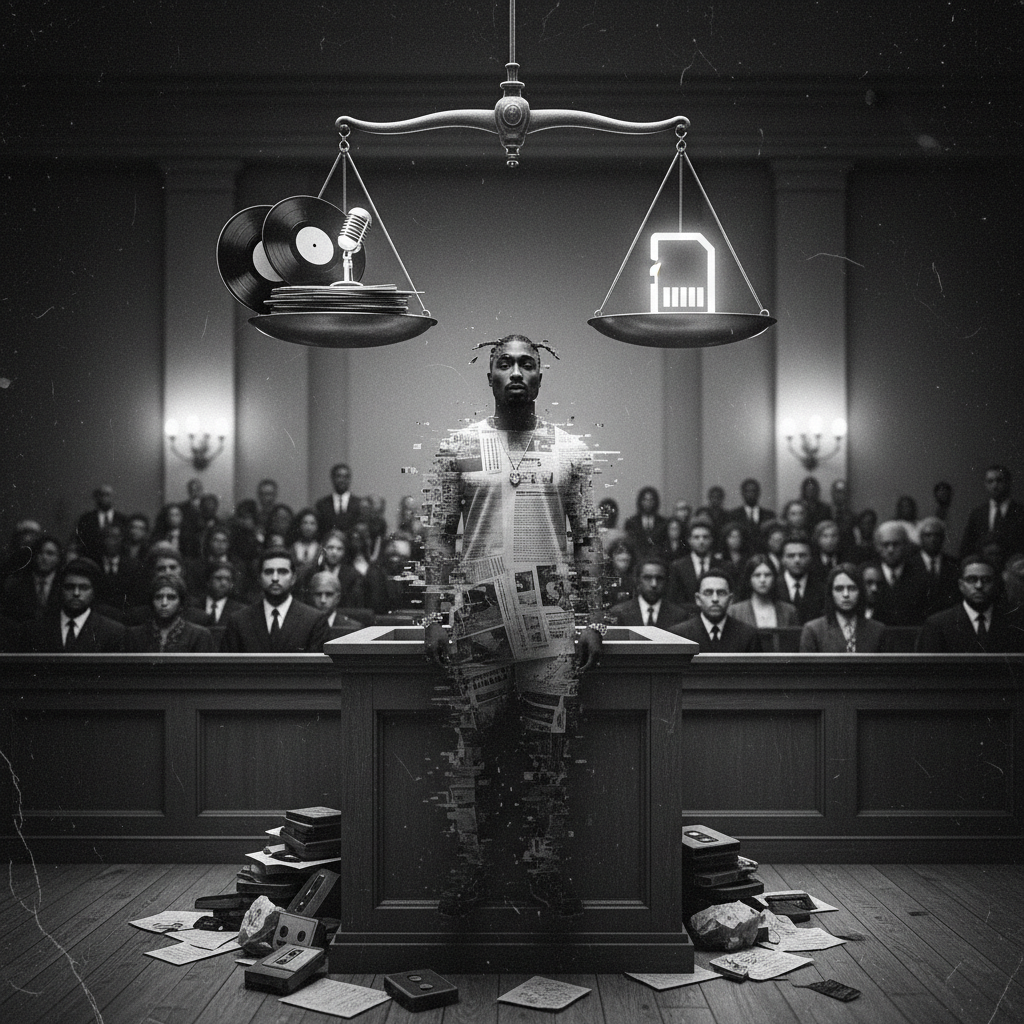
The loudest thing in the courtroom is not the gunfire from September 1996. It is the echo.
Week one of the Tupac Shakur murder trial has dragged one of hip-hop’s most mythologized nights back into the procedural light: exhibits, testimony, police recordings, timelines, motive. Billboard’s recap of opening testimony, revenge claims, and tapes captures the strange tension at the center of the case. Nearly three decades after Tupac was shot near the Las Vegas Strip, the trial is not only asking whether prosecutors can prove a murder charge against Duane “Keffe D” Davis. It is asking what happens when hip-hop history — shaped by grief, rumor, interviews, documentaries, memoirs, street codes, and industry mythology — is forced to answer under oath.
Tupac’s killing has never been just a cold case. It is a cultural wound with a case number.
A Night Hip-Hop Still Replays
The basic outline has become part of rap’s permanent folklore. On Sept. 7, 1996, Tupac Shakur attended the Mike Tyson–Bruce Seldon fight at the MGM Grand in Las Vegas with Death Row Records co-founder Suge Knight. After the fight, a fight of a different kind erupted inside the casino: Tupac, Knight, and members of their entourage were involved in an assault on Orlando “Baby Lane” Anderson, a reputed South Side Compton Crip.
Hours later, Tupac was riding in a black BMW driven by Knight when a white Cadillac pulled alongside near Flamingo Road and Koval Lane. Shots were fired into the passenger side. Tupac was hit multiple times. He died six days later at 25.
That sequence — casino beating, Cadillac, retaliation — has powered the prosecution theory for years. It also powered a generation of speculation. For fans, the story became inseparable from the volatile climate around Death Row, Bad Boy, the East Coast–West Coast media machine, and a music industry that turned conflict into content until the consequences became fatal.
Week one matters because it re-centers the story in the language of evidence. A courtroom does not care how many times a theory has circulated on message boards, in barbershops, or in YouTube breakdowns. It cares about admissibility, corroboration, credibility, and reasonable doubt.
The Revenge Theory Comes Into Focus
Prosecutors have framed the killing as retaliation. Their argument is straightforward: the MGM Grand assault created a motive; Davis, a longtime Compton gang figure, allegedly helped set the armed response in motion; and the Cadillac ambush was payback.
That theory is powerful because it gives the case a clean narrative arc. But clean narratives are not automatically convictions. The trial’s first week appears designed to establish not merely that revenge was plausible, but that it was organized, immediate, and tied directly to the defendant’s own words.
The defense’s challenge is equally clear: separate a man’s decades of self-incriminating public persona from proof beyond a reasonable doubt. Davis has spoken about the night in interviews and in his memoir. He has placed himself in the orbit of the shooting. But defense lawyers can argue that street storytelling, entertainment incentives, faulty memory, or efforts to inflate one’s role do not equal a legally reliable confession.
That is the hard question beneath the spectacle: when someone spends years talking about a historic crime, how much of that talk is evidence, and how much is performance?
Police Tapes and the Problem of Memory
The police tapes are where the trial becomes more than a nostalgia excavation. Recordings can be devastating because they preserve tone, sequence, and detail in a way that later testimony often cannot. They can also become battlegrounds over context: what was said, why it was said, under what understanding, and whether investigators were hearing truth, negotiation, bravado, or strategy.
In the Tupac case, Davis’s prior statements are central because so many of the people long associated with the shooting are dead. Orlando Anderson was killed in 1998. Others connected to the story have died over the years. Time has thinned the witness pool and hardened public assumptions. That makes recorded statements and earlier investigative material unusually important.
But memory is unstable, especially when filtered through fame. Tupac was not an anonymous victim; he was a symbol before he died and a larger one after. Every recollection of that night has been shaped by the size of his legend. Witnesses are not simply remembering a crime scene. They are remembering an event that became a documentary genre, a rap lyric reference point, and a conspiracy economy.
That is why the courtroom setting feels almost disorienting. The same details fans have debated for decades — the fight footage, the Cadillac, the gang affiliations, the Death Row entourage, the timing after the Tyson bout — are being stripped of mythic haze and reassembled as elements of a prosecution.
Why This Case Still Belongs in the Music Section
A murder trial belongs to the courts. Tupac’s murder trial also belongs to music because the stakes extend beyond one verdict.
Tupac’s death froze a particular moment in hip-hop: the moment when rap’s commercial explosion collided with real-world violence, media sensationalism, and label power. He was already one of the most electric figures in American music — a writer who could move from “Dear Mama” to “Hit ’Em Up,” from vulnerability to threat, from political imagination to scorched-earth ego. His murder turned that contradiction into a permanent argument about what hip-hop was being rewarded for, what it was being punished for, and who profited from the chaos.
That is why the trial feels bigger than legal housekeeping. It revisits the conditions around an era when artists, executives, street affiliations, and press narratives were often dangerously intertwined. It asks the culture to look again at how quickly beef became branding, how eagerly television and magazines amplified danger, and how little infrastructure existed to protect young Black artists becoming multimillion-dollar institutions in real time.
The courtroom cannot resolve all of that. It cannot bring Tupac back, redeem the tabloid frenzy, or untangle every rumor that grew around his death. But it can puncture the fantasy that the story belongs only to legend. Somebody fired into that BMW. Somebody carried the consequences. Somebody, prosecutors argue, helped make it happen.
A Verdict Will Not Close the Wound
The first week of testimony is only a beginning. Trials are built slowly, and the defense has not yet had the final word. The state must do more than tell a familiar story; it must prove a criminal case with evidence that survives cross-examination.
Still, the emotional weight is already obvious. Tupac’s killing remains one of the rare music stories that never aged into mere history. It continues to hurt because it sits at the intersection of art, violence, race, celebrity, policing, and memory. It is a reminder that hip-hop’s archives are not just albums and videos. They are also court transcripts, evidence logs, and the unfinished business of lives cut short.
The trial may eventually produce a verdict. The culture, however, has been testifying for 30 years.