Uber Eats’ Drone Bet Could Make Delivery Faster
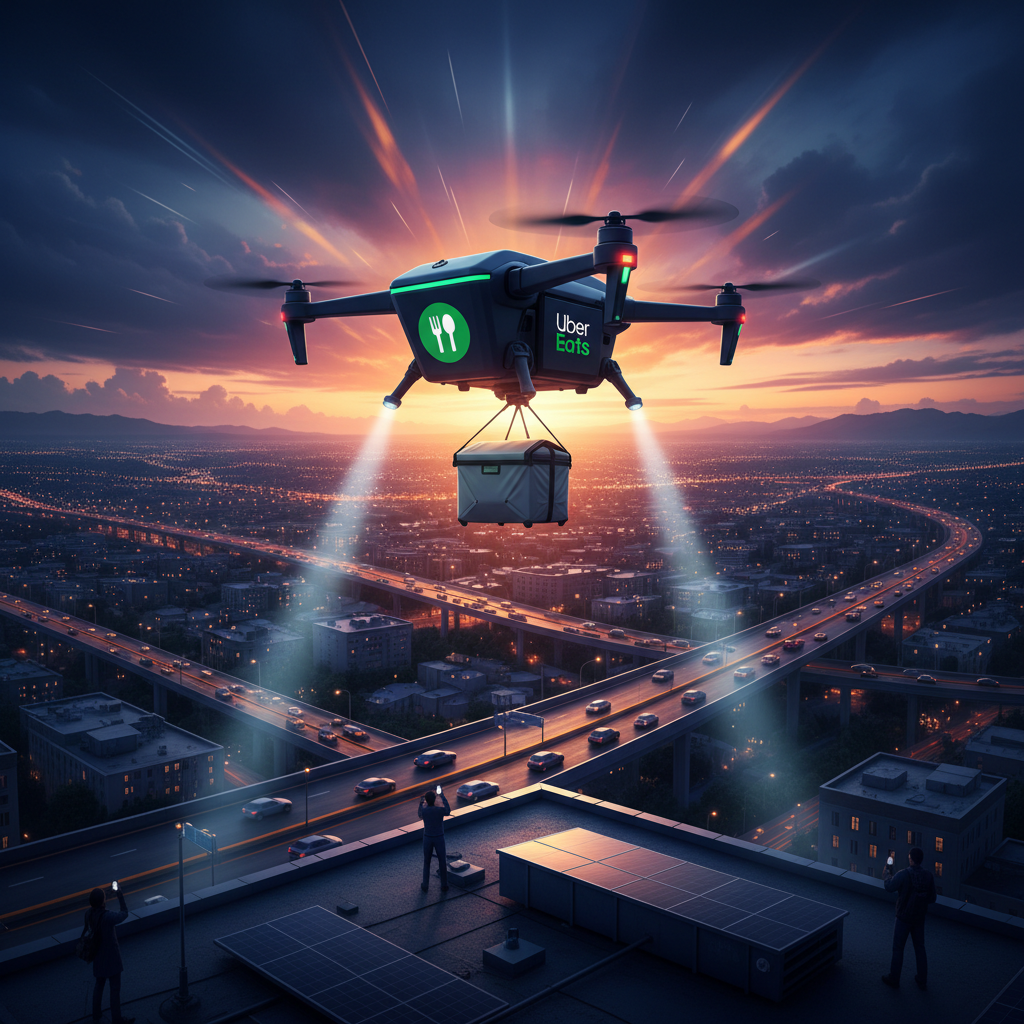
The next delivery driver at your door may never touch the sidewalk.
Uber Eats’ new partnership with Zipline puts one of food delivery’s biggest platforms together with one of the most battle-tested drone logistics companies in the world. The pitch is simple: use autonomous aircraft to move meals quickly across U.S. markets. The bigger story is more interesting. Drone delivery has spent years trapped between demo-day spectacle and regulatory reality. Zipline, meanwhile, has been doing the less glamorous work of delivering blood, vaccines, prescriptions, and retail goods at scale.
That makes this deal a useful signal. Drone delivery is not just a novelty for burritos and lattes. It is a test of whether automated logistics can move from high-stakes health supply chains into the messy, high-volume world of everyday commerce.
Why Uber Needs a Drone Partner, Not a Drone Hobby
Uber does not need drones because human couriers are going away tomorrow. It needs drones because the last mile remains the most expensive, variable, and capacity-constrained part of delivery.
A restaurant can make a burger in eight minutes. The app can match an order instantly. But the delivery still depends on a courier being nearby, roads being clear, parking being possible, and the route making economic sense. Dense urban cores create congestion. Suburbs create distance. Bad weather, peak dinner hours, and driver supply swings can turn a predictable order into an expensive one.
Uber brings the demand side: millions of customers, restaurant relationships, pricing systems, routing logic, and a habit-forming app interface. Zipline brings the aviation side: autonomous aircraft, launch-and-recovery systems, safety operations, and experience navigating regulated airspace.
That division of labor matters. Plenty of companies have learned that drone delivery is not a feature you bolt onto an app. It is an aviation business. The aircraft need to be reliable. The network needs defined service areas. The drop-off mechanism needs to work at real homes, not just staged lawns. The operation needs regulators, cities, restaurants, and customers to trust it.
Zipline’s advantage is that it has already solved versions of those problems in harder contexts.
From Blood Deliveries to Burgers
Zipline built its reputation delivering medical products in countries including Rwanda and Ghana, where fast access to blood and vaccines can be a matter of life or death. That origin story matters because health logistics force discipline. The payloads are small but critical. Delivery windows matter. Packaging matters. Reliability matters. Failure is not funny.
Food delivery is lower stakes, but it has similar constraints. A hot meal is time-sensitive. A milkshake is fragile. A pharmacy order may require careful handling. A small grocery basket has to arrive quickly enough to beat the car trip it replaces.
Zipline’s newer platform is designed for precise home delivery without requiring the drone to land. Instead of dropping a package from altitude or needing a wide landing zone, the system can lower a small delivery vessel to a target area. That is the kind of detail that separates a drone video from a real logistics network. Most customers do not have a helipad. They have a porch, a driveway, an apartment courtyard, or a patch of grass near the front walk.
If Uber can plug that capability into its marketplace, the use cases become clearer. A suburban family could order lunch from a restaurant five miles away and receive it faster than a car courier fighting traffic. A café could serve nearby office parks without tying up a driver. A pharmacy or convenience store could send small, urgent items without waiting for a human courier to batch multiple stops.
The key is not replacing every delivery. It is matching drones to the orders they are best at: lightweight, time-sensitive, point-to-point trips over distances where roads are inefficient.
The Hard Part Is the Network, Not the Aircraft
The public tends to focus on the drone. The business challenge is the network around it.
Drone delivery needs launch sites close enough to customers to make the time savings real. Restaurants may need packaging that protects temperature, texture, and spill risk. Uber’s app will need to decide when a drone is faster or cheaper than a courier, then set customer expectations clearly. Drop-off locations must be mapped and confirmed. Support teams need a plan for exceptions: wind, blocked yards, address errors, restricted airspace, or a customer who changes their mind.
Regulation is another limiting factor. In the U.S., commercial drone operations are governed by the Federal Aviation Administration, and the most valuable delivery models often require approvals beyond basic small-drone rules, especially for operations beyond visual line of sight. That is where experienced operators have an edge. A delivery drone network cannot scale on vibes; it has to scale through safety cases, waivers, certifications, and operational discipline.
There is also the neighborhood test. Drones must be quiet enough, predictable enough, and useful enough for people to tolerate them. A few promotional flights can be charming. Hundreds of daily flights over a suburb will be judged by noise, privacy concerns, and whether the service actually improves life.
That is why Zipline is a more credible partner than a startup selling aerial spectacle. Its core product is not the drone itself. It is dependable autonomous delivery.
What Customers and Restaurants Could Actually Notice
If the partnership works, the biggest change for customers may be speed consistency. Today’s delivery estimate can swing wildly depending on driver supply and traffic. Drone delivery could make certain routes more predictable: ten to twenty minutes, with fewer surprises from congestion or parking.
For restaurants, drones could expand the practical delivery radius without destroying food quality. A shop that currently serves customers within two or three miles might reach farther suburbs if flight paths are direct and delivery times stay short. That could be especially valuable for high-frequency, small-ticket categories: coffee, snacks, fast casual meals, desserts, convenience items, and pharmacy products.
But the economics will be selective. Drones will not carry family-size grocery orders or replace bike couriers in dense neighborhoods where elevators and high-rises complicate drop-off. They will struggle in storms, heavy winds, and complex urban canyons. They may work best in the very places where car delivery is least elegant: spread-out suburbs with predictable homes, driveways, and short but annoying car trips.
That makes Uber’s marketplace role important. The company does not need every order to fly. It needs enough eligible orders in the right geographies to make drone delivery a reliable option, not a gimmick.
The Delivery Race Is Becoming an Automation Race
Uber is not alone. Walmart has worked with drone operators, including Zipline, to test and expand aerial delivery. Alphabet’s Wing has pursued restaurant and retail delivery in multiple markets. Amazon has spent years pushing Prime Air toward commercial reality. DoorDash has also experimented with autonomous delivery partners.
The pattern is clear: delivery platforms are looking for ways to reduce dependence on road-based labor and congestion without degrading the customer experience. Robots may handle sidewalks. Autonomous vehicles may handle roads. Drones may handle short aerial hops. The winning networks will likely combine all three, using software to choose the best mode for each order.
Uber’s move with Zipline fits that future. It is not about replacing the courier overnight. It is about adding a new logistics layer to the marketplace.
Conclusion: The Future Arrives One Route at a Time
Drone delivery will not become normal because it looks futuristic. It will become normal if it is boringly reliable: the food arrives fast, the aircraft is quiet, the drop-off is accurate, and the price makes sense.
That is what makes the Uber-Zipline partnership worth watching. Zipline has already shown that autonomous delivery can work for critical medical supply chains. Uber can test whether the same discipline can survive the chaos of dinner rush.
If it can, the next phase of food delivery will not be defined by a drone in the sky. It will be defined by a shorter wait at the door.