Voyager 2 Gets One More Year in Deep Space
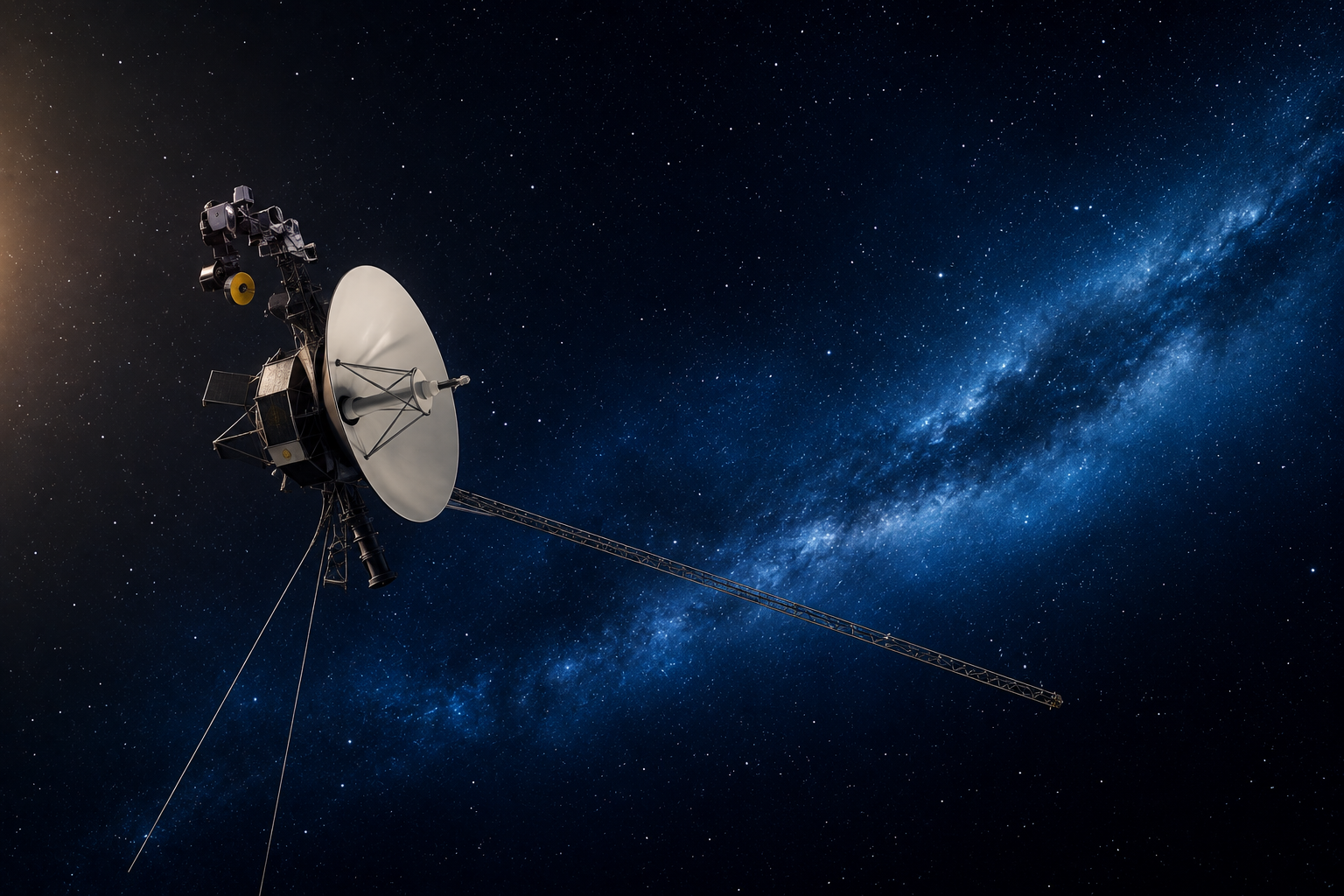
NASA’s Voyager 2 is old enough to be a museum piece, yet it is still working beyond the Sun’s protective bubble, sending measurements from interstellar space back to Earth. NASA’s latest power-saving move is not glamorous: turn off more hardware now so the spacecraft can keep doing science a little longer.
The takeaway: Voyager 2’s extra year is less a miracle than a master class in engineering triage.
A mission built for planets, now measuring interstellar space
Voyager 2 launched in 1977 on what was originally a planetary tour, not a half-century expedition. Its prime mission was to visit Jupiter and Saturn, but a rare alignment let engineers keep going, using gravity assists to send the probe past Uranus in 1986 and Neptune in 1989.
That made Voyager 2 the only spacecraft ever to fly by Uranus and Neptune, a distinction that still shapes planetary science decades later. Then, instead of fading into history, it kept traveling outward until it crossed the heliopause in 2018, the boundary where the solar wind gives way to the interstellar medium.
NASA now describes the Voyager mission as humanity’s farthest and longest-running spacecraft project, with Voyager 1 and Voyager 2 both operating outside the heliosphere. The mission’s continuing value comes from its location: no laboratory on Earth can reproduce the environment the probes are sampling, and no newer spacecraft is close to joining them.
The power budget is the mission
The reason Voyager 2 needs another rescue is simple: it is running out of electricity. The spacecraft is powered by radioisotope thermoelectric generators, or RTGs, which convert heat from decaying plutonium-238 into electrical power. That system was robust enough to survive for decades, but the power supply has been declining year by year.
NASA has said the Voyagers lose roughly a few watts of available power annually, a small-sounding decline that becomes mission-defining when every heater, instrument, computer and radio subsystem competes for the same shrinking supply. In March 2025, NASA announced it would switch off Voyager 2’s low-energy charged particle instrument as part of a broader effort to keep the spacecraft operating into 2026 and beyond.
That shutdown followed an earlier sacrifice: in 2024, engineers turned off Voyager 2’s plasma science instrument, which had helped confirm the spacecraft’s passage into interstellar space. Each instrument retirement narrows the mission, but it also reduces the risk that the whole spacecraft will trip into a fault condition because voltage drops too low.
This is the hard arithmetic of deep-space survival:
Power: RTG output keeps falling, so instruments must be prioritized.
Heat: Some heaters have been turned off, leaving components to survive colder-than-planned conditions.
Data: The spacecraft transmits slowly across billions of miles, so every bit counts.
Risk: Commands take many hours to arrive, and mistakes cannot be fixed quickly.
Science: The remaining instruments are chosen for the most irreplaceable measurements.
How to operate a spacecraft older than the web
Keeping Voyager 2 alive is not like maintaining an old laptop. The spacecraft’s computers, memory and communications systems come from an era before modern microprocessors, broadband networks or the World Wide Web. Much of the original team has retired, and today’s engineers work from aging documentation, institutional memory and painstaking reconstructions of how the spacecraft behaves.
Commands are sent through NASA’s Deep Space Network, the global system of giant radio antennas that talks to spacecraft across the solar system. At Voyager 2’s distance, a command takes many hours to reach the probe, and the reply takes many hours to come back. A routine operation can therefore unfold over a day or more, with no real-time joystick control and no second chance if a command sequence is wrong.
The spacecraft is also operating in a configuration its designers never expected to last this long. Over the years, NASA has turned off heaters, reallocated power, changed fault-protection settings and carefully managed which instruments remain on. In 2023, engineers even delayed an instrument shutdown by tapping a small reserve of power that had been used to help regulate voltage, accepting a calculated risk in exchange for more science time.
That kind of decision captures the modern Voyager philosophy. The mission is no longer about preserving every subsystem; it is about preserving the minimum set of capabilities needed to communicate, stay oriented and return unique measurements. In deep space, longevity is not passive durability. It is active, continuous negotiation with failure.
Why one more year matters
A year might sound modest next to a 48-year mission, but for Voyager 2 it is scientifically meaningful. The spacecraft is sampling a region where the Sun’s influence fades but has not become irrelevant, giving researchers a rare view of how the heliosphere interacts with the surrounding galaxy.
Voyager 2 is especially important because it took a different path through space than Voyager 1 and carried a different mix of working instruments during key parts of the interstellar mission. Together, the two probes provide two separated data points in a vast, uneven boundary region. That helps scientists avoid mistaking a local fluctuation for a global feature of the heliosphere.
The remaining instruments can still track magnetic fields, plasma waves and high-energy particles, all of which help scientists understand the environment beyond the planets. Those measurements connect solar physics to astrophysics: the Sun is a star moving through interstellar space, and the Voyagers are measuring the bubble it carves around itself.
There is also a broader lesson here for future exploration. Missions to the outer solar system take years to reach their targets and decades to mature. The Voyagers show that margins, redundancy and operational creativity can turn a nominal mission into a generational scientific asset.
The bottom line
Voyager 2’s extra year is not a comeback story in the usual sense; it is a controlled drawdown. NASA is spending the spacecraft’s remaining power with extraordinary care, trading one instrument at a time for continued contact with a place no other machine can yet study.
Eventually, Voyager 2 will fall silent. Until then, every faint signal is a reminder that great engineering is not only about building for launch day, but about leaving enough flexibility for discoveries no one could schedule in advance.