West Africa’s $294bn Climate Finance Gap
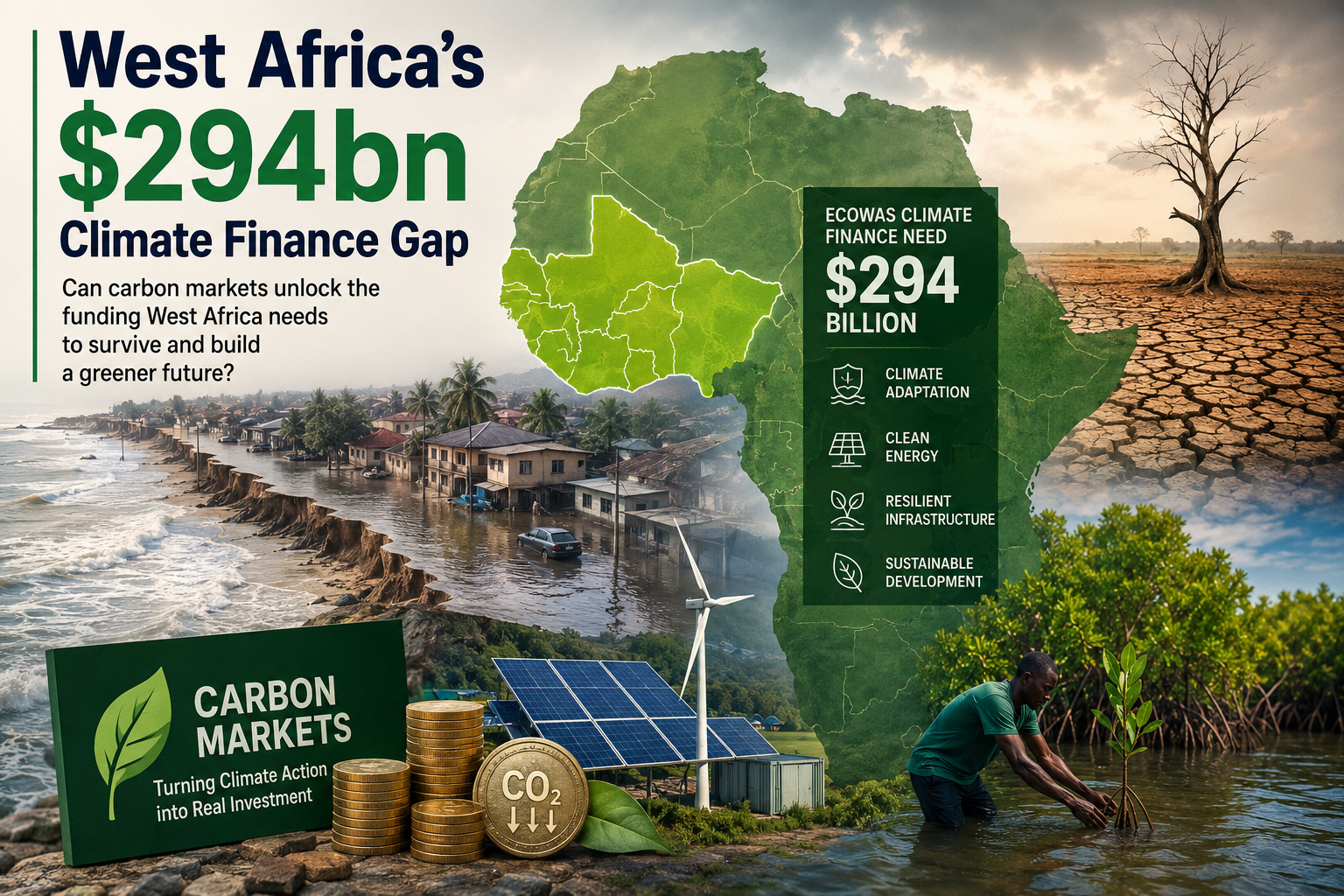
West Africa has a climate problem that can be counted in floods, failed rains, eroding coastlines — and dollars. ECOWAS countries have put the region’s climate-finance need at roughly $294 billion, a figure large enough to make carbon markets look less like an accounting experiment and more like a survival strategy.
That is the pitch now gaining momentum across the region: if governments cannot secure enough grants, concessional loans and private investment to pay for adaptation, clean power and resilient infrastructure, perhaps verified carbon credits can unlock a new stream of capital.
The science explains the urgency. The economics explain the appeal. The politics will decide whether it works.
Why the finance gap is so large
West Africa sits on the front line of climate risk. The region spans the Sahel, where rising temperatures and rainfall volatility threaten farming and pastoral livelihoods, and the Gulf of Guinea, where coastal cities face sea-level rise, flooding and erosion. The Intergovernmental Panel on Climate Change has warned that Africa is already experiencing widespread climate impacts despite contributing a small share of historic emissions.
Those impacts are not abstract. In Nigeria, extreme flooding has repeatedly displaced communities and damaged farmland. In Ghana, Togo, Benin and Côte d’Ivoire, coastal erosion is eating away at settlements, roads and ports. In Niger, Mali and Burkina Faso, heat stress and drought risk compound food insecurity and conflict pressure.
Climate finance is meant to help countries do two things at once: adapt to climate damage already locked in, and shift development onto a lower-carbon path. That means early-warning systems, flood defenses, climate-smart agriculture, off-grid solar, cleaner cooking, grid upgrades, mangrove restoration and more efficient transport.
But most West African governments have limited fiscal space. Many are already carrying heavy debt burdens, while public budgets must also fund health, education, security and basic infrastructure. The result is a widening mismatch between climate plans and available money.
That is where carbon markets enter the conversation.
What a carbon market can pay for
A carbon credit represents one tonne of carbon dioxide equivalent reduced, removed or avoided. A company, government or other buyer can purchase credits to compensate for emissions elsewhere, while the project developer receives revenue for the climate benefit.
In West Africa, the most obvious projects are not futuristic. They are practical.
A clean-cooking programme can replace charcoal or firewood stoves with more efficient alternatives, reducing emissions while cutting household air pollution and pressure on forests. A solar mini-grid can displace diesel generation in rural communities. A mangrove restoration project can store carbon, protect coastlines from storm surge and support fisheries. A climate-smart agriculture project can improve soil carbon while helping farmers retain moisture and withstand erratic rainfall.
At their best, these projects combine mitigation with adaptation. That matters because West Africa’s need is not only to cut emissions; it is to survive climate shocks that are already intensifying. Carbon revenue could help make resilience projects bankable where conventional finance is too slow or too expensive.
The Africa Carbon Markets Initiative has argued that the continent could expand production of carbon credits dramatically by 2030, potentially generating billions in annual revenue if high-integrity markets grow. For ECOWAS, that prospect is tempting: a functioning regional market could attract investment, standardize rules and give smaller countries more bargaining power.
The science problem: a credit must be real
Carbon markets rise or fall on environmental integrity. A credit is valuable only if it represents a real, additional, measurable and durable climate benefit.
“Additional” means the emissions reduction would not have happened without the carbon revenue. If a solar plant was already fully financed, selling credits for it may not change the climate outcome. “Durable” means the carbon benefit should last. A restored forest can burn; a mangrove can be cleared; soil carbon can be lost if farming practices change. “Measurable” means the project must be monitored with credible data, not wishful estimates.
This is where science, satellite monitoring and local governance become central. Forest and land-use projects require reliable baselines: what would have happened without the project? Energy projects need accurate fuel-displacement calculations. Agriculture projects need soil sampling, remote sensing and long-term verification.
Bad credits do more than waste money. They can allow buyers to claim climate progress while global emissions continue rising. They can also damage public trust and depress prices for legitimate African projects.
For West Africa, the lesson is clear: the region should not race to sell cheap credits. It should build systems that produce high-quality credits buyers will pay a premium for.
The policy test for ECOWAS
A regional carbon market cannot run on ambition alone. It needs rules.
Under Article 6 of the Paris Agreement, countries can cooperate on emissions reductions and potentially trade mitigation outcomes across borders. But the accounting is complex. If a credit is sold internationally and counted by a buyer, the host country may need to make a “corresponding adjustment” so the same emissions reduction is not counted twice.
That creates a strategic choice for West African governments. Credits can bring in foreign exchange and private capital, but selling too many of the cheapest reductions could make it harder for countries to meet their own nationally determined contributions. The best approach is likely selective: approve projects that support national climate plans, protect communities and generate durable development benefits.
ECOWAS can add value by harmonizing standards across the region. A common framework could set minimum rules for project approval, benefit sharing, land rights, data reporting and grievance mechanisms. It could also help countries negotiate better terms with developers and buyers, rather than leaving each government to build capacity from scratch.
This matters because carbon projects often touch land, forests and community resources. If local people do not understand contracts, share revenue fairly or retain rights, carbon finance can become another extractive industry. If communities are genuine partners, it can fund livelihoods and resilience.
Carbon markets are a tool, not a rescue plan
Even a well-designed carbon market will not close a $294 billion gap by itself. Prices are too uncertain, demand is uneven and many adaptation needs — such as drainage systems, climate-resilient roads or public health preparedness — do not easily produce tradable credits.
West Africa still needs more concessional finance, grant-based adaptation funding, debt relief tools, public investment and reforms that reduce the cost of clean-energy capital. Carbon markets should complement those flows, not replace them.
But they can do something important: turn some climate solutions into investable assets. A mangrove belt that protects a coastal community may be hard to finance through a normal infrastructure budget. If its carbon value can be measured and sold with integrity, it can attract new capital. A clean-cooking programme that improves health and reduces deforestation can scale faster if carbon revenue lowers costs for households.
The opportunity is real — and so is the risk. A weak market would sell low-value credits, enrich intermediaries and leave communities with little. A strong one would use science, transparency and regional bargaining power to channel money into projects that make West Africa safer, cleaner and more resilient.
Conclusion
The $294 billion climate-finance hole is not just a budget line. It is a measure of how exposed West Africa is to a warming world. Carbon markets are being pitched as a lifeline because they promise something the region urgently needs: new money for practical climate action.
But the credits must be real, the benefits must be shared and the rules must be strong. If ECOWAS gets that right, carbon finance will not solve the climate crisis — but it could help West Africa buy time, build resilience and shape a cleaner development path on its own terms.